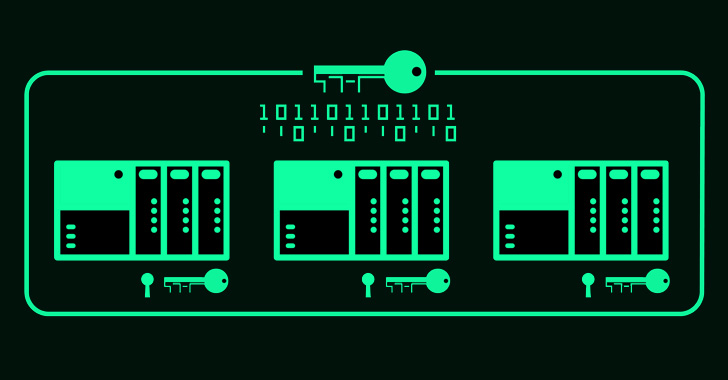
A vulnerability in Siemens Simatic programmable logic controller
(PLC) can be exploited to retrieve the hard-coded, global private
cryptographic keys and seize control of the devices.
“An attacker can use these keys to perform multiple advanced
attacks against Siemens SIMATIC devices and the related TIA Portal[1], while bypassing all
four of its access level protections[2],” industrial
cybersecurity company Claroty said[3]
in a new report.
“A malicious actor could use this secret information to
compromise the entire SIMATIC S7-1200/1500 product line in an
irreparable way.”
The critical vulnerability, assigned the identifier CVE-2022-38465[4], is rated 9.3 on the
CVSS scoring scale and has been addressed by Siemens as part of
security updates issued on October 11, 2022.
The list of impacted products and versions is below –
- SIMATIC Drive Controller family (all versions before
2.9.2) - SIMATIC ET 200SP Open Controller CPU 1515SP PC2, including
SIPLUS variants (all versions before 21.9) - SIMATIC ET 200SP Open Controller CPU 1515SP PC, including
SIPLUS variants (all versions) - SIMATIC S7-1200 CPU family, including SIPLUS variants (all
versions before 4.5.0) - SIMATIC S7-1500 CPU family, including related ET200 CPUs and
SIPLUS variants (all versions before V2.9.2) - SIMATIC S7-1500 Software Controller (all versions before 21.9),
and - SIMATIC S7-PLCSIM Advanced (all versions before 4.0)
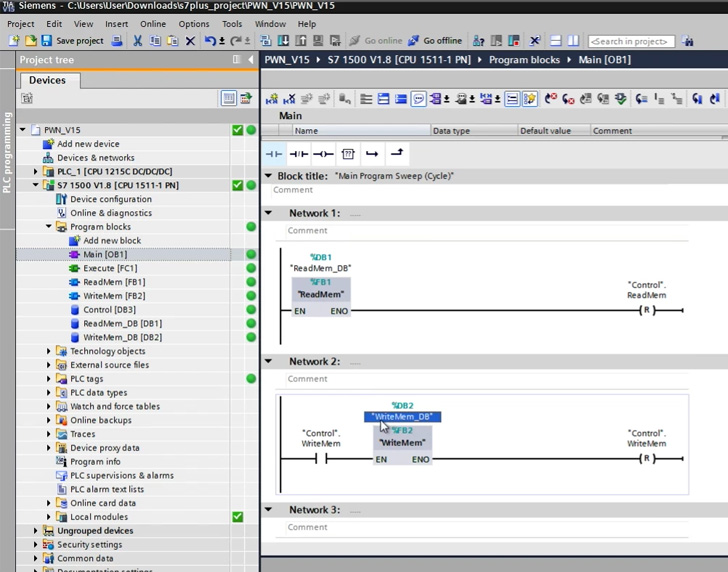
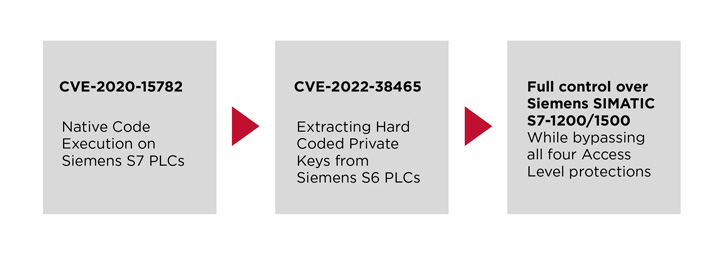
Claroty said it was able to get read and write privileges to the
controller by exploiting a previously disclosed flaw in Siemens
PLCs (CVE-2020-15782[5]), allowing for the
recovery of the private key.
Doing so would not only permit an attacker to override native
code and extract the key, but also obtain full control over every
PLC per affected Siemens product line.
CVE-2022-38465 mirrors another severe shortcoming that was
identified in Rockwell Automation PLCs (CVE-2021-22681) last year
and which could have enabled an adversary to remotely connect to
the controller, and upload malicious code, download information
from the PLC, or install new firmware.
“The vulnerability lies in the fact that Studio 5000 Logix
Designer software may allow a secret cryptographic key to be
discovered,” Claroty noted[6]
in February 2021.
As workarounds and mitigations, Siemens is recommending
customers to use legacy PG/PC and HMI communications only in
trusted network environments and secure access to TIA Portal and
CPU to prevent unauthorized connections.
The German industrial manufacturing company has also taken the step[7]
of encrypting the communications between engineering stations, PLCs
and HMI panels with Transport Layer Security (TLS) in TIA Portal
version 17, while warning[8]
that the “likelihood of malicious actors misusing the global
private key as increasing.”
The findings are the latest in a series of severe flaws that
have been discovered in PLCs. Earlier this June, Claroty detailed[9]
over a dozen issues in Siemens SINEC network management system
(NMS) that could be abused to gain remote code execution
capabilities.
Then in April 2022, the company unwrapped[10] two vulnerabilities in
Rockwell Automation PLCs (CVE-2022-1159 and CVE-2022-1161) that
could be exploited to modify user programs and download malicious
code to the controller.
References
- ^
TIA
Portal (new.siemens.com) - ^
access
level protections
(support.industry.siemens.com) - ^
said
(claroty.com) - ^
CVE-2022-38465
(claroty.com) - ^
CVE-2020-15782
(thehackernews.com) - ^
noted
(claroty.com) - ^
taken
the step (support.industry.siemens.com) - ^
warning
(cert-portal.siemens.com) - ^
detailed
(thehackernews.com) - ^
unwrapped
(thehackernews.com)
Read more https://thehackernews.com/2022/10/critical-bug-in-siemens-simatic-plcs.html