Cisco has once again fixed[1]
four previously disclosed critical
bugs[2] in its Jabber video
conferencing and messaging app that were inadequately addressed,
leaving its users susceptible to remote attacks.
The vulnerabilities, if successfully exploited, could allow an
authenticated, remote attacker to execute arbitrary code on target
systems by sending specially-crafted chat messages in group
conversations or specific individuals.
They were reported to the networking equipment maker on
September 25 by Watchcom[3], three weeks after the
Norwegian cybersecurity firm publicly disclosed multiple security
shortcomings in Jabber that were found during a penetration test
for a client in June.
The new flaws, which were uncovered after one of its clients
requested a verification audit of the patch, affects all currently
supported versions of the Cisco Jabber client (12.1 – 12.9).
“Three of the four vulnerabilities Watchcom disclosed in September[4]
have not been sufficiently mitigated,” Watchcom said in a report
published today. “Cisco released a patch that fixed the injection
points we reported, but the underlying problem has not been fixed.
As such, we were able to 7ind new injection points that could be
used to exploit the vulnerabilities.”
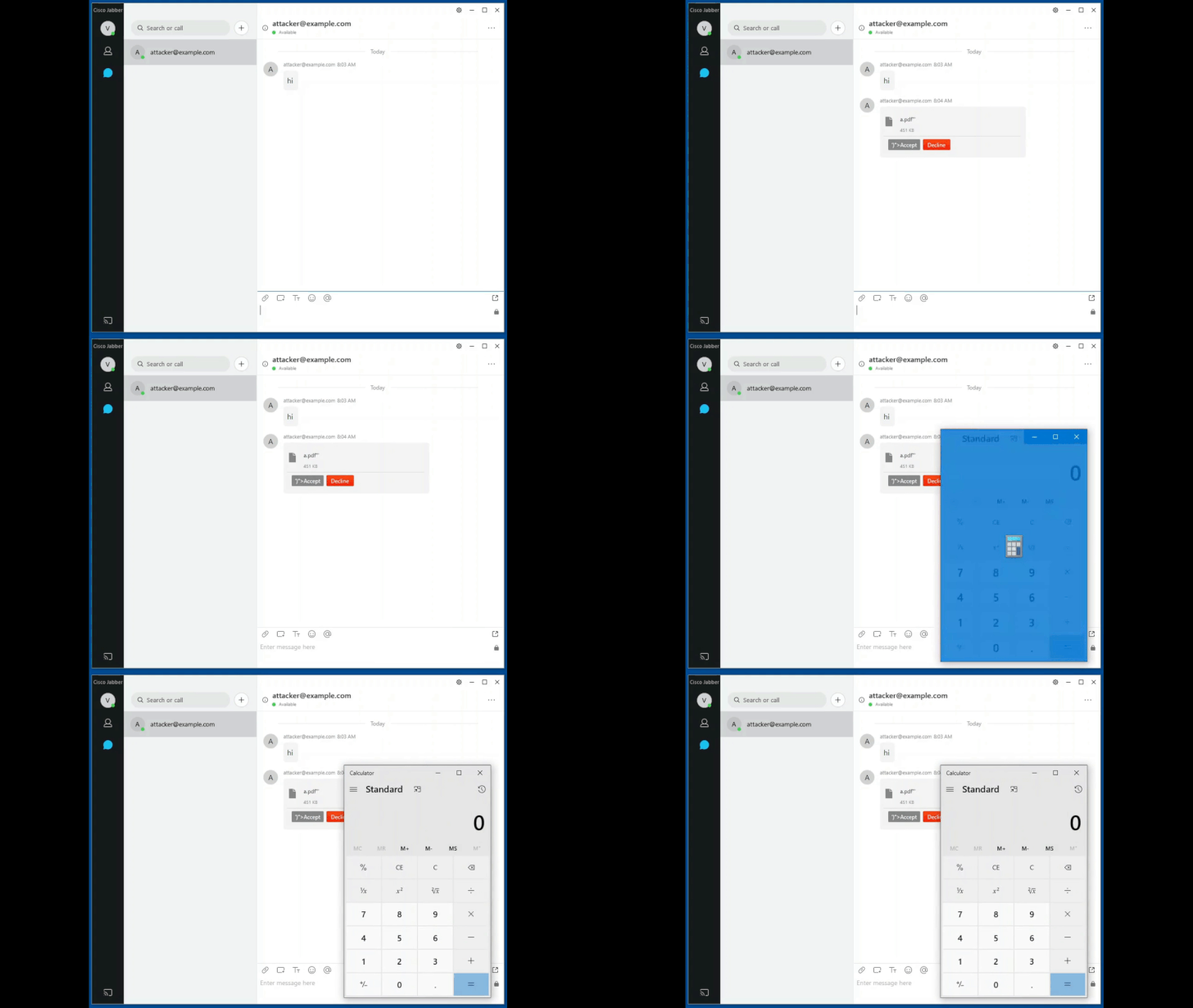
Most critical among the flaws is CVE-2020-26085 (similar
to CVE-2020-3495), which has a severity rating of 9.9 out of
10, a zero-click cross-site scripting (XSS) vulnerability that can
be used to achieve remote code execution by escaping the CEF
sandbox.
CEF or Chromium Embedded Framework is an open-source framework
that’s used to embed a Chromium-based web browser within other
apps.
While the embedded browser is sandboxed to prevent unauthorized
access to files, the researchers found a way to bypass the
protections by abusing the window.CallCppFunction, which is
designed to open files sent by other Cisco Jabber users.
All an adversary has to do is initiate a file transfer
containing a malicious “.exe” file and force the victim to accept
it using an XSS attack, then trigger a call to the aforementioned
function, causing the executable to be run on the victim’s
machine.
Worse, this vulnerability doesn’t require user interaction and
is wormable, meaning it can be used to automatically spread the
malware to other systems by disguising the payload in a chat
message.
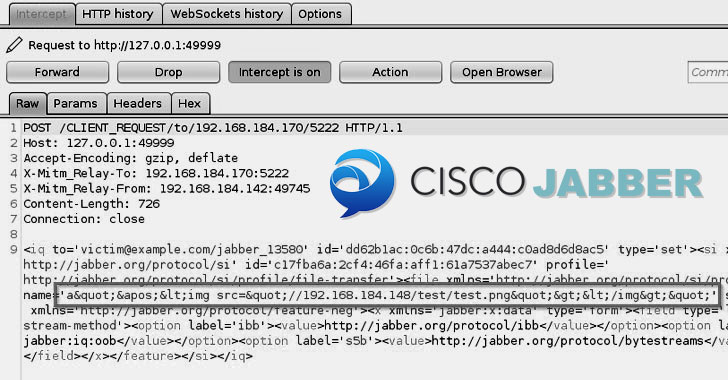
A second flaw, CVE-2020-27132, stems from the way it
parses HTML tags in XMPP messages, an XML-based communications
protocol used for facilitating instant messaging between any two or
more network entities.
Due to the lack of proper sanitization of these tags, a harmless
file transfer message can be manipulated by injecting, say, an
image HTML tag pointing to a malicious URL or even execute
malicious JavaScript code.
“No additional security measures had been put in place and it
was therefore possible to both gain remote code execution and steal
NTLM password hashes using this new injection point,” the
researchers said.
The third and final vulnerability (CVE-2020-27127) is a
command injection flaw concerning protocol handlers[5], which are used to
inform the operating system to open specific URLs (e.g., XMPP://,
IM://, and TEL://) in Jabber, making it possible for an attacker to
insert arbitrary command-line flags by simply including a space the
URL.
Given the self-replicating nature of the attacks, it’s advised
that Jabber users update to the latest version of the software to
mitigate the risk.
Watchcom also recommends that organizations consider disabling
communication with external entities through Cisco Jabber until all
employees have installed the update.
References
- ^
fixed
(tools.cisco.com) - ^
previously disclosed critical bugs
(thehackernews.com) - ^
Watchcom
(watchcom.no) - ^
disclosed in September
(thehackernews.com) - ^
protocol
handlers (www.cisco.com)