
Microsoft Edge, Internet Explorer, and Mozilla Firefox, altogether
today announced to soon remove support for TLS 1.0 (20-year-old)
and TLS 1.1 (12-year-old) communication encryption protocols.
Developed initially as Secure Sockets Layer (SSL) protocol,
Transport Layer Security (TLS) is an updated cryptographic protocol
used to establish a secure and encrypted communications channel
between clients and servers.
There are currently four versions of the TLS protocol—TLS 1.0,
1.1, 1.2 and 1.3 (latest)—but older versions, TLS 1.0 and
1.1, are known to be vulnerable to a number of critical attacks,
such as POODLE and BEAST.
[1][2][3]
Since TLS implementation in all major web browsers and applications
supports downgrade negotiation process, it leaves an opportunity
for attackers to exploit weaker protocols even if a server supports
the latest version.
All Major Web Browsers Will Remove TLS 1.0 and TLS 1.1 Support
in 2020
According to the press releases published by four major companies,
Google[4], Microsoft[5], Apple[6]
and Mozilla[7], their web browsers will
completely drop TLS 1.0 and 1.1support by default in the first half
of 2020.
TLS 1.2, which was released ten years ago to address weaknesses
in TLS 1.0 and 1.1, has enjoyed wide adoption since then, and will
thus be the default TLS version unless the availability of TLS 1.3,
which is currently in the development stage.
According to Microsoft, as TLS 1.0 continues to age, many
websites have already moved to newer versions of the protocol.
Today 94 percent of sites already support TLS 1.2, while only less
than one percent of daily connections in Microsoft Edge are using
TLS 1.0 or 1.1.
“Two decades is a long time for a security technology to stand
unmodified. While we aren’t aware of significant vulnerabilities
with our up-to-date implementations of TLS 1.0 and TLS 1.1,
vulnerable third-party implementations do exist,” Microsoft writes.
“Moving to newer versions helps ensure a more secure web for
everyone. Additionally, we expect the IETF to formally deprecate
TLS 1.0 and 1.1 later this year, at which point protocol
vulnerabilities in these versions will no longer be addressed by
the IETF.”
represents 99.6 percent of TLS connections made from Safari, while
TLS 1.0 and 1.1 account for less than 0.36 percent of all
connections.
Google could not agree more and says that today only 0.5 percent of
HTTPS connections made by Chrome use TLS 1.0 or 1.1.
All the tech companies recommended websites that do not support
TLS 1.2 or newer to move off of the old versions of the protocol as
soon as possible and is practical.
Furthermore, the PCI Data Security Standard (PCI DSS[8]) compliance also
requires websites to disable SSL/TLS 1.0 implementation by June 30,
2018.
Besides these tech giants, Gitlab today also announced to deprecate support for TLS
1.0 and TLS 1.1 on its website and API infrastructure by the end of
2018.
[9]
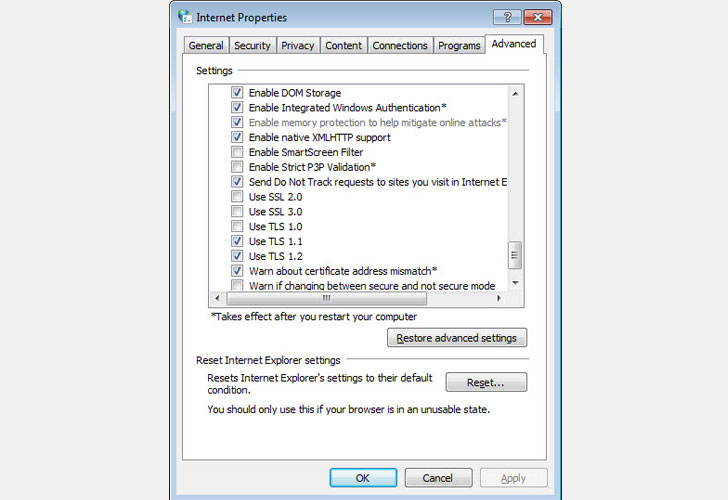
by opening Settings → Advanced Settings → Open Proxy Settings →
Click ‘Advanced’ Tab → Under ‘Security’ section uncheck TLS 1.0 and
1.1 and then save.
References
Read more http://feedproxy.google.com/~r/TheHackersNews/~3/X2qTX1zhGdM/web-browser-tls-support.html