Mar 30, 2023Ravie Lakshmanan

A Chinese state-sponsored threat activity group tracked as
RedGolf has been attributed[1]
to the use of a custom Windows and Linux backdoor called
KEYPLUG.
“RedGolf is a particularly prolific Chinese state-sponsored
threat actor group that has likely been active for many years
against a wide range of industries globally,” Recorded Future told
The Hacker News.
“The group has shown the ability to rapidly weaponize newly reported vulnerabilities[2] (e.g. Log4Shell[3]
and ProxyLogon[4]) and has a history of
developing and using a large range of custom malware families.”
The use of KEYPLUG by Chinese threat actors was first disclosed[5]
by Google-owned Manidant in March 2022 in attacks targeting
multiple U.S. state government networks between May 2021 and
February 2022.
Then in October 2022, Malwarebytes detailed[6]
a separate set of attacks targeting government entities in Sri
Lanka in early August that leveraged a novel implant dubbed
DBoxAgent to deploy KEYPLUG.
Both these campaigns were attributed to Winnti[7]
(aka APT41[8], Barium, Bronze Atlas,
or Wicked Panda), which Recorded Future said “closely overlaps”
with RedGolf.
“We have not observed specific victimology as part of the latest
highlighted RedGolf activity,” Recorded Future said. “However, we
believe this activity is likely being conducted for intelligence
purposes rather than financial gain due to the overlaps with
previously reported cyberespionage campaigns.”
The cybersecurity firm, in addition to detecting a cluster of
KEYPLUG samples and operational infrastructure (codenamed
GhostWolf) used by the hacking group from at least 2021 to 2023,
noted its use of other tools like Cobalt Strike[9]
and PlugX[10].
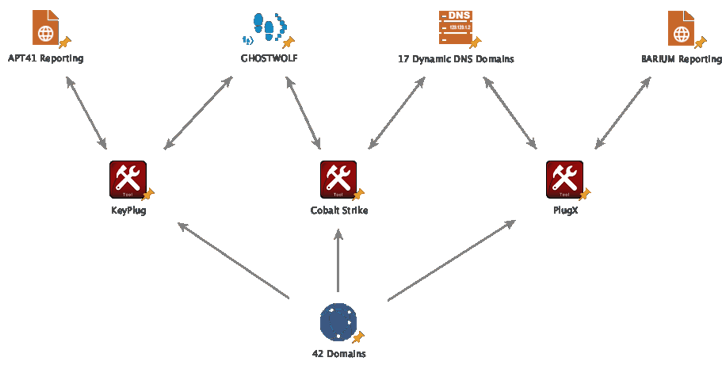
The GhostWolf infrastructure, for its part, consists of 42 IP
addresses that function as KEYPLUG command-and-control. The
adversarial collective has also been observed utilizing a mixture
of both traditionally registered domains and Dynamic DNS domains,
often featuring a technology theme, to act as communication points
for Cobalt Strike and PlugX.
“RedGolf will continue to demonstrate a high operational tempo
and rapidly weaponize vulnerabilities in external-facing corporate
appliances (VPNs, firewalls, mail servers, etc.) to gain initial
access to target networks,” the company said.
THN WEBINAR
Become an Incident Response Pro!
Unlock the secrets to bulletproof incident response – Master the
6-Phase process with Asaf Perlman, Cynet’s IR Leader!
Don’t Miss Out –
Save Your Seat![11]
“Additionally, the group will likely continue to adopt new
custom malware families to add to existing tooling such as
KEYPLUG.”
To defend against RedGolf attacks, organizations are recommended
to apply patches regularly, monitor access to external facing
network devices, track and block identified command-and-control
infrastructure, and configure intrusion detection or prevention
systems to monitor for malware detections.
The findings come as Trend Micro revealed that it discovered
more than 200 victims of Mustang Panda[12] (aka Earth Preta)
attacks as part of a far-reaching cyber espionage effort
orchestrated by various sub-groups since 2022.
A majority of the cyber strikes have been detected in Asia,
followed by Africa, Europe, the Middle East, Oceania, North
America, and South America.
“There are strong indications of intertwined traditional
intelligence tradecraft and cyber collection efforts, indicative of
a highly coordinated and sophisticated cyber espionage operation,”
Trend Micro said[13].
Found this article interesting? Follow us on Twitter [14] and LinkedIn[15] to read more exclusive
content we post.
References
- ^
attributed
(www.recordedfuture.com) - ^
newly
reported vulnerabilities (www.mandiant.com) - ^
Log4Shell
(thehackernews.com) - ^
ProxyLogon
(thehackernews.com) - ^
first
disclosed (thehackernews.com) - ^
detailed
(thehackernews.com) - ^
Winnti
(thehackernews.com) - ^
APT41
(thehackernews.com) - ^
Cobalt
Strike (thehackernews.com) - ^
PlugX
(thehackernews.com) - ^
Don’t Miss Out – Save Your Seat!
(thn.news) - ^
Mustang Panda
(thehackernews.com) - ^
said
(www.trendmicro.com) - ^
Twitter
(twitter.com) - ^
LinkedIn
(www.linkedin.com)
Read more https://thehackernews.com/2023/03/chinese-redgolf-group-targeting-windows.html