A notorious advanced persistent threat actor known as
Mustang Panda has been linked to a spate of
spear-phishing attacks targeting government, education, and
research sectors across the world.
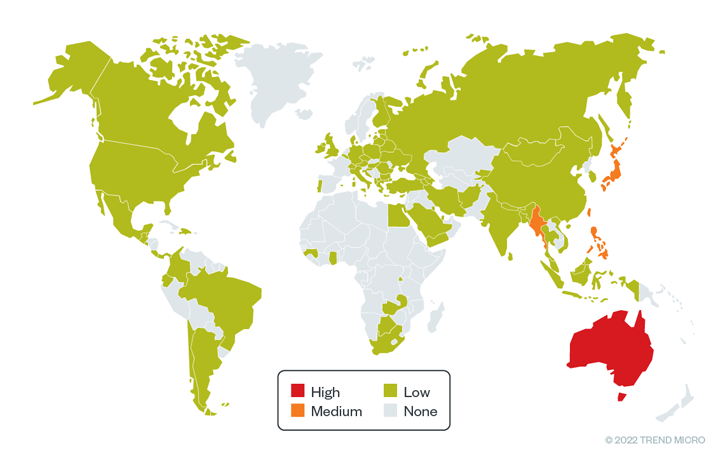
The primary targets of the intrusions from May to October 2022
included counties in the Asia Pacific region such as Myanmar,
Australia, the Philippines, Japan, and Taiwan, cybersecurity firm
Trend Micro said[1]
in a Friday report.
Mustang Panda, also called Bronze President, Earth Preta,
HoneyMyte, and Red Lich, is a China-based espionage actor believed
to be active since at least July 2018. The group is known for its
use of malware, such as China Chopper and PlugX to collect data
from compromised environments.
Activities of the group chronicled by ESET[2], Google, Proofpoint[3], Cisco Talos[4], and Secureworks[5]
this year have revealed the threat actor’s pattern of using PlugX
(and its variant called Hodur) to infect a wide range of entities
in Asia, Europe, the Middle East, and the Americas.
The latest findings from Trend Micro show that Mustang Panda
continues to evolve its tactics in a strategy to evade detection
and adopt infection routines that lead to the deployment of bespoke
malware families like TONEINS, TONESHELL, and PUBLOAD.
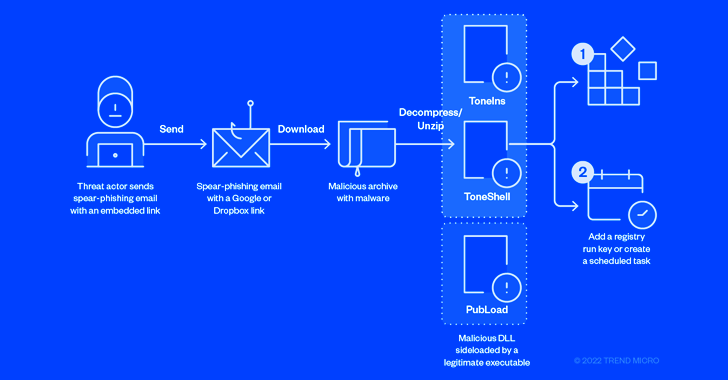
“Earth Preta abused fake Google accounts to distribute the
malware via spear-phishing emails, initially stored in an archive
file (such as RAR/ZIP/JAR) and distributed through Google Drive
links,” researchers Nick Dai, Vickie Su, and Sunny Lu said.
Initial access is facilitated through decoy documents that cover
controversial geopolitical themes to entice the targeted
organizations into downloading and triggering the malware.
In some cases, the phishing messages were sent from previously
compromised email accounts belonging to specific entities,
indicating the efforts undertaken by the Mustang Panda actor to
increase the likelihood of the success of its campaigns.
The archive files, when opened, are designed to display a lure
document to the victim, while stealthily loading the malware in the
background through a method referred to as DLL side-loading[6].
The attack chains ultimately lead to the delivery of three
malware families – PUBLOAD, TONEINS, and TONESHELL – which are
capable of downloading next-stage payloads and flying under the
radar.
TONESHELL, the main backdoor used in the attacks, is installed
through TONEINS and is a shellcode loader, with an early version of
the implant detected in September 2021, suggesting continued
efforts on part of the threat actor to update its arsenal.
“Earth Preta is a cyber espionage group known to develop their
own loaders in combination with existing tools like PlugX and
Cobalt Strike for compromise,” the researchers concluded.
“Once the group has infiltrated a targeted victim’s systems, the
sensitive documents stolen can be abused as the entry vectors for
the next wave of intrusions. This strategy largely broadens the
affected scope in the region involved.”
References
- ^
said
(www.trendmicro.com) - ^
ESET
(thehackernews.com) - ^
Google,
Proofpoint (thehackernews.com) - ^
Cisco
Talos (thehackernews.com) - ^
Secureworks
(thehackernews.com) - ^
DLL
side-loading (attack.mitre.org)
Read more https://thehackernews.com/2022/11/chinese-mustang-panda-hackers-actively.html