Mar 03, 2023Ravie Lakshmanan
The China-aligned Mustang Panda actor has been observed using a
hitherto unseen custom backdoor called MQsTTang as
part of an ongoing social engineering campaign that commenced in
January 2023.
“Unlike most of the group’s malware, MQsTTang doesn’t seem to be
based on existing families or publicly available projects,” ESET
researcher Alexandre Côté Cyr said[1]
in a new report.
Attack chains orchestrated by the group have stepped up
targeting of European entities in the wake of Russia’s full-scale invasion of
Ukraine[2] last year. The
victimology of the current activity is unclear, but the Slovak
cybersecurity company said the decoy filenames are in line with the
group’s previous campaigns that target European political
organizations.
That said, ESET also observed attacks against unknown entities
in Bulgaria and Australia, as well as a governmental institution in
Taiwan, indicating focus on Europe and Asia.
Mustang Panda has a history[3]
of using a remote access trojan[4]
dubbed PlugX[5]
for achieving its objectives, although recent intrusions have seen
the group expanding its malware arsenal to include custom tools[6]
like TONEINS, TONESHELL, and PUBLOAD.
In December 2022, Avast disclosed[7]
another set of attacks aimed at government agencies and political
NGOs in Myanmar that led to the exfiltration of sensitive data,
including email dumps, files, court hearings, interrogation
reports, and meeting transcripts, using a PlugX variant called
Hodur[8]
and a Google Drive uploader utility.
What’s more, an FTP server linked to the threat actor has been
found to host a variety of previously undocumented tools used to
distribute malware to infected devices, including a Go-based trojan
called JSX and a sophisticated backdoor referred to as HT3.
The development of MQsTTang points to a continuation of that
trend, even if it’s a “barebones” single-stage backdoor sans any
obfuscation techniques that allows for executing arbitrary commands
received from a remote server.
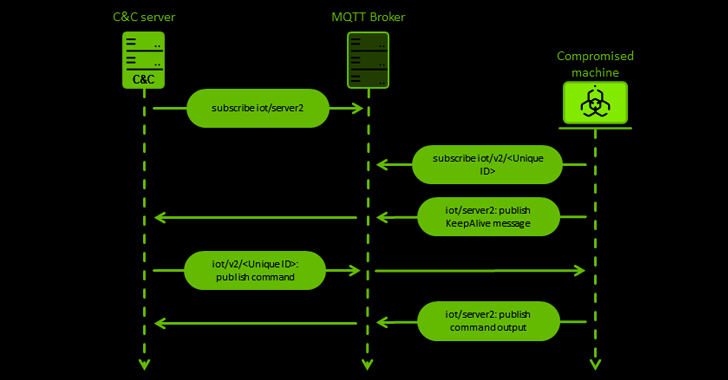
However, an unusual aspect of the implant is the use of an IoT
messaging protocol called MQTT[9]
for command-and-control (C2) communications, which is achieved
using an open source library called QMQTT[10], an MQTT client for the
Qt cross-platform
application framework.
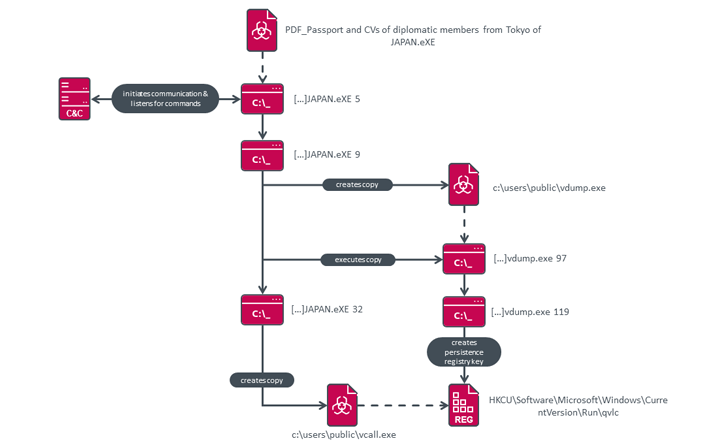
The initial intrusion vector for the attacks is spear-phishing,
with MQTT distributed via RAR archives containing a single
executable that features filenames with diplomatic themes (e.g.,
“PDF_Passport and CVs of diplomatic members from Tokyo of
JAPAN.eXE”).
“This new MQsTTang backdoor provides a kind of remote shell
without any of the bells and whistles associated with the group’s
other malware families,” Côté Cyr said. “However, it shows that
Mustang Panda is exploring new technology stacks for its
tools.”
Found this article interesting? Follow us on Twitter [11] and LinkedIn[12] to read more exclusive
content we post.
References
- ^
said
(www.welivesecurity.com) - ^
Russia’s
full-scale invasion of Ukraine
(thehackernews.com) - ^
history
(thehackernews.com) - ^
remote
access trojan (www.bitdefender.com) - ^
PlugX
(thehackernews.com) - ^
custom
tools (thehackernews.com) - ^
disclosed
(decoded.avast.io) - ^
Hodur
(thehackernews.com) - ^
MQTT (mqtt.org) - ^
QMQTT
(github.com) - ^
Twitter
(twitter.com) - ^
LinkedIn
(www.linkedin.com)
Read more https://thehackernews.com/2023/03/chinese-hackers-targeting-european.html