
Over a dozen military-industrial complex enterprises and public
institutions in Afghanistan and Europe have come under a wave of
targeted attacks since January 2022 to steal confidential data by
simultaneously making use of six different backdoors.
Russian cybersecurity firm Kaspersky attributed[1]
the attacks “with a high degree of confidence” to a China-linked
threat actor tracked by Proofpoint[2]
as TA428[3], citing overlaps in
tactics, techniques, and procedures (TTPs).
TA428, also tracked under the names Bronze Dudley, Temp.Hex, and
Vicious Panda, has a history[4]
of striking entities in Ukraine, Russia, Belarus, and Mongolia.
It’s believed to share connections with another hacking group
called Mustang Panda (aka Bronze President).
Targets of the latest cyber espionage campaign included
industrial plants, design bureaus and research institutes,
government agencies, ministries and departments in several East
European countries and Afghanistan.
Attack chains entail penetrating the enterprise IT networks
using carefully crafted phishing emails, including some that
referenced non-public information pertaining to the organizations,
to trick recipients into opening rogue Microsoft Word
documents.
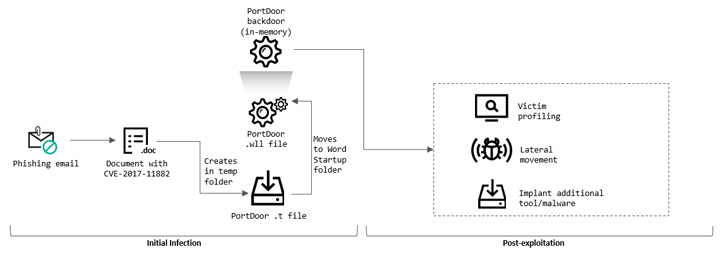
These decoy files come with exploits for a 2017 memory
corruption flaw in the Equation Editor component (CVE-2017-11882[5]) that could lead to the
execution of arbitrary code in the affected systems, ultimately
leading to the deployment of a backdoor called PortDoor.
PortDoor was notably employed[6]
in spear-phishing attacks mounted by Chinese state-sponsored
hackers in April 2021 to hack into the systems of a defense
contractor that designs submarines for the Russian Navy.
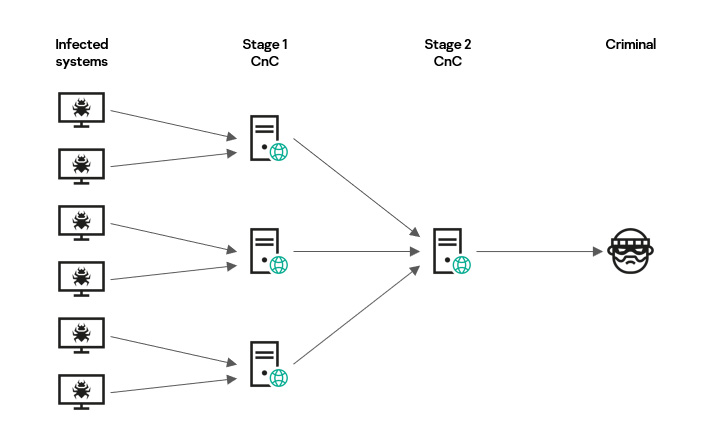
The use of six different implants is likely an attempt on the
part of the threat actors to establish redundant channels for
controlling infected hosts should one of them get detected and
removed from the networks.
The intrusions culminate with the attacker hijacking the domain
controller and gaining complete control of all of the
organization’s workstations and servers, leveraging the privileged
access to exfiltrate files of interest in the form of compressed
ZIP archives to a remote server located in China.
Other backdoors utilized in the attacks include nccTrojan[7], Cotx, DNSep,
Logtu[8], and a previously
undocumented malware dubbed as CotSam, so named owing to its
similarities with Cotx. Each provides extensive functionality for
commandeering the systems and harvesting sensitive data.
Also incorporated in the attacks is Ladon, a hacking framework
for the lateral movement that also enables the adversary to scan
for devices in the network as well as exploit security
vulnerabilities in them to execute malicious code.
“Spear phishing remains one of the most relevant threats to
industrial enterprises and public institutions,” Kaspersky said[9]. “The attackers used
primarily known backdoor malware, as well as standard techniques
for lateral movement and antivirus solution evasion.”
“At the same time, they were able to penetrate dozens of
enterprises and even take control of the entire IT infrastructure,
and IT security solutions of some of the organizations
attacked.”
The findings arrive a little over two months after the Twisted Panda[10] actors were observed
targeting research institutes in Russia and Belarus to drop a
bare-bones backdoor called Spinner.
References
- ^
attributed
(securelist.com) - ^
Proofpoint
(www.proofpoint.com) - ^
TA428
(malpedia.caad.fkie.fraunhofer.de) - ^
history
(thehackernews.com) - ^
CVE-2017-11882
(msrc.microsoft.com) - ^
notably
employed (thehackernews.com) - ^
nccTrojan
(insight-jp.nttsecurity.com) - ^
Cotx,
DNSep, Logtu (news.drweb.ru) - ^
said
(ics-cert.kaspersky.com) - ^
Twisted Panda
(thehackernews.com)
Read more https://thehackernews.com/2022/08/chinese-hackers-targeted-dozens-of.html