
Cybersecurity researchers today unveiled a complex and targeted
espionage attack on potential government sector victims in South
East Asia that they believe was carried out by a sophisticated
Chinese APT group at least since 2018.
“The attack has a complex and complete arsenal of droppers,
backdoors and other tools involving Chinoxy backdoor, PcShare RAT
and FunnyDream backdoor binaries, with forensic artefacts pointing
towards a sophisticated Chinese actor,” Bitdefender said in a new
analysis shared with The Hacker News.
It’s worth noting that the FunnyDream[1]
campaign has been previously linked to high-profile government
entities in Malaysia, Taiwan, and the Philippines, with a majority
of victims located in Vietnam.
According to the researchers, not only around 200 machines
exhibited attack indicators associated with the campaign, evidence
points to the fact the threat actor may have compromised domain controllers[2]
on the victim’s network, allowing them to move laterally and
potentially gain control of other systems.
The research has yielded little to no clues as to how the
infection happened, although it’s suspected that the attackers
employed social engineering lures to trick unwitting users into
opening malicious files.
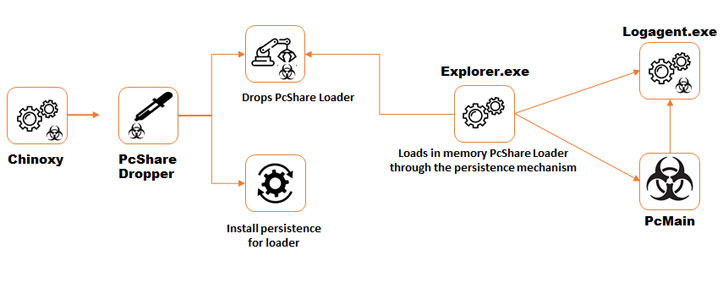
Upon gaining an initial foothold, multiple tools were found to
be deployed on the infected system, including the Chinoxy backdoor[3]
to gain persistence as well as a Chinese remote access Trojan (RAT)
called PcShare, a modified variant of the same tool available on
GitHub[4].
Besides using command-line utilities such as tasklist.exe,
ipconfig.exe, systeminfo.exe, and netstat to gather system
information, a number of others — ccf32, FilePak, FilePakMonitor,
ScreenCap, Keyrecord, and TcpBridge — were installed to collect
files, capture screenshots, logging keystrokes, and exfiltrate the
collected information to an attacker-controlled server.
The investigation also uncovered the use of the aforementioned
FunnyDream backdoor starting in May 2019, which comes with multiple
capabilities to amass user data, clean traces of malware
deployment, thwart detection and execute malicious commands, the
results of which were transmitted back to command-and-control
(C&C) servers situated in Hong Kong, China, South Korea, and
Vietnam.
“Attributing APT style attacks to a particular group or country
can be extremely difficult, mostly because forensic artefacts can
sometimes be planted intentionally, C&C infrastructure can
reside anywhere in the world, and the tools used can be repurposed
from other APT groups,” the researchers concluded.
“During this analysis, some forensic artifacts seem to suggest a
Chinese-speaking APT group, as some of the resources found in
several binaries had a language set to Chinese, and the Chinoxy
backdoor used during the campaign is a Trojan known to have been
used by Chinese-speaking threat actors.”
References
- ^
FunnyDream
(securelist.com) - ^
domain
controllers (en.wikipedia.org) - ^
Chinoxy
backdoor (malpedia.caad.fkie.fraunhofer.de) - ^
available on GitHub
(github.com)