
temporarily unavailable on the Google Play Store in October after
they were caught collecting sensitive user details.
The two apps in question—Baidu Maps and Baidu Search
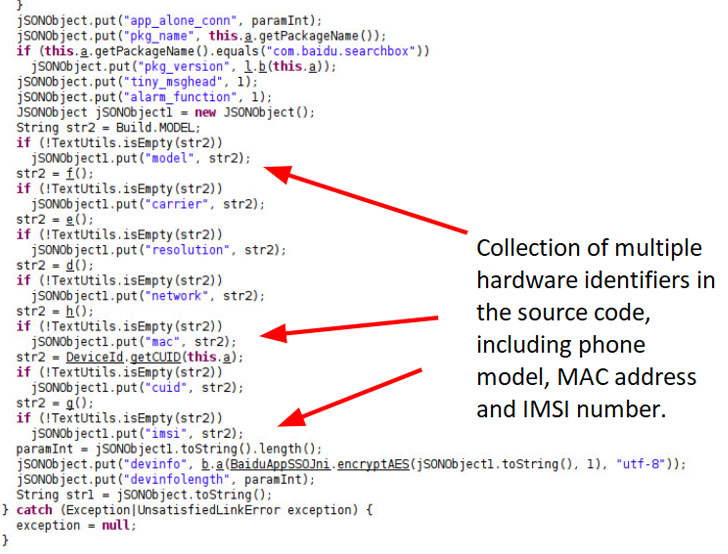
Box—were found to collect device identifiers, such as the
International Mobile Subscriber Identity (IMSI) number or MAC
address, without users’ knowledge, thus making them potentially trackable[1]
online.
The discovery[2]
was made by network security firm Palo Alto Networks, who notified
both Baidu and Google of their findings, after which the search
company pulled the apps on October 28, citing “unspecified
violations.”
As of writing, a compliant version of Baidu Search Box has been
restored to the Play Store on November 19, while Baidu Maps remains
unavailable until the unresolved issues highlighted by Google are
fixed.
A separate app named Homestyler was also found to collect
private information from users’ Android devices.
According to Palo Alto researchers, the full list of data
collected by the apps include:
- Phone model
- Screen resolution
- Phone MAC address
- Carrier (Telecom Provider)
- Network (Wi-Fi, 2G, 3G, 4G, 5G)
- Android ID
- IMSI number
- International Mobile Equipment Identity (IMEI) number
Using a machine learning-based algorithm designed to detect
anomalous spyware traffic, the origin of the data leak was traced
to Baidu’s Push SDK as well as ShareSDK from the Chinese vendor
MobTech, the latter of which supports 37,500 apps, including more
than 40 social media platforms.
While Google has taken steps[3]
to secure the Play store and stop the malicious activity, bad
actors are still finding ways[4]
to infiltrate[5]
the app marketplace[6]
and leverage the platform for their gain.
Indeed, an academic study[7]
published by researchers from NortonLifeLock earlier this month
found the Play Store to be the primary source of malware installs
(about 67.5%) on Android devices based on an analysis of app
installations on 12 million handsets over a four-month period
between June and September 2019, fueled in part due to the wide
popularity of the platform.
However, its vector detection ratio — the ratio of unwanted apps
installed through that vector overall apps installed through that
vector — was found to be only 0.6% when compared to alternative
third-party app stores (3.2%).
“Thus, the Play market defenses against unwanted apps work, but
still significant amounts of unwanted apps are able to bypass them,
making it the main distribution vector for unwanted apps,” the
researchers said.
If anything, the incident is yet another reminder that no app,
even if developed by a legitimate third-party, can be taken for
granted.
This also means the usual safeguards such as scrutinizing app
reviews, developer details, and the list of requested permissions
may not offer enough protection, thus making it difficult to
ascertain if a permission is misused by cybercriminals to steal
private data.
“In mobile devices, it is typical to ask a user to grant a list
of permissions upon installation of an application or to prompt a
user to allow or deny a permission while the application is
running,” Palo Alto researchers concluded.
“Disallowing permissions can often result in a non-working
application, which leads to a bad user experience and might tempt a
user to click on ‘allow’ just to be able to use an application.
Even if a certain permission is granted, it is often up to the app
developers whether it is used in accordance with the official
guidelines.”
References
- ^
potentially trackable
(unit42.paloaltonetworks.com) - ^
discovery
(unit42.paloaltonetworks.com) - ^
taken
steps (developers.google.com) - ^
finding
ways (thehackernews.com) - ^
infiltrate
(thehackernews.com) - ^
app
marketplace (thehackernews.com) - ^
academic
study (arxiv.org)
