The operators behind BRATA[1]
have once again added more capabilities to the Android mobile
malware in an attempt to make their attacks against financial apps
more stealthy.
“In fact, the modus operandi now fits into an Advanced
Persistent Threat (APT) activity pattern,” Italian cybersecurity
firm Cleafy said[2]
in a report last week. “This term is used to describe an attack
campaign in which criminals establish a long-term presence on a
targeted network to steal sensitive information.”
An acronym for “Brazilian Remote Access Tool Android,” BRATA was
first detected[3]
in the wild in Brazil in late 2018, before making its first
appearance in Europe last April, while masquerading as antivirus
software and other common productivity tools to trick users into
downloading them.
The change in the attack pattern, which scaled new highs in
early April 2022, involves tailoring the malware to strike a
specific financial institution at a time, switching to a different
bank only after the victim begins implementing countermeasures
against the threat.
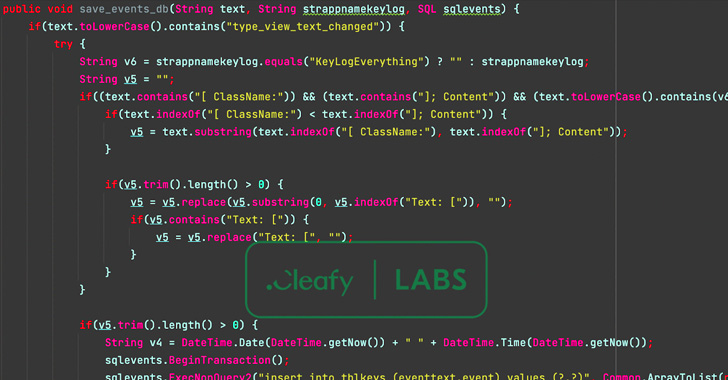
Also incorporated in the rogue apps are new features that enable
it to impersonate the login page of the financial institution to
harvest credentials, access SMS messages, and sideload a
second-stage payload (“unrar.jar”) from a remote server to log
events on the compromised device.
“The combination of the phishing page with the possibility to
receive and read the victim’s sms could be used to perform a
complete Account Takeover (ATO) attack,” the researchers said.
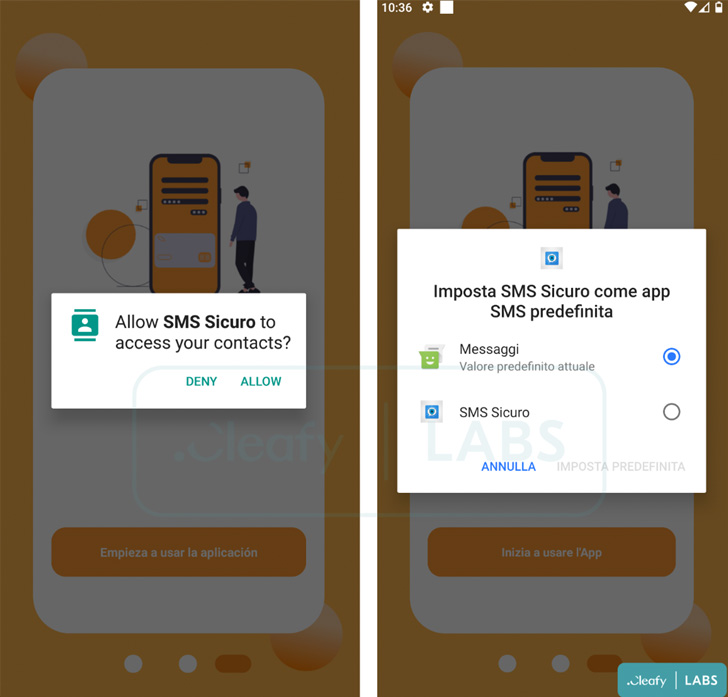
Additionally, Cleafy said it found a separate Android app
package sample (“SMSAppSicura.apk”) that used the same
command-and-control (C2) infrastructure as BRATA to siphon SMS
messages, indicating that the threat actors are testing out
different methods to expand their reach.
The SMS stealer app is said to be specifically singling out
users in the U.K., Italy, and Spain, its goal being able to
intercept and exfiltrate all incoming messages related to one-time
passwords sent by banks.
“The first campaigns of malware were distributed through fake
antivirus or other common apps, while during the campaigns the
malware is taking the turn of an APT attack against the customer of
a specific Italian bank,” the researchers said.
“They usually focus on delivering malicious applications
targeted to a specific bank for a couple of months, and then moving
to another target.”
Read more https://thehackernews.com/2022/06/brata-android-malware-gains-advanced.html