Mar 01, 2023Ravie Lakshmanan
A stealthy Unified Extensible Firmware Interface (UEFI) bootkit
called BlackLotus has become the first publicly known malware
capable of bypassing Secure
Boot[1] defenses, making it a
potent threat in the cyber landscape.
“This bootkit can run even on fully up-to-date Windows 11
systems with UEFI Secure Boot enabled,” Slovak cybersecurity
company ESET said[2]
in a report shared with The Hacker News.
UEFI bootkits[3]
are deployed in the system firmware and allow full control over the
operating system (OS) boot process, thereby making it possible to
disable OS-level security mechanisms and deploy arbitrary payloads
during startup with high privileges.
Offered for sale at $5,000 (and $200 per new subsequent
version), the powerful and persistent toolkit is programmed in
Assembly and C and is 80 kilobytes in size. It also features
geofencing capabilities to avoid infecting computers in Armenia,
Belarus, Kazakhstan, Moldova, Romania, Russia, and Ukraine.
Details about BlackLotus first emerged[4]
in October 2022, with Kaspersky security researcher Sergey Lozhkin
describing it as a sophisticated crimeware solution.
“This represents a bit of a ‘leap’ forward, in terms of ease of
use, scalability, accessibility, and most importantly, the
potential for much more impact in the forms of persistence,
evasion, and/or destruction,” Eclypsium’s Scott Scheferman noted[5].
BlackLotus, in a nutshell, exploits a security flaw tracked as
CVE-2022-21894[6]
(aka Baton Drop[7]) to get around UEFI
Secure Boot protections and set up persistence. The vulnerability
was addressed[8]
by Microsoft as part of its January 2022 Patch Tuesday update.
A successful exploitation of the vulnerability, according to
ESET, allows arbitrary code execution during early boot phases,
permitting a threat actor to carry out malicious actions on a
system with UEFI Secure Boot enabled without having physical access
to it.
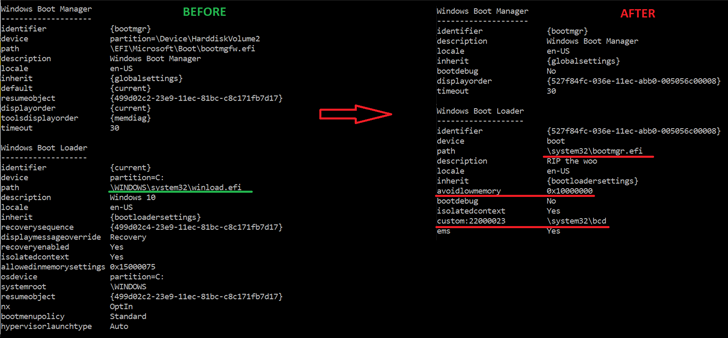
“This is the first publicly known, in-the-wild abuse of this
vulnerability,” ESET researcher Martin Smolár said. “Its
exploitation is still possible as the affected, validly signed
binaries have still not been added to the UEFI revocation
list[9].”
“BlackLotus takes advantage of this, bringing its own copies of
legitimate – but vulnerable – binaries to the system in order to
exploit the vulnerability,” effectively paving the way for Bring
Your Own Vulnerable Driver (BYOVD[10]) attacks.
Besides being equipped to turn off security mechanisms like
BitLocker, Hypervisor-protected Code Integrity (HVCI[11]), and Windows Defender,
it’s also engineered to drop a kernel driver and an HTTP downloader
that communicates with a command-and-control (C2) server to
retrieve additional user-mode or kernel-mode malware.
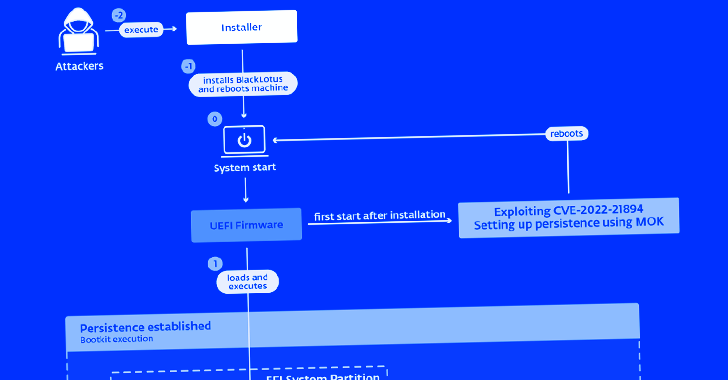
The exact modus operandi used to deploy the bootkit is unknown
as yet, but it starts with an installer component that’s
responsible for writing the files to the EFI system partition[12], disabling HVCI and
BitLocker, and then rebooting the host.
The restart is followed by the weaponization of CVE-2022-21894
to achieve persistence and install the bootkit, after which it is
automatically executed on every system start to deploy the kernel
driver.
While the driver is tasked with launching the user-mode HTTP
downloader and running next-stage kernel-mode payloads, the latter
is capable of executing commands received from the C2 server over
HTTPS.
This includes downloading and executing a kernel driver, DLL, or
a regular executable; fetching bootkit updates, and even
uninstalling the bootkit from the infected system.
“Many critical vulnerabilities affecting security of UEFI
systems have been discovered in the last few years,” Smolár said.
“Unfortunately, due the complexity of the whole UEFI ecosystem and
related supply-chain problems, many of these vulnerabilities have
left many systems vulnerable even a long time after the
vulnerabilities have been fixed – or at least after we were told
they were fixed.”
“It was just a matter of time before someone would take
advantage of these failures and create a UEFI bootkit capable of
operating on systems with UEFI Secure Boot enabled.”
Found this article interesting? Follow us on Twitter [13] and LinkedIn[14] to read more exclusive
content we post.
References
- ^
Secure Boot
(thehackernews.com) - ^
said
(www.welivesecurity.com) - ^
UEFI
bootkits (thehackernews.com) - ^
first
emerged (www.theregister.com) - ^
noted
(www.linkedin.com) - ^
CVE-2022-21894
(msrc.microsoft.com) - ^
Baton Drop
(github.com) - ^
addressed
(thehackernews.com) - ^
UEFI
revocation list (uefi.org) - ^
BYOVD
(thehackernews.com) - ^
HVCI
(learn.microsoft.com) - ^
EFI
system partition (en.wikipedia.org) - ^
Twitter
(twitter.com) - ^
LinkedIn
(www.linkedin.com)
Read more https://thehackernews.com/2023/03/blacklotus-becomes-first-uefi-bootkit.html