More than a week after Microsoft released a one-click mitigation tool[1] to mitigate cyberattacks
targeting on-premises Exchange servers, the company disclosed[2]
that patches have been applied to 92% of all internet-facing
servers affected by the ProxyLogon vulnerabilities.
The development, a 43% improvement from the previous week, caps
off a whirlwind of espionage and malware campaigns that hit
thousands of companies worldwide, with as many as 10 advanced
persistent threat (APT) groups opportunistically moving quickly to
exploit the bugs.
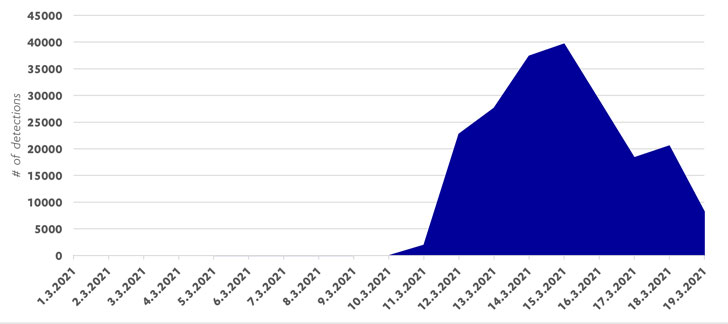
According to telemetry data from RiskIQ, there are roughly
29,966 instances of Microsoft Exchange servers still exposed to
attacks, down from 92,072 on March 10.
While Exchange servers were under assault by multiple
Chinese-linked state-sponsored hacking groups prior to Microsoft’s patch[3]
on March 2, the release of public proof-of-concept[4]
exploits fanned a feeding frenzy of infections, opening the door
for escalating attacks like ransomware and hijacking web shells
planted on unpatched Microsoft Exchange servers to deliver
cryptominers and other malware.
“To make matters worse, proof-of-concept automated attack
scripts are being made publicly available, making it possible for
even unskilled attackers to quickly gain remote control of a
vulnerable Microsoft Exchange Server,” cybersecurity firm F-Secure
noted[5]
in a write-up last week.
In the weeks since Microsoft first released its patches, at
least two different strains of ransomware have been discovered as
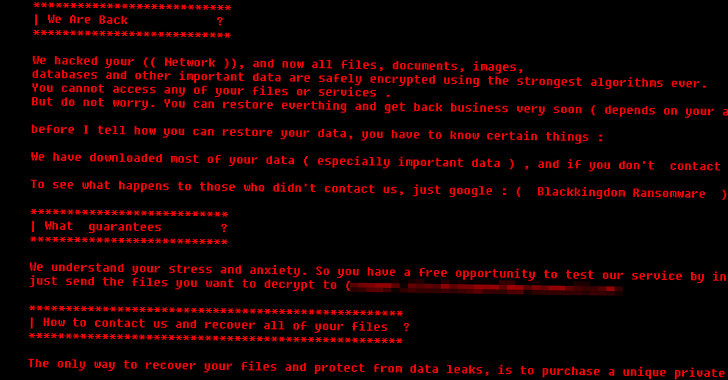
leveraging the flaws to install “DearCry[6]” and “Black
Kingdom.”
Cybersecurity firm Sophos’ analysis[7]
of Black Kingdom paints the ransomware as “somewhat rudimentary and
amateurish in its composition,” with the attackers abusing the
ProxyLogon flaw to deploy a web shell, utilizing it to issue a
PowerShell command that downloads the ransomware payload, which
encrypts the files and demands a bitcoin ransom in exchange for the
private key.
“The Black Kingdom ransomware targeting unpatched Exchange
servers has all the hallmarks of being created by a motivated
script-kiddie,” Mark Loman, director of engineering at Sophos,
said. “The encryption tools and techniques are imperfect but the
ransom of $10,000 in bitcoin is low enough to be successful. Every
threat should be taken seriously, even seemingly low-quality
ones.”
The volume of attacks even before the public disclosure of
ProxyLogon has prompted experts to investigate[8]
if the exploit was shared or sold on the Dark Web, or a Microsoft
partner, with whom the company shared information about the
vulnerabilities through its Microsoft Active Protections Program
(MAPP), either accidentally or purposefully leaked it to other
groups.
References
- ^
one-click mitigation tool
(thehackernews.com) - ^
disclosed
(twitter.com) - ^
Microsoft’s patch
(thehackernews.com) - ^
public
proof-of-concept (thehackernews.com) - ^
noted
(blog.f-secure.com) - ^
DearCry
(thehackernews.com) - ^
analysis
(news.sophos.com) - ^
investigate
(thehackernews.com)
Read more http://feedproxy.google.com/~r/TheHackersNews/~3/9gpZG_Qu02c/black-kingdom-ransomware-hunting.html