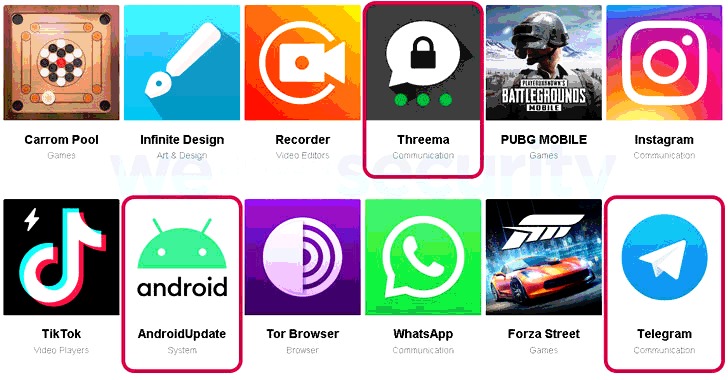
A hacking group known for its attacks in the Middle East, at
least since 2017, has recently been found impersonating legitimate
messaging apps such as Telegram and Threema to infect Android
devices with a new, previously undocumented malware.
“Compared to the versions documented in 2017, Android/SpyC23.A
has extended spying functionality, including reading notifications
from messaging apps, call recording and screen recording, and new
stealth features, such as dismissing notifications from built-in
Android security apps,” cybersecurity firm ESET said[1] in a Wednesday
analysis.
First detailed by Qihoo 360 in 2017 under the
moniker Two-tailed Scorpion[2]
(aka APT-C-23 or Desert Scorpion), the mobile malware has been
deemed “surveillanceware” for its abilities to spy on the devices
of targeted individuals, exfiltrating call logs, contacts,
location, messages, photos, and other sensitive documents in the
process.
In 2018, Symantec discovered a newer
variant[3] of the campaign
that employed a malicious media player as a lure to grab
information from the device and trick victims into installing
additional malware.
Then earlier
this year[4], Check Point Research
detailed fresh signs of APT-C-23 activity when Hamas operators
posed as young teenage girls on Facebook, Instagram, and Telegram
to lure Israeli soldiers into installing malware-infected apps on
their phones.
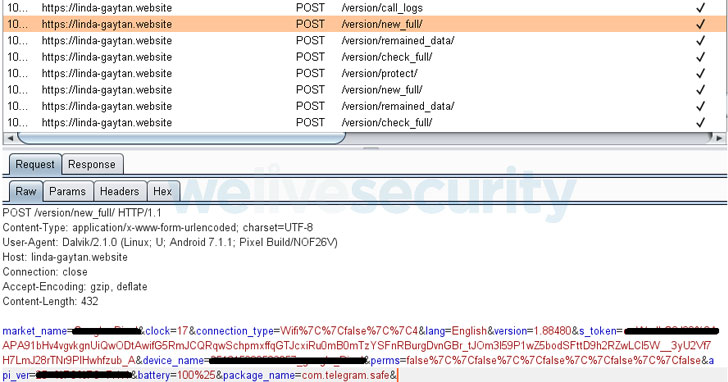
The latest version of the spyware detailed by ESET expands on
these features, including the ability to collect information from
social media and messaging apps via screen recording and
screenshots, and even capture incoming and outgoing calls in
WhatsApp and read the text of notifications from social media apps,
including WhatsApp, Viber, Facebook, Skype, and Messenger.
The infection begins when a victim visits a fake Android app
store called “DigitalApps,” and downloads apps such as Telegram,
Threema, and weMessage, suggesting that the group’s motivation
behind impersonating messaging apps is to “justify the various
permissions requested by the malware.”
In addition to requesting invasive permissions to read
notifications, turn off Google Play Protect, and record a user’s
screen under the guise of security and privacy features, the
malware communicates with its command-and-control (C2) server to
register the newly infected victim and transmit the device
information.
The C2 servers, which typically masquerade as websites under
maintenance, are also responsible for relaying the commands to the
compromised phone, which can be used to record audio, restart
Wi-Fi, uninstall any app installed on the device, among others.
What’s more, it also comes equipped with a new feature that
allows it to stealthily make a call while creating a black screen
overlay to mask the call activity.
“Our research shows that the APT-C-23 group is still active,
enhancing its mobile toolset and running new operations.
Android/SpyC32.A – the group’s newest spyware version — features
several improvements making it more dangerous to victims,” ESET
said.
Apps downloaded from fraudulent third-party app stores has been
a conduit for Android malware in recent years. It’s always
essential to stick to official sources to limit risk, and
scrutinize permissions requested by apps before installing them on
the device.
References
- ^
said
(www.welivesecurity.com) - ^
Two-tailed Scorpion
(zhuiri.360.cn) - ^
newer variant
(symantec-enterprise-blogs.security.com) - ^
earlier this year
(research.checkpoint.com)
Read more http://feedproxy.google.com/~r/TheHackersNews/~3/DY7a-k-Hk4k/android-mobile-hacking.html