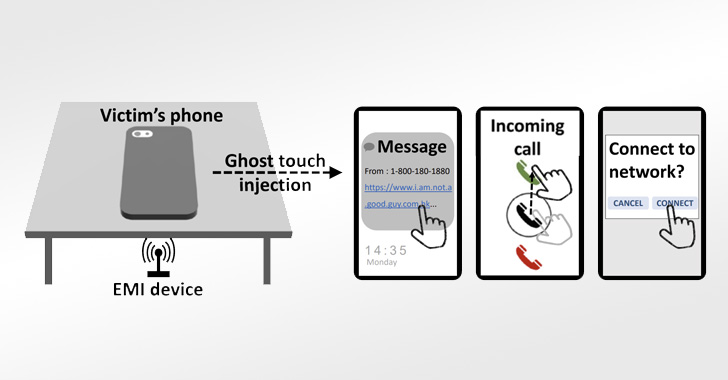
Researchers have demonstrated what they call the “first active
contactless attack against capacitive touchscreens.”
GhostTouch, as it’s called, “uses
electromagnetic interference (EMI) to inject fake touch points into
a touchscreen without the need to physically touch it,” a group of
academics from Zhejiang University and Technical University of
Darmstadt said[1]
in a new research paper.
The core idea is to take advantage of the electromagnetic
signals to inject fake touch events such as taps and swipes into
targeted locations of the touchscreen with the goal of taking over
remote control and manipulating the underlying device.
The attack, which works from a distance of up to 40mm, hinges on
the fact that capacitive touchscreens[2]
are sensitive to EMI, leveraging it to inject electromagnetic
signals into transparent electrodes that are built into the
touchscreen so as to register them as touch events.
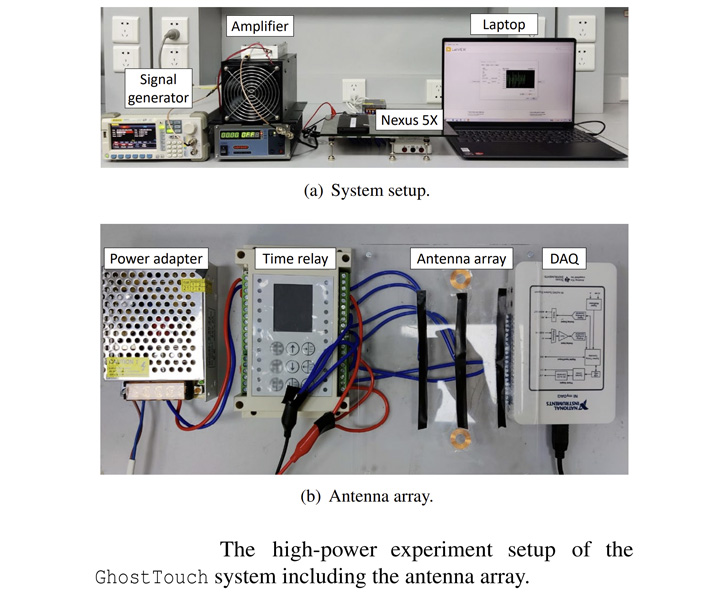
The experimental setup[3]
involves an electrostatic gun to generate a strong pulse signal
that’s then sent to an antenna to transmit an electromagnetic field
to the phone’s touchscreen, thereby causing the electrodes — which
act as antennas themselves — to pick up the EMI.
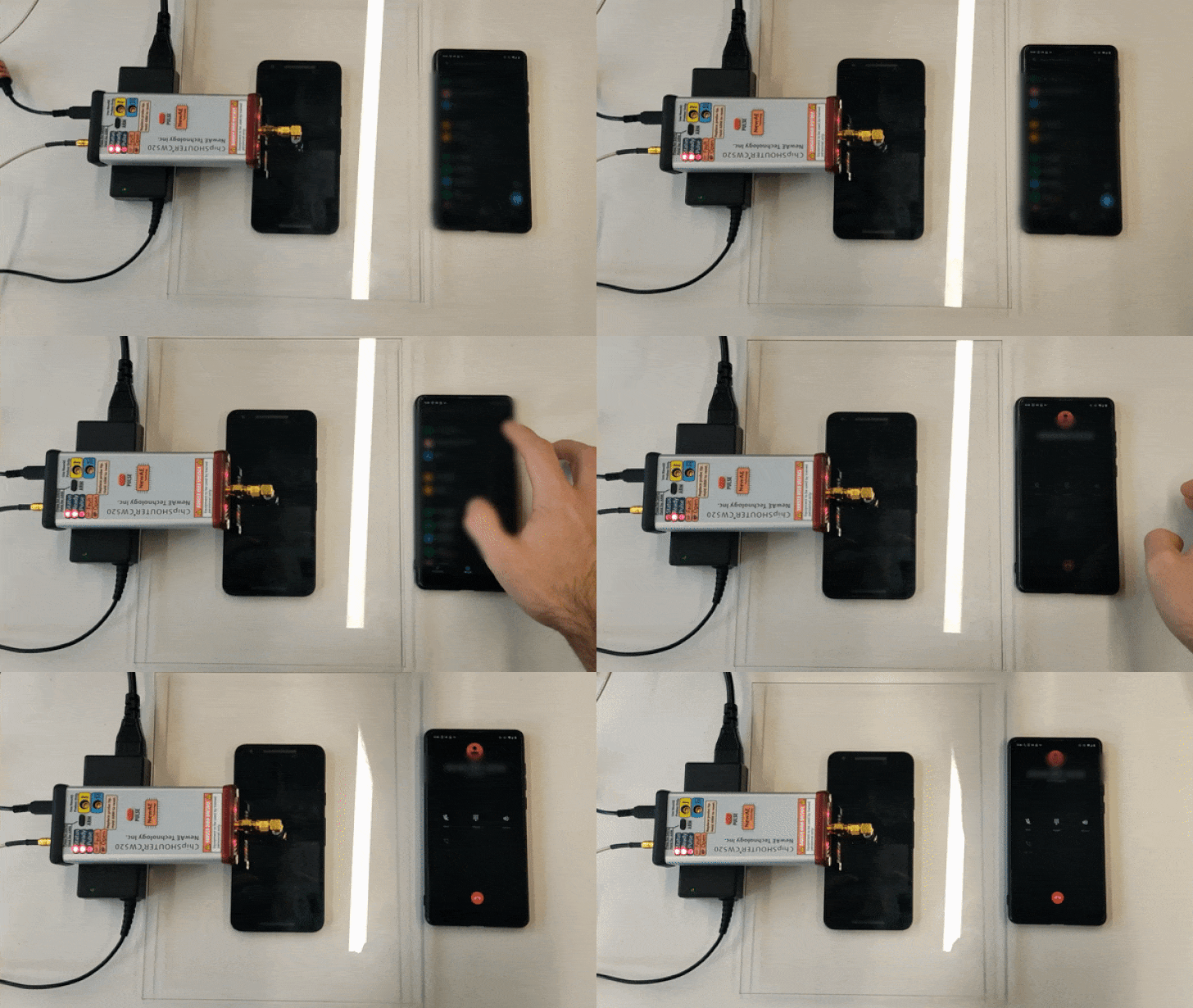
This can be further fine-tuned by tweaking the signal and the
antenna to induce a variety of touch behaviors, such as press and
hold and swipe to select, depending on the device model
targeted.
In a real-world scenario, this could play out in different ways,
including swiping up to unlock a phone, connecting to a rogue Wi-Fi
network, stealthily clicking on a malicious link containing
malware, and even answering a phone call on the victim’s
behalf.
“In places like a cafe, library, meeting room, or conference
lobbies, people might place their smartphone face-down on the
table,” the researchers said. “An attacker may embed the attack
equipment under the table and launch attacks remotely.”
As many as nine different smartphone models have been found
vulnerable to GhostTouch, including Galaxy A10s, Huawei P30 Lite,
Honor View 10, Galaxy S20 FE 5G, Nexus 5X, Redmi Note 9S, Nokia
7.2, Redmi 8, and an iPhone SE (2020), the latter of which was used
to establish a malicious Bluetooth connection.
To counteract the threat, the researchers recommend adding
electromagnetic shielding to block EMI, improving the detection
algorithm of the touchscreen, and prompting users to enter the
phone’s PIN or verify their faces or fingerprints prior to
executing high-risk actions.
“GhostTouch controls and shapes the near-field electromagnetic
signal, and injects touch events into the targeted area on the
touchscreen, without the need for physical touch or access to the
victim’s device,” the researchers said.
References
- ^
said
(www.usenix.org) - ^
capacitive touchscreens
(en.wikipedia.org) - ^
experimental setup
(github.com)
Read more https://thehackernews.com/2022/05/attackers-can-use-electromagnetic.html