Apple on Thursday said it’s introducing new child safety
features in iOS, iPadOS, watchOS, and macOS as part of its efforts
to limit the spread of Child Sexual Abuse Material (CSAM) in the
U.S.
To that effect, the iPhone maker said it intends to begin
client-side scanning of images shared via every Apple device for
known child abuse content as they are being uploaded into iCloud
Photos, in addition to leveraging on-device machine learning to vet
all iMessage images sent or received by minor accounts (aged under
13) to warn parents of sexually explicit photos in the messaging
platform.
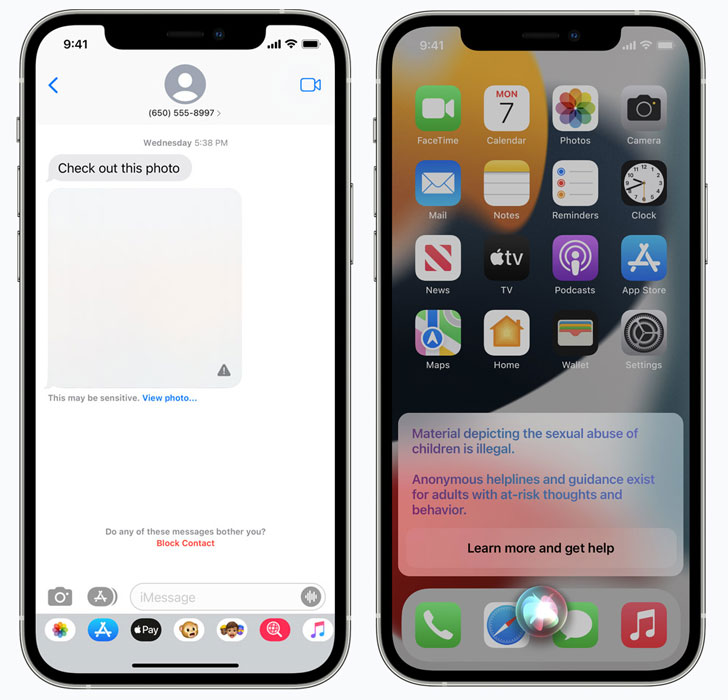
Furthermore, Apple also plans to update Siri and Search to stage
an intervention when users try to perform searches for CSAM-related
topics, alerting the “interest in this topic is harmful and
problematic.”
“Messages uses on-device machine learning to analyze image
attachments and determine if a photo is sexually explicit,” Apple
noted[1]. “The feature is
designed so that Apple does not get access to the messages.” The
feature, called Communication Safety, is said to be an opt-in
setting that must be enabled by parents through the Family Sharing
feature.
How Child Sexual Abuse Material is Detected
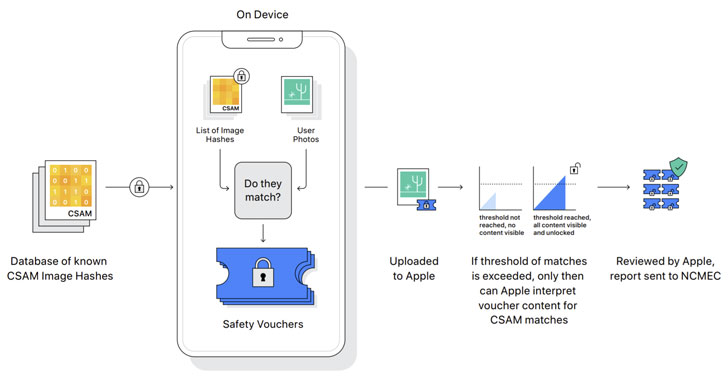
Detection of known CSAM images involves[2]
carrying out on-device matching using a database of known CSAM
image hashes provided by the National Center for Missing and
Exploited Children (NCMEC) and other child safety organizations
before the photos are uploaded to the cloud. “NeuralHash,” as the
system is called, is powered by a cryptographic technology known as
private set intersection[3]. However, it’s worth
noting that while the scanning happens automatically, the feature
only works when iCloud photo sharing is turned on.
What’s more, Apple is expected to use another cryptographic
principle called threshold secret sharing that allows it to
“interpret” the contents if an iCloud Photos account crosses a
threshold of known child abuse imagery, following which the content
is manually reviewed to confirm there is a match, and if so,
disable the user’s account, report the material to NCMEC, and pass
it on to law enforcement.
Researchers Express Concern About Privacy
Apple’s CSAM initiative has prompted security researchers to
express anxieties[4]
that it could suffer from a mission creep and be expanded to detect
other kinds of content that could have political and safety
implications, or even frame innocent individuals by sending them
harmless but malicious images designed to appear as matches for
child porn.
U.S. whistle-blower Edward Snowden tweeted[5]
that, despite the project’s good intentions, what Apple is rolling
out is “mass surveillance,” while Johns Hopkins University
cryptography professor and security expert Matthew Green[6]
said[7], “the problem is that
encryption is a powerful tool that provides privacy, and you can’t
really have strong privacy while also surveilling every image
anyone sends.”
Apple already checks iCloud files and images sent over email
against known child abuse imagery, as do tech giants like Google,
Twitter, Microsoft, Facebook, and Dropbox, who employ similar image hashing methods[8] to look for and flag
potential abuse material, but Apple’s attempt to walk a privacy
tightrope could renew debates[9]
about weakening encryption, escalating a long-running tug of war
over privacy and policing in the digital age.
The New York Times, in a 2019 investigation[10], revealed that a record
45 million online photos and videos of children being sexually
abused were reported in 2018, out of which Facebook Messenger
accounted for nearly two-thirds, with Facebook as a whole
responsible for 90% of the reports.
Apple, along with Facebook-owned WhatsApp, have continually resisted efforts[11] to intentionally weaken
encryption and backdoor their systems. That said, Reuters reported[12] last year that the
company abandoned plans to encrypt users’ full backups to iCloud in
2018 after the U.S. Federal Bureau of Investigation (FBI) raised
concerns that doing so would impede investigations.
“Child exploitation is a serious problem, and Apple isn’t the
first tech company to bend its privacy-protective stance in an
attempt to combat it. But that choice will come at a high price for
overall user privacy,” the Electronic Frontier Foundation (EFF)
said[13] in a statement, noting
that Apple’s move could break encryption protections and open the
door for broader abuses.
“All it would take to widen the narrow backdoor that Apple is
building is an expansion of the machine learning parameters to look
for additional types of content, or a tweak of the configuration
flags to scan, not just children’s, but anyone’s accounts. That’s
not a slippery slope; that’s a fully built system just waiting for
external pressure to make the slightest change,” it added.
The CSAM efforts are set to roll out in the U.S. in the coming
months as part of iOS 15 and macOS Monterey, but it remains to be
seen if, or when, it would be available internationally. In
December 2020, Facebook was forced to switch off[14] some of its child abuse
detection tools in Europe in response to recent changes to the
European commission’s e-privacy directive that effectively ban
automated systems scanning for child sexual abuse images and other
illegal content without users’ explicit consent.
References
- ^
noted
(www.apple.com) - ^
involves
(www.apple.com) - ^
private
set intersection (thenextweb.com) - ^
express
anxieties (cdt.org) - ^
tweeted
(twitter.com) - ^
Matthew
Green (twitter.com) - ^
said
(twitter.com) - ^
similar
image hashing methods (www.nytimes.com) - ^
renew
debates (www.nytimes.com) - ^
2019
investigation (www.nytimes.com) - ^
continually resisted efforts
(thehackernews.com) - ^
reported
(www.reuters.com) - ^
said
(www.eff.org) - ^
forced
to switch off (www.theguardian.com)