Cybersecurity researchers disclosed a dozen new flaws in
multiple widely-used embedded TCP/IP stacks impacting millions of
devices ranging from networking equipment and medical devices to
industrial control systems that could be exploited by an attacker
to take control of a vulnerable system.
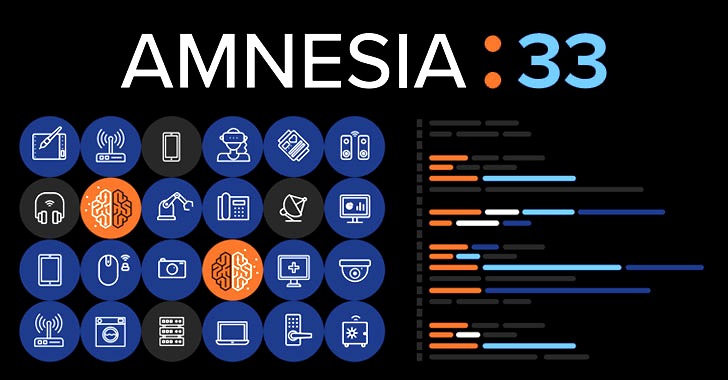
Collectively called “AMNESIA:33[1]” by Forescout
researchers, it is a set of 33 vulnerabilities that impact four
open-source TCP/IP protocol stacks — uIP, FNET, picoTCP, and
Nut/Net — that are commonly used in Internet-of-Things (IoT) and
embedded devices.
As a consequence of improper memory management, successful
exploitation[2] of these flaws could
cause memory corruption, allowing attackers to compromise devices,
execute malicious code, performing denial-of-service (DoS) attacks,
steal sensitive information, and even poison DNS cache.
In the real world, these attacks could play out in various ways:
disrupting the functioning of a power station to result in a
blackout or taking smoke alarm and temperature monitor systems
offline by using any of the DoS vulnerabilities.
The flaws, which will be detailed today at the Black Hat Europe Security
Conference[3], were discovered as part
of Forescout’s Project Memoria initiative to study the security of
TCP/IP stacks.
The development has prompted the CISA ICS-CERT to issue a
security advisory[4]
in an attempt to provide early notice of the reported
vulnerabilities and identify baseline mitigations for mitigating
risks associated with the flaws.
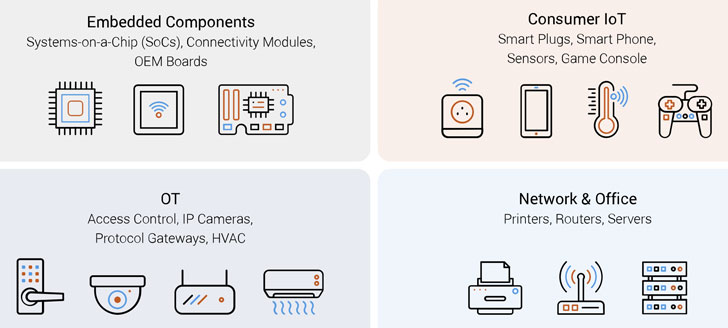
Millions of devices from an estimated 158 vendors are vulnerable
to AMNESIA:33, with the possibility of remote code execution
allowing an adversary to take complete control of a device, and
using it as an entry point on a network IoT devices to laterally
move, establish persistence, and co-opt the compromised systems
into botnets without their knowledge.
“AMNESIA:33 affects multiple open source TCP/IP stacks that are
not owned by a single company,” the researchers said[5]. “This means that a
single vulnerability tends to spread easily and silently across
multiple codebases, development teams, companies and products,
which presents significant challenges to patch management.”
Because these vulnerabilities span across a complex IoT supply
chain, Forescout cautioned it’s as challenging it is to determine
which devices are affected as they are hard to eradicate.
Like the Urgent/11[6]
and Ripple20[7]
flaws that were disclosed in recent times, AMNESIA:33 stems from
out-of-bounds writes[8], overflow flaws[9], or a lack of input validation[10], leading to memory
corruption and enabling an attacker to put devices into infinite
loops, poison DNS caches, and extract arbitrary data.
Three of the most severe issues reside in uIP (CVE-2020-24336),
picoTCP (CVE-2020-24338), and Nut/Net (CVE-2020-25111), all of
which are remote code execution (RCE) flaws and have a CVSS score
of 9.8 out of a maximum of 10.
- CVE-2020-24336 – The code for parsing DNS
records in DNS response packets sent over NAT64 does not validate
the length field of the response records, allowing attackers to
corrupt memory. - CVE-2020-24338 – The function that parses
domain names lacks bounds checks, allowing attackers to corrupt
memory with crafted DNS packets. - CVE-2020-25111 – A heap buffer overflow
occurring during the processing of the name field of a DNS response
resource record, allowing an attacker to corrupt adjacent memory by
writing an arbitrary number of bytes to an allocated buffer.
As of writing, vendors such as Microchip Technology[11] and Siemens[12] that have been affected
by the reported vulnerabilities have also released security
advisories.
“Embedded systems, such as IoT and [operational technology]
devices, tend to have long vulnerability lifespans resulting from a
combination of patching issues, long support lifecycles and
vulnerabilities ‘trickling down’ highly complex and opaque supply
chains,” Forescout said.
“As a result, vulnerabilities in embedded TCP/IP stacks have the
potential to affect millions – even billions – of devices across
verticals and tend to remain a problem for a very long time.”
Besides urging organizations to perform proper impact analysis
and risk assessment prior to deploying defensive measures, CISA has
recommended minimizing network exposure, isolating control system
networks and remote devices behind firewalls, and using Virtual
Private Networks (VPNs) for secure remote access.
References
- ^
AMNESIA:33
(www.forescout.com) - ^
successful exploitation
(kb.cert.org) - ^
Black
Hat Europe Security Conference
(www.blackhat.com) - ^
security
advisory (us-cert.cisa.gov) - ^
said
(www.forescout.com) - ^
Urgent/11
(thehackernews.com) - ^
Ripple20
(thehackernews.com) - ^
out-of-bounds writes
(cwe.mitre.org) - ^
overflow
flaws (cwe.mitre.org) - ^
lack
of input validation (cwe.mitre.org) - ^
Microchip Technology
(www.microchip.com) - ^
Siemens
(cert-portal.siemens.com)