A previously undocumented malware downloader has been spotted in
the wild in phishing attacks to deploy credential stealers and
other malicious payloads.
Dubbed “Saint Bot,” the malware is said to have first
appeared on the scene in January 2021, with indications that it’s
under active development.
“Saint Bot is a downloader that appeared quite recently, and
slowly is getting momentum. It was seen dropping stealers (i.e.
Taurus[1]
Stealer) or further loaders (example[2]), yet its design allows
[it] to utilize it for distributing any kind of malware,” said
Aleksandra “Hasherezade” Doniec, a threat intelligence analyst at
Malwarebytes.
“Furthermore, Saint Bot employs a wide variety of techniques
which, although not novel, indicate some level of sophistication
considering its relatively new appearance.”
The infection chain analyzed by the cybersecurity firm begins
with a phishing email containing an embedded ZIP file
(“bitcoin.zip”) that claims to be a bitcoin wallet when, in fact,
it’s a PowerShell script under the guise of .LNK shortcut file.
This PowerShell script then downloads the next stage malware, a
WindowsUpdate.exe executable, which, in turn, drops a second
executable (InstallUtil.exe) that takes care of downloading two
more executables named def.exe and putty.exe.
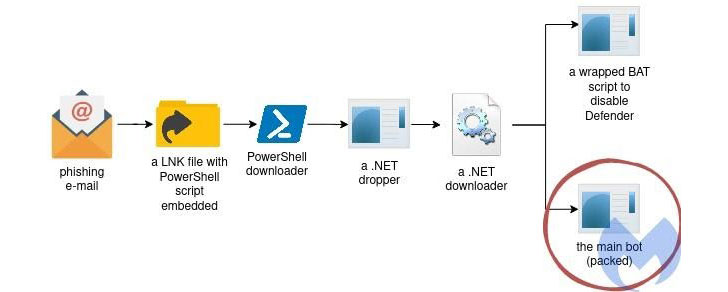
While the former is a batch script responsible for disabling
Windows Defender, putty.exe contains the malicious payload that
eventually connects to a command-and-control (C2) server for
further exploitation.
The obfuscation present in each stage of the infection, coupled
with the anti-analysis techniques adopted by the malware, allows
the malware operators to exploit the devices they were installed on
without attracting attention.
Besides performing “self defense checks” to verify the presence
of a debugger or a virtual environment, Saint Bot is designed to
not execute in Romania and select countries within the Commonwealth
of Independent States (CIS), which includes Armenia, Belarus,
Kazakhstan, Moldova, Russia, and Ukraine.
The list of commands supported by the malware include —
- downloading and executing other payloads retrieved from the C2
server - updating the bot malware, and
- uninstalling itself from the compromised machine
While these capabilities may seem very small, the fact that
Saint Bot serves as a downloader for other malware makes it
dangerous enough.
Interestingly, the payloads are themselves fetched from files
hosted on Discord, a tactic that has become increasingly common
among threat actors, who are abusing legitimate functions of such
platforms for C2 communications, evade security, and deliver
malware.
“When files are uploaded and stored within the Discord CDN, they
can be accessed using the hardcoded CDN URL by any system,
regardless of whether Discord has been installed, simply by
browsing to the CDN URL where the content is hosted,” researchers
from Cisco Talos disclosed[3]
in an analysis earlier this week, thus turning software like
Discord and Slack into lucrative targets for hosting malicious
content.
“Saint Bot is yet another tiny downloader,” Hasherezade said.
“”[It is] not as mature as SmokeLoader, but it is quite new and
currently actively developed. The author seems to have some
knowledge of malware design, which is visible by the wide range of
techniques used. Yet, all the deployed techniques are well-known
and pretty standard, [and] not showing much creativity so far.”
References
Read more http://feedproxy.google.com/~r/TheHackersNews/~3/qp1Nruco_Oc/alert-theres-new-malware-out-there.html