
A now-patched critical remote code execution (RCE) vulnerability
in GitLab’s web interface has been detected as actively exploited
in the wild, cybersecurity researchers warn, rendering a large
number of internet-facing GitLab instances susceptible to
attacks.
Tracked as CVE-2021-22205[1], the issue relates to an
improper validation of user-provided images that results in
arbitrary code execution. The vulnerability, which affects all
versions starting from 11.9, has since been addressed[2]
by GitLab on April 14, 2021 in versions 13.8.8, 13.9.6, and
13.10.3.
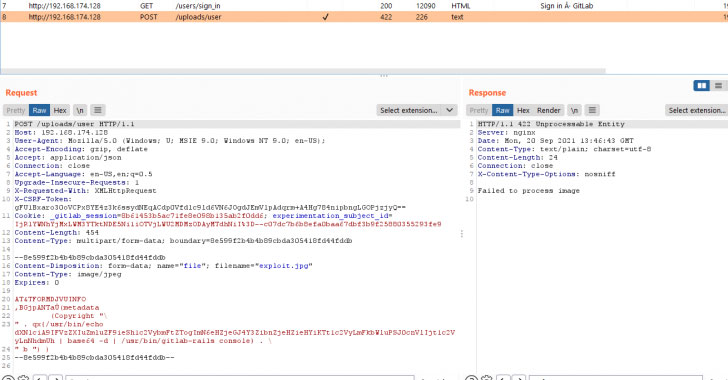
In one of the real-world attacks detailed[3]
by HN Security last month, two user accounts with admin privileges
were registered on a publicly-accessible GitLab server belonging to
an unnamed customer by exploiting the aforementioned flaw to upload
a malicious payload that leads to remote execution of arbitrary
commands, including obtaining elevated permissions.
Although the flaw was initially deemed to be a case of
authenticated RCE and assigned a CVSS score of 9.9, the severity
rating was revised to 10.0 on September 21, 2021 owing to the fact
that it can be triggered by unauthenticated threat actors as
well.
“Despite the tiny move in CVSS score, a change from
authenticated to unauthenticated has big implications for
defenders,” cybersecurity firm Rapid7 said[4]
in an alert published Monday.
Despite the public availability of the patches for more than six
months, of the 60,000 internet-facing GitLab installations, only
21% of the instances are said to be fully patched against the
issue, with another 50% still vulnerable to RCE attacks.
In the light of the unauthenticated nature of this
vulnerability, exploitation activity is expected to increase,
making it critical that GitLab users update to the latest version
as soon as possible. “In addition, ideally, GitLab should not be an
internet facing service,” the researchers said. “If you need to
access your GitLab from the internet, consider placing it behind a
VPN.”
Additional technical analysis related to the vulnerability can
be accessed here[5].
References
Read more http://feedproxy.google.com/~r/TheHackersNews/~3/YfdGQJ54bZw/alert-hackers-exploiting-gitlab.html