
Malicious actors are actively mass scanning the internet for
vulnerable VMware vCenter servers that are unpatched against a
critical remote code execution flaw, which the company addressed
late last month.
The ongoing activity was detected by Bad Packets on June 3 and
corroborated yesterday[1]
by security researcher Kevin Beaumont. “Mass scanning activity
detected from 104.40.252.159 checking for VMware vSphere hosts
vulnerable to remote code execution,” tweeted[2]
Troy Mursch, chief research officer at Bad Packets.
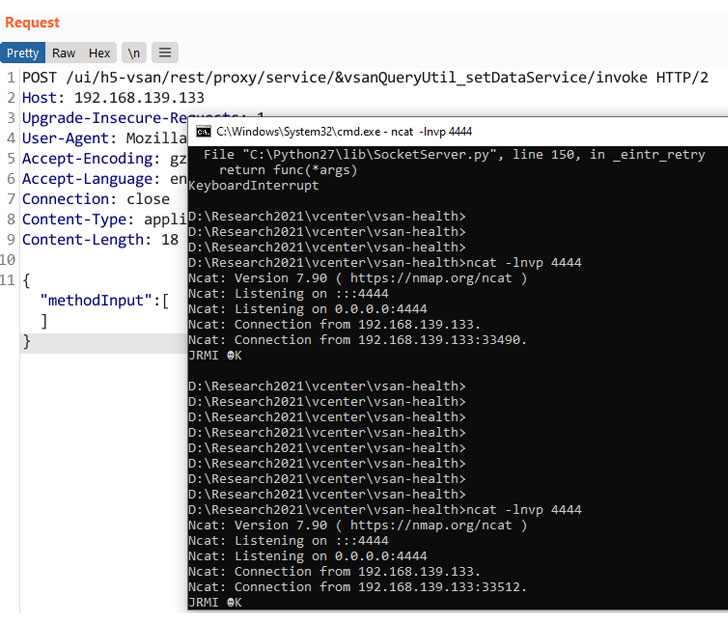
The development follows the publication of a proof-of-concept[3]
(PoC) RCE exploit code targeting the VMware vCenter bug.
Tracked as CVE-2021-21985[4]
(CVSS score 9.8), the issue is a consequence of a lack of input
validation in the Virtual SAN (vSAN) Health Check plug-in, which
could be abused by an attacker to execute commands with
unrestricted privileges on the underlying operating system that
hosts the vCenter Server.
Although the flaw was rectified by VMware on May 25, the company
strongly urged[5]
its customers to apply the emergency change immediately. “In this
era of ransomware it is safest to assume that an attacker is
already inside the network somewhere, on a desktop and perhaps even
in control of a user account, which is why we strongly recommend
declaring an emergency change and patching as soon as possible,”
VMware said.
This is not the first time adversaries have opportunistically
mass scanned the internet for vulnerable VMware vCenter servers. A
similar remote code execution vulnerability (CVE-2021-21972[6]) that was patched by
VMware in February became the target of cyber threat actors[7] attempting to exploit
and take control of unpatched systems.
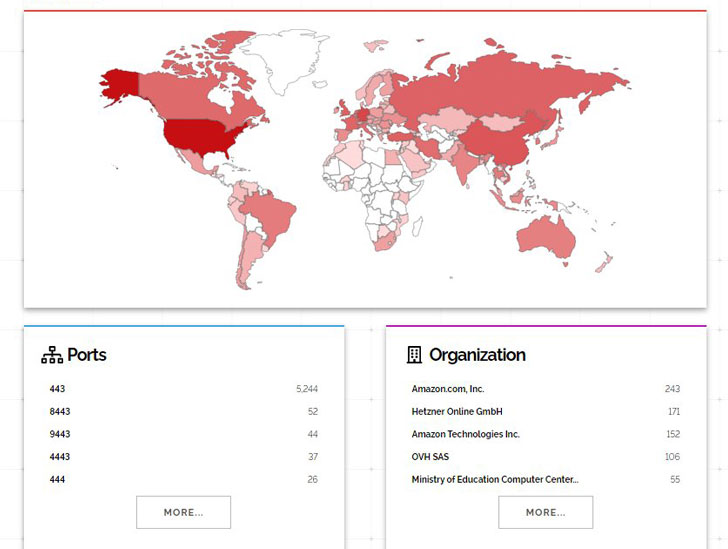
At least 14,858 vCenter servers[8]
were found reachable over the internet, according to Bad Packets
and Binary Edge.
What’s more, a new research from Cisco Talos earlier this week
found that the threat actor behind the Python-based Necro[9]
bot wormed its way into exposed VMware vCenter servers by abusing
the same security weakness to boost the malware’s infection
propagation capabilities.
References
- ^
yesterday
(twitter.com) - ^
tweeted
(twitter.com) - ^
proof-of-concept
(www.iswin.org) - ^
CVE-2021-21985
(thehackernews.com) - ^
strongly
urged (thehackernews.com) - ^
CVE-2021-21972
(thehackernews.com) - ^
target
of cyber threat actors (twitter.com) - ^
14,858
vCenter servers (twitter.com) - ^
Necro
(thehackernews.com)
Read more http://feedproxy.google.com/~r/TheHackersNews/~3/wWV17v49chM/alert-critical-rce-bug-in-vmware.html