
Network Attached Storage (NAS) devices made by Taiwan-based QNAP
Systems and holding users’ important data hostage until a ransom is
paid, researchers told The Hacker News.
Ideal for home and small business, NAS devices are dedicated
file storage units connected to a network or through the Internet,
which allow users to store and share their data and backups with
multiple computers.
Independently discovered by researchers at two separate security
firms, Intezer and Anomali, the new ransomware family targets
poorly protected or vulnerable QNAP NAS servers either by brute
forcing weak SSH credentials or exploiting known
vulnerabilities.
Dubbed “QNAPCrypt” by
Intezer and “eCh0raix” by
Anomali, the new ransomware is written in the Go programming
language and encrypts files with targeted extensions using AES
encryption and appends .encrypt extension to each.
[1][2]
However, if a compromised NAS device is located in Belarus,
Ukraine, or Russia, the ransomware terminates the file encryption
process and exits without doing any harm to the files.
Moreover, later in this article, we have also explained how
researchers took advantage of a logical weakness in the ransomware
infrastructure that allowed them to stop this malware from
infecting new victims temporarily.
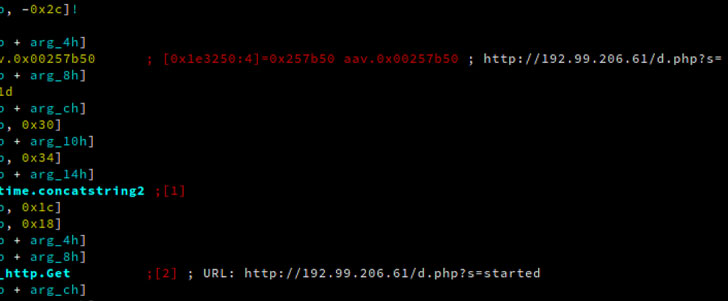
to its remote command-and-control server, protected behind the Tor
network, using a SOCKS5 Tor proxy to notify attackers about new
victims.
“Based on the analysis it is clear that the proxy has been set
up by the malware author to provide Tor network access to the
malware without including Tor functionality in the malware,” the
Anomali researchers say.
Before encrypting files, the ransomware requests a unique
bitcoin wallet address, where victims are supposed to transfer the
ransom amount, from the attacker’s C&C server that contains a
predefined list of already created bitcoin addresses.
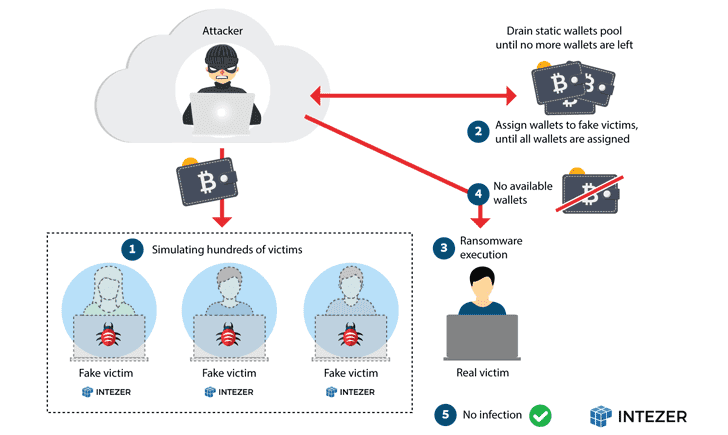
ransomware doesn’t proceed to encrypt files and wait for attackers
to create and provide a new address.
Interestingly, researchers at Intezer took advantage of this
mechanism and created a script that allowed them to trick the
attacker’s C&C server into assigning all available bitcoin
addresses to hundreds of virtual victims, thereby blocking the
ransomware from encrypting files for new legitimate
victims.
“Since the authors behind this ransomware were delivering one
Bitcoin wallet per victim from a static pool of already generated
wallets, we could replicate the infection packets to retrieve all
of the wallets until they had no further wallets under their
control,” Intezer said.
“We were able to collect a total of 1,091 unique wallets meant
to be delivered to new victims distributed among 15 different
campaigns.”
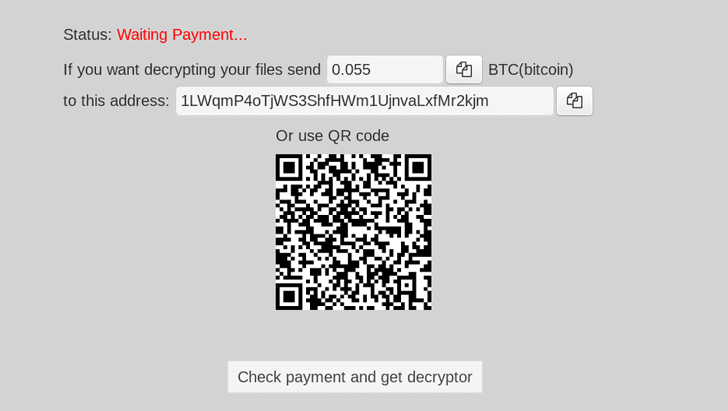
If the ransomware gets its unique bitcoin wallet, it generates a
32-character random string to create an AES-256 secret key and then
uses it to encrypt all the files stored on targeted NAS device with
AES algorithm in Cipher Feedback Mode (CFB), removing the original
files.
the secret key, Anomali said it’s likely possible for researchers
to write a decryptor for the new ransomware family because the
function is not entirely random.
“Malware initializes the math random page with the seed of the
current time. Since it is using the math’s package to generate the
secret key, it is not cryptographically random, and it is likely
possible to write a decryptor,” the Anomali researchers
said.
“The threat actor targets QNAP NAS devices that are used for file
storage and backups. It is not common for these devices to run
antivirus products, and currently, the samples are only detected by
2-3 products on VirusTotal, which allows the ransomware to run
uninhibited.”
Researchers also noted that before encrypting files stored on
targeted NAS devices, the ransomware also attempts to kill a
specific list of processes, including apache2, httpd, nginx, MySQL,
mysql, and PostgreSQL.
As a reminder, we urge users not to, unknowingly or
unnecessarily, connect their NAS devices directly to the Internet,
and also enable automatic updates to keep firmware up-to-date.
Moreover, users are always recommended to use strong passwords
to secure their NAS devices in the first place and regularly backup
stored information on these devices, so that in case of any
disaster, the important data can be recovered without paying ransom
to attackers.
Read more http://feedproxy.google.com/~r/TheHackersNews/~3/5siQ1PRrOfE/ransomware-nas-devices.html