
A new advanced persistent threat (APT) has been behind a string
of attacks against hotels across the world, along with governments,
international organizations, engineering companies, and law
firms.
Slovak cybersecurity firm ESET codenamed the cyber espionage
group FamousSparrow[1], which it said has been
active since at least August 2019, with victims located across
Africa, Asia, Europe, the Middle East, and the Americas, spanning
several countries such as Burkina Faso, Taiwan, France, Lithuania,
the U.K., Israel, Saudi Arabia, Brazil, Canada, and Guatemala.
Attacks mounted by the group involve exploiting known
vulnerabilities in server applications such as SharePoint and
Oracle Opera, in addition to the ProxyLogon[2]
remote code execution vulnerability in Microsoft Exchange Server
that came to light in March 2021, making it the latest threat actor[3]
to have had access to the exploit before details of the flaw became
public.
According to ESET, intrusion exploiting the flaws commenced on
March 3, resulting in the deployment of several malicious
artifacts, including two bespoke versions of Mimikatz credential
stealer, a NetBIOS scanner named Nbtscan[4], and a loader for a
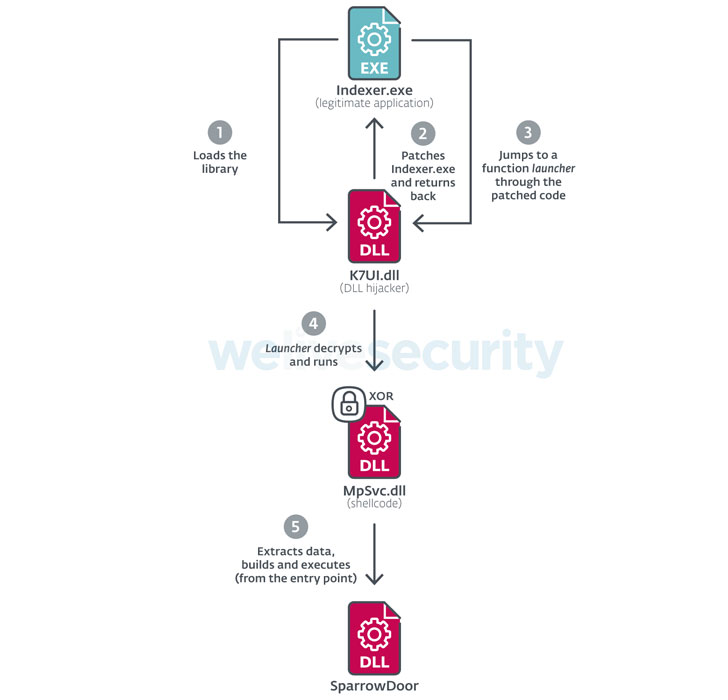
custom implant dubbed SparrowDoor.
Installed by leveraging a technique called DLL search order hijacking[5], SparrowDoor functions
as a utility to burrow into new corners of the target’s internal
network that hackers also gained access to execute arbitrary
commands as well as amass and exfiltrate sensitive information to a
remote command-and-control (C2) server under their control.
While ESET didn’t attribute the FamousSparrow group to a
specific country, it did find similarities between its techniques
and those of SparklingGoblin[6], an offshoot of the
China-linked Winnti Group, and DRBControl[7], which also overlaps
with malware previously identified with Winnti and Emissary Panda
campaigns.
“This is another reminder that it is critical to patch
internet-facing applications quickly, or, if quick patching is not
possible, to not expose them to the internet at all,” ESET
researchers Tahseen Bin Taj and Matthieu Faou said.
References
- ^
FamousSparrow
(www.welivesecurity.com) - ^
ProxyLogon
(thehackernews.com) - ^
latest
threat actor (thehackernews.com) - ^
Nbtscan
(www.unixwiz.net) - ^
DLL
search order hijacking (attack.mitre.org) - ^
SparklingGoblin
(thehackernews.com) - ^
DRBControl
(www.trendmicro.com)