What To Look For In A Penetration Testing Statement Of Work?
A Statement of Work or “SOW” is a key document for your penetration testing project. If you are at the stage of executing an SOW, it should mean that you have completed your vetting process and will be locking in your penetration testing vendor. Today, we discuss some of the key elements that you should look for in a penetration testing SOW to ensure you, as the purchaser, are protected and know what you are getting.
Key Items to Look For in a Penetration Testing Statement of Work:
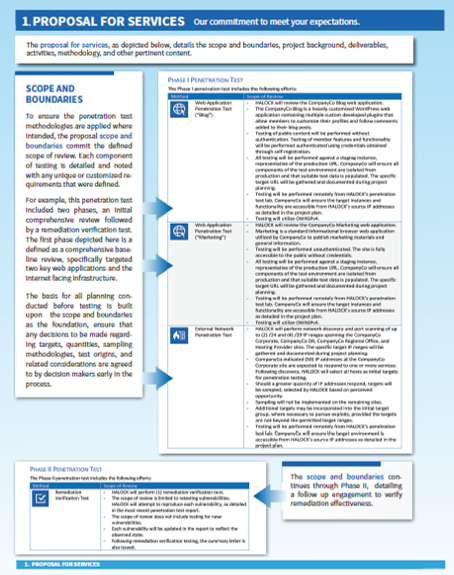
- Scope – Ensure that the scope of the proposed project has been captured accurately, including key information such as the number of IP addresses, testing restrictions (time windows), key delivery dates, any travel requirements, etc. All of these items will usually factor into the price so as the buyer, you want to be sure that the firm correctly scoped the project so that you’re not paying too much and they’re planning to assess your entire scope.
- Deliverables – At the end of the day, the key output of any penetration testing project are the final reports. Be sure that the SOW clearly articulates exactly what documents you will receive. At a minimum, this should generally include an executive summary and a technical findings report.
- Price – This goes without saying, but the SOW should have a fixed price for the requested assessment services most of the time. Be sure to cross reference the penetration testing proposal or quote to ensure that the price in the SOW is the price that you originally saw in the proposal. The SOW is a legal document and therefore will supersede any prior documentation.
- Completion Date – Odds are that you have a key date that you are tracking on for your penetration testing project to be completed. Even if there is no specific date, it is best practice to ensure that some end date is indicated to ensure that you can hold your penetration testing vendor accountable to complete the project on time.
- Location of Work – In the event that work will need to be at a specific location, be sure that it is explicitly called out within the Statement of Work. The last thing you want is to get half way through the penetration test and get into a disagreement on where you pentester should be, whether that be a specific onsite location or remote.
- Payment Schedule – The project payment schedule should not be overlooked. Every firm is different and we have seen 100% upfront, 50% upfront and 50% after project completion, 100% following project completion, and just about any other variation you can imagine. Make sure you’re aware of the required schedule and you’ve got business buy-in, as delays in payment could delay project execution or report delivery.
All companies are different and the Statement of Work may vary, however, in our experience, the aforementioned items should always be included. Penetration testing project documents can often times have legalese that may be confusing and may require review by a legal team to ensure you understand what you are executing. Have any questions on a penetration testing Statement of Work?
Penetration Testing Checklist
Here’s a checklist of what we might look for:
Logging and Monitoring
Does the application track users properly? Are systems actively checked?
Broken Authentication
Is there proper authentication? Do authorization controls apply to users’ actions?
Sensitive Data Exposure
Does the application disclose confidential information? Is the environment providing information that could aid an attacker?
Input Validation
Are user inputs validated and sanitized? Does the application behave independently of input?
Output Encoding
Does the application enforce output Encoding? Is there consistent interpretation of the output?
Filtering Layers
Are there filtering mechanisms? Do they proactively defend against common web application attacks?
SSL Encryption Analysis
Does the web server support the security levels of the encryption ciphers? Are certificates supported on both the server-side and client-side?
Parameter Passing
Is parameter handling secure? Could the application mishandle authorization information? Could server-side information mistakenly be sent to the user?
Application Logic Flow
Does the application enforce logic flow? Could an attacker control the application flow at will?
Cross-Site Scripting
Are there cross-site scripting vulnerabilities? Is there proper encoding of user-supplied input?
Injections
Does user input construct database queries? Can an attacker craft an input to control queries beyond the programmer’s intent?
Path Traversals
Do user inputs construct file paths? Can an attacker craft an input to escape the directory structure of the application?
XML External Entities
Is it possible to inject XML tags or modify the XPath query?
Certificate Testing
Are the application’s certificates current, issued by a trusted authority, in the correct domain name, etc?
Integer Underflow/Overflow
Are there instances that result in values above or below the allowable integer value?
Buffer Overflow
Does the application perform proper bounds checking?
Known Vulnerable Components
Are server-side and client-side components current and secure?
Should You Vet Penetration Testing Companies Via References?
We often get asked for references for our work. As you would expect, if you are hiring someone to hack your company or determine where your security vulnerabilities lie, you want to make sure they can be trusted. As part of the screening process, we highly recommend that you vet penetration testing partners via professional references for the specific type of work that you are looking to have completed. Below, we detail how we recommend you approach the reference process.
Reference Vetting Process:
Request References – The first step in the vetting process is to ask for references if they have not been provided yet. In the event a company is not willing to provide any references, this should raise a red flag. With that being said, keep in mind that some organizations are very wary about disclosing who their penetration testing firm is, and many don’t want their name to be used at all, much less as a professional reference for other organizations. This can limit the options of references for penetration testing firms.
Ensure References are Applicable – Where possible, request that at least one of the references provided have had a similar project performed to what you are looking to complete. A Best Practice Gap Analysis is completely different assessment than an External Penetration Test, each requiring a completely different set of skills. Overall, references should be used to confirm quality of work, professionalism, communication, responsiveness, etc. regardless of specific task, but it always helps to compare apples to apples.
Engage References – Ask for a general overview or prepare a more specific list of questions that you would like to get addressed. Email is often the easiest method of communication for initial contact so you don’t have to worry about playing phone tag, but you can always request a follow-up call to ensure clear lines of communication. Below is a sample of possible questions:
How responsive were they throughout the process?
Were they professional throughout the engagement?
Do you feel that you received value for the price that you paid?
Did they meet the deadlines laid out at the beginning of the project?
Did they try to sell you unnecessary products?
Do you feel the engineers were qualified to conduct the testing you hired them for?
How was the technical writing in the final reports? How was the final presentation?
Would you hire that firm again? Would you recommend that firm?
Odds are that you are looking to spend at least a few thousand dollars for a security assessment, so you want to ensure you have conducted your due diligence. At the end of the day, taking 5-10 minutes for a few simple phone calls to properly vet your penetration testing firm can save you from hours of headache down the road if you wind up with a bad fit. The vetting process can pay dividends in the quality of work that you ultimately receive at the end of the project, maybe driving you to pay a little extra for a better fit or help you narrow down a close competition between firms.