
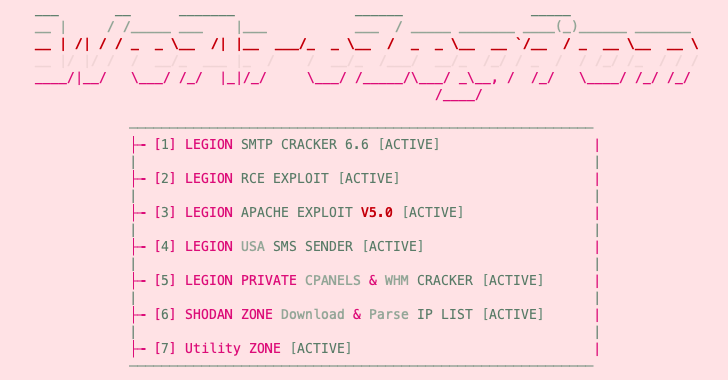
An emerging Python-based credential harvester and a hacking tool
named Legion is being marketed via Telegram as a way for
threat actors to break into various online services for further
exploitation.
Legion, according to Cado Labs[1], includes modules to
enumerate vulnerable SMTP servers, conduct remote code execution
(RCE) attacks, exploit unpatched versions of Apache, and
brute-force cPanel and WebHost Manager (WHM) accounts.
The malware is suspected to be linked to another malware family
called AndroxGh0st that was first documented[2]
by cloud security services providerLacework in December 2022.
Cybersecurity firm SentinelOne, in an analysis[3]
published late last month, revealed that AndroxGh0st is part of a
comprehensive toolset called AlienFox that’s offered to threat
actors to steal API keys and secrets from cloud services.
“Legion appears to be part of an emerging generation of
cloud-focused credential harvester/spam utilities,” security
researcher Matt Muir told The Hacker News. “Developers of these
tools often steal each other’s code, making attribution to a
particular group difficult.”
Besides using Telegram as a data exfiltration point, Legion is
designed to exploit web servers running content management systems
(CMS), PHP, or PHP-based frameworks like Laravel.
“It can retrieve credentials for a wide range of web services,
such as email providers, cloud service providers, server management
systems, databases, and payment platforms like Stripe and PayPal,”
Cado Labs said.
Some of the other targeted services include SendGrid, Twilio,
Nexmo, AWS, Mailgun, Plivo, ClickSend, Mandrill, Mailjet,
MessageBird, Vonage, Exotel, OneSignal, Clickatell, and TokBox.
The primary goal of the malware is to enable threat actors to
hijack the services and weaponize the infrastructure for follow-on
attacks, including mounting opportunistic phishing campaigns.
The primary goal of the malware is to enable threat actors to
hijack the services and weaponize the infrastructure for follow-on
attacks, including mounting mass spam and opportunistic phishing
campaigns.
The cybersecurity firm said it also discovered a YouTube channel
containing tutorial videos on how to use Legion, suggesting that
the “tool is widely distributed and is likely paid malware.” The
YouTube channel, which was created on June 15, 2021, remains active
as of writing.
Furthermore, Legion retrieves AWS credentials from insecure or
misconfigured web servers and deliver SMS spam messages to users of
U.S. mobile networks such as AT&T, Sprint, T-Mobile, Verizon,
and Virgin.
UPCOMING WEBINAR
Master the Art of Dark Web Intelligence Gathering
Learn the art of extracting threat intelligence from the dark
web – Join this expert-led webinar!
“To do this, the malware retrieves the area code for a U.S.
state of the user’s choosing from the website
www.randomphonenumbers.com,” security researcher Matt Muir said. “A
rudimentary number generator function is then used to build up a
list of phone numbers to target.”
Furthermore, Legion can retrieve AWS credentials from insecure
or misconfigured web servers and deliver SMS spam messages to users
of U.S. mobile networks such as AT&T, Sprint, T-Mobile,
Verizon, and Virgin by leveraging the stolen SMTP credentials.
“To do this, the malware retrieves the area code for a U.S.
state of the user’s choosing from the website
www.randomphonenumbers[.]com,” Muir said. “A rudimentary number
generator function is then used to build up a list of phone numbers
to target.”
Another notable aspect of Legion is its ability to exploit
well-known PHP vulnerabilities to register a web shell for
persistent remote access or execute malicious code.
The origins of the threat actor behind the tool, who goes by the
alias “forzatools” on Telegram, remain unknown, although the
presence of Indonesian-language comments in the source code
indicates that the developer may be Indonesian or based in the
country.
“Since this malware relies heavily on misconfigurations in web
server technologies and frameworks such as Laravel, it’s
recommended that users of these technologies review their existing
security processes and ensure that secrets are appropriately
stored,” Muir said.
Found this article interesting? Follow us on Twitter [5]
and LinkedIn[6]
to read more exclusive content we post.
References
Read more https://thehackernews.com/2023/04/new-python-based-legion-hacking-tool.html