Apr 08, 2023Ravie Lakshmanan

The Iranian nation-state group known as
MuddyWater has been observed carrying out
destructive attacks on hybrid environments under the guise of a
ransomware operation.
That’s according to new findings from the Microsoft Threat
Intelligence team, which discovered the threat actor targeting both
on-premises and cloud infrastructures in partnership with another
emerging activity cluster dubbed DEV-1084.
“While the threat actors attempted to masquerade the activity as
a standard ransomware campaign, the unrecoverable actions show
destruction and disruption were the ultimate goals of the
operation,” the tech giant revealed[1]
Friday.
MuddyWater[2]
is the name assigned to an Iran-based actor[3]
that the U.S. government has publicly connected to the country’s
Ministry of Intelligence and Security (MOIS). It’s been known to be
active since at least 2017.
It’s also tracked by the cybersecurity community under various
names, including Boggy Serpens, Cobalt Ulster, Earth Vetala, ITG17,
Mercury, Seedworm, Static Kitten, TEMP.Zagros, and Yellow Nix.
Attacks mounted by the group have primarily singled out Middle
Eastern nations, with intrusions observed over the past year
leveraging the Log4Shell flaw[4] to breach Israeli
entities.
The latest findings from Microsoft reveal the threat actor
probably worked together with DEV-1084 to pull off the attack, the
latter of which conducted the destructive actions after MuddyWater
successfully gained a foothold onto the target environment.
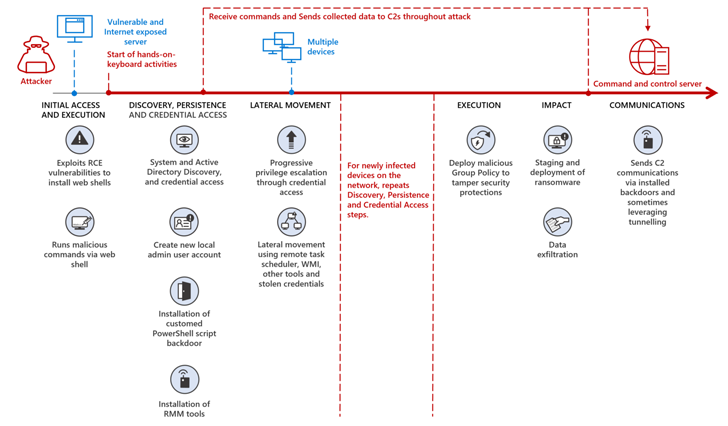
“Mercury likely exploited known vulnerabilities in unpatched
applications for initial access before handing off access to
DEV-1084 to perform extensive reconnaissance and discovery,
establish persistence, and move laterally throughout the network,
oftentimes waiting weeks and sometimes months before progressing to
the next stage,” Microsoft said.
In the activity detected by Redmond, DEV-1084 subsequently
abused highly privileged compromised credentials to perform
encryption of on-premise devices and large-scale deletion of cloud
resources, including server farms, virtual machines, storage
accounts, and virtual networks.
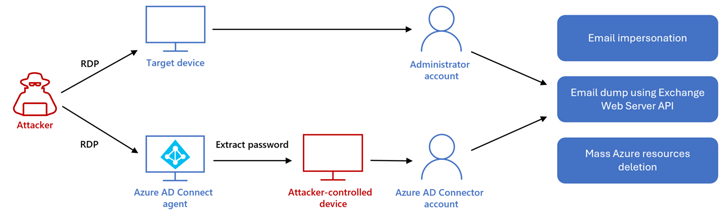
Furthermore, the threat actors gained full access to email
inboxes through Exchange Web Services, using it to perform
“thousands of search activities” and impersonate an unnamed
high-ranking employee to send messages to both internal and
external recipients.
All these actions are actions are estimated to have transpired
over a roughly three-hour timeframe starting at 12:38 a.m. (when
the attacker logged into the Microsoft Azure environment via
compromised credentials) and ending at 3:21 a.m. (when the attacker
sent emails to other parties after the successful cloud
disruption).
It’s worth noting here that DEV-1084 refers to the same threat actor[5]
that assumed[6]
the “DarkBit” persona as part of a ransomware and extortion attack
aimed at Technion, a leading research university in Israel, in
February. The Israel National Cyber Directorate, last month,
attributed[7]
the attack to MuddyWater.
UPCOMING WEBINAR
Learn to Secure the Identity Perimeter – Proven Strategies
Improve your business security with our upcoming expert-led
cybersecurity webinar: Explore Identity Perimeter strategies!
Don’t Miss Out – Save Your Seat![8]
“DEV-1084 […] presented itself as a criminal actor interested
in extortion, likely as an attempt to obfuscate Iran’s link to and
strategic motivation for the attack,” Microsoft added.
The links between Mercury and DEV-1084 originate from
infrastructure, IP address, and tooling overlaps, with the latter
observed using a reverse tunneling utility called Ligolo[9], a staple MuddyWater artifact[10].
That said, there is not ample evidence to determine if DEV-1084
operates independently of MuddyWater and collaborates with other
Iranian actors, or if it’s a sub-team that’s only summoned when
there is a need to conduct a destructive attack.
Cisco Talos, early last year, described[11] MuddyWater as a
“conglomerate” comprising several smaller clusters rather than a
single, cohesive group. The emergence of DEV-1084 suggests a nod in
this direction.
“While these teams seem to operate independently, they are all
motivated by the same factors that align with Iranian national
security objectives, including espionage, intellectual theft, and
destructive or disruptive operations based on the victims they
target,” Talos noted in March 2022.
Found this article interesting? Follow us on Twitter [12] and LinkedIn[13] to read more exclusive
content we post.
References
- ^
revealed
(www.microsoft.com) - ^
MuddyWater
(thehackernews.com) - ^
Iran-based actor
(thehackernews.com) - ^
leveraging the Log4Shell flaw
(thehackernews.com) - ^
same
threat actor (blogs.blackberry.com) - ^
assumed
(blog.cyble.com) - ^
attributed
(www.gov.il) - ^
Don’t
Miss Out – Save Your Seat! (thehacker.news) - ^
Ligolo
(github.com) - ^
MuddyWater artifact
(thehackernews.com) - ^
described
(thehackernews.com) - ^
Twitter
(twitter.com) - ^
LinkedIn
(www.linkedin.com)
Read more https://thehackernews.com/2023/04/iran-based-hackers-caught-carrying-out.html