Mar 18, 2023Ravie Lakshmanan

The zero-day exploitation of a now-patched medium-severity
security flaw in the Fortinet FortiOS[1]
operating system has been linked to a suspected Chinese hacking
group.
Threat intelligence firm Mandiant, which made the attribution,
said the activity cluster is part of a broader campaign designed to
deploy backdoors onto Fortinet and VMware solutions and maintain
persistent access to victim environments.
The Google-owned threat intelligence and incident response firm
is tracking the malicious operation under its uncategorized moniker
UNC3886, a China-nexus threat actor.
“UNC3886 is an advanced cyber espionage group with unique
capabilities in how they operate on-network as well as the tools
they utilize in their campaigns,” Mandiant researchers said[2]
in a technical analysis.
“UNC3886 has been observed targeting firewall and virtualization
technologies which lack EDR support. Their ability to manipulate
firewall firmware and exploit a zero-day indicates they have
curated a deeper-level of understanding of such technologies.”
It’s worth noting that the adversary was previously tied[3]
to another intrusion set targeting VMware ESXi and Linux vCenter
servers as part of a hyperjacking campaign designed to drop
backdoors such as VIRTUALPITA and VIRTUALPIE.
The latest disclosure from Mandiant comes as Fortinet revealed[4]
that government entities and large organizations were victimized by
an unidentified threat actor by leveraging a zero-day bug in
Fortinet FortiOS software to result in data loss and OS and file
corruption.
The vulnerability, tracked as CVE-2022-41328[5]
(CVSS score: 6.5), concerns a path traversal bug in FortiOS that
could lead to arbitrary code execution. It was patched by Fortinet
on March 7, 2023.
According to Mandiant, the attacks mounted by UNC3886 targeted
Fortinet’s FortiGate, FortiManager, and FortiAnalyzer appliances to
deploy two different implants such as THINCRUST and CASTLETAP.
This, in turn, was made possible owing to the fact that the
FortiManager device was exposed to the internet.
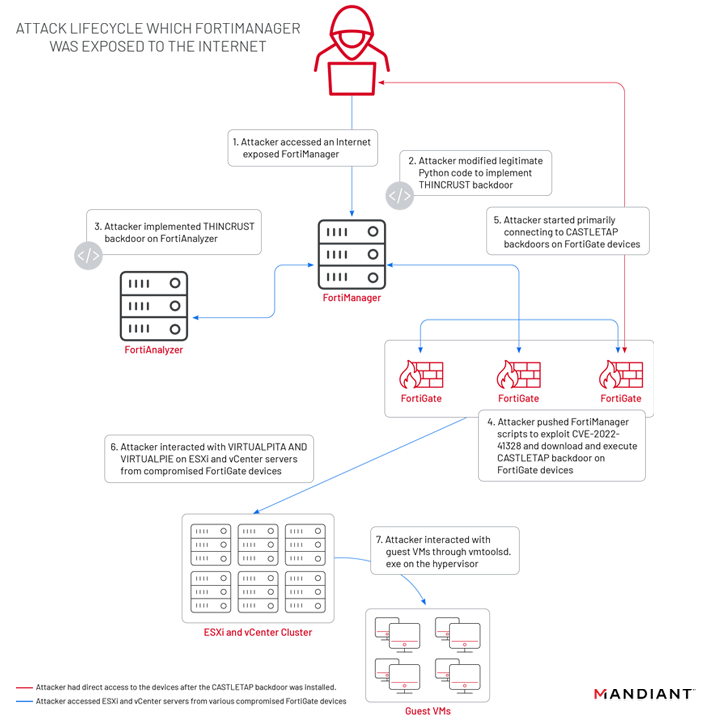
THINCRUST is a Python backdoor capable of executing arbitrary
commands as well as reading and writing from and to files on
disk.
The persistence afforded by THINCRUST is subsequently leveraged
to deliver FortiManager scripts that weaponize the FortiOS path
traversal flaw to overwrite legitimate files and modify firmware
images.
This includes a newly added payload called “/bin/fgfm” (referred
to as CASTLETAP) that beacons out to an actor-controlled server so
as to accept incoming instructions that allow it to run commands,
fetch payloads, and exfiltrate data from the compromised host.
“Once CASTLETAP was deployed to the FortiGate firewalls, the
threat actor connected to ESXi and vCenter machines,” the
researchers explained. “The threat actor deployed VIRTUALPITA and
VIRTUALPIE to establish persistence, allowing for continued access
to the hypervisors and the guest machines.”
Alternatively, on FortiManager devices that implement internet
access restrictions, the threat actor is said to have pivoted from
a FortiGate firewall compromised with CASTLETAP to drop a reverse
shell backdoor named REPTILE (“/bin/klogd”) on the network
management system to regain access.
WEBINAR
Discover the Hidden Dangers of Third-Party SaaS Apps
Are you aware of the risks associated with third-party app
access to your company’s SaaS apps? Join our webinar to learn about
the types of permissions being granted and how to minimize
risk.
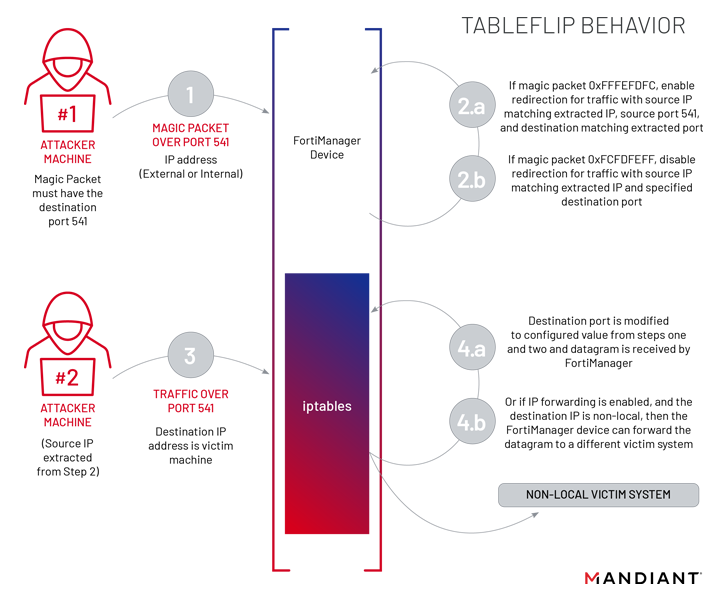
Also employed by UNC3886 at this stage is a utility dubbed
TABLEFLIP, a network traffic redirection software to connect
directly to the FortiManager device regardless of the
access-control list (ACL[7]) rules put in place.
This is far from the first time Chinese adversarial collectives
have targeted networking equipment to distribute bespoke malware,
with recent attacks taking advantage of other vulnerabilities in
Fortinet[8]
and SonicWall[9]
devices.
The revelation also comes as threat actors are developing and
deploying exploits faster than ever before, with as many as 28
vulnerabilities exploited within seven days of public disclosure —
a 12% rise over 2021 and an 87% rise over 2020, according to
Rapid7[10].
This is also significant, not least because China-aligned
hacking crews have become “particularly proficient[11]” at exploiting zero-day
vulnerabilities and deploying custom malware to steal user
credentials and maintain long-term access to target networks.
“The activity […] is further evidence that advanced cyber
espionage threat actors are taking advantage of any technology
available to persist and traverse a target environment, especially
those technologies that do not support EDR solutions,” Mandiant
said.
Found this article interesting? Follow us on Twitter [12] and LinkedIn[13] to read more exclusive
content we post.
References
- ^
FortiOS
(www.fortinet.com) - ^
said
(www.mandiant.com) - ^
previously tied
(thehackernews.com) - ^
revealed
(thehackernews.com) - ^
CVE-2022-41328
(nvd.nist.gov) - ^
RESERVE YOUR SEAT
(thn.news) - ^
ACL
(en.wikipedia.org) - ^
Fortinet
(thehackernews.com) - ^
SonicWall
(thehackernews.com) - ^
Rapid7
(www.rapid7.com) - ^
particularly proficient
(thehackernews.com) - ^
Twitter
(twitter.com) - ^
LinkedIn
(www.linkedin.com)
Read more https://thehackernews.com/2023/03/chinese-hackers-exploit-fortinet-zero.html