
In last year’s edition of the Security Navigator[1]
we noted that the Manufacturing Industry appeared to be totally
over-represented in our dataset of Cyber Extortion victims. Neither
the number of businesses nor their average revenue particularly
stood out to explain this.
Manufacturing was also the most represented Industry in our
CyberSOC dataset – contributing more Incidents than any other
sector.
We found this trend confirmed in 2023 – so much in fact that we
decided to take a closer look. So let’s examine some possible
explanations.
And debunk them.
Hunting for possible explanations
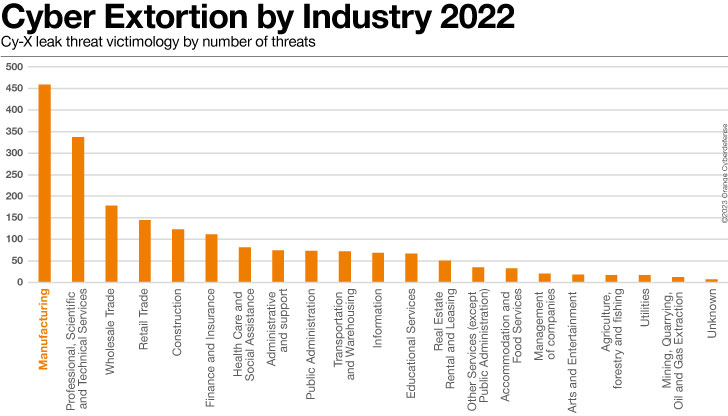
Manufacturing is still the most impacted industry in our Cyber
Extortion dataset in 2023, as tracked by monitoring
double-extortion leak sites. Indeed, this sector now represents
more than 20% of all victims since we started observing the leak
sites in the beginning of 2020.
Approximately 28% of all our clients are from Manufacturing,
contributing with an overall share of 31% of all potential
incidents we investigated.
We note that 58% of the Incidents this industry deals with are
internally caused, 32% were externally caused, 1% was classified as
“Partner” or 3rd parties. When external threat actors had caused
the security incident, we observed the top 3 threat actions were
Web Attacks, Port Scanning and Phishing.
On the other hand, Manufacturing has the lowest apparent number
of confirmed security vulnerabilities per IT Asset in our
Vulnerability scanning dataset. Our pentesting teams on the other
hand report 4.81 CVSS findings per day, which is quite a bit above
the average of 3.61 across all other industries.
Several questions present themselves, which we will
attempt to examine here:
- What part does Operation Technology play?
- Are businesses in Manufacturing more vulnerable?
- Is the Manufacturing sector being deliberately targeted
more? - Do our Manufacturing clients experience more incidents?
What part does OT play?
A tempting assumption to make is that businesses in the
Manufacturing sector are compromised more often via notoriously
insecure Operational Technology (OT) or Internet of Things (IoT)
systems. Plants and factories can often not afford to be disrupted
or shut down and that Manufacturing is therefore a soft target for
extortionists.
It sure sounds plausible. The catch is: we don’t see these
theories supported in our data.
The attack against US Energy giant Colonial Pipeline was
probably the most notable recent example of a successful attack
against an industrial facility.
Discover the latest in cybersecurity with comprehensive
“Security Navigator 2023[2]” report. This
research-driven report is based on 100% first-hand information from
17 global SOCs and 13 CyberSOCs of Orange Cyberdefense, the CERT,
Epidemiology Labs and World Watch and provides a wealth of valuable
information and insights into the current and future threat
landscape.
In July this year US intelligence agencies even warned of a
hacking toolset dubbed ‘Pipedream’ that is designed target specific
Industrial Control Systems. But it is not clear to us if or when
these tools have ever been encountered in the wild. Apart from the
infamous Stuxnet attack from 2010, one struggles to recall a single
cyber security incident where the entry point was an OT system.
At Colonial Pipeline the backend ‘conventional’ administrative
systems were compromised first. Looking more closely, this is the
case for almost all reported incidents at industrial
facilities.
Are businesses in the Manufacturing sector more
vulnerable to attacks?
To answer this questions we examined a set of 3 million
vulnerability scan findings, and a sample of 1,400 Ethical Hacking
reports.
We derived three metrics that facilitate somewhat normalized
comparisons across the industries in our client base:
VOC scanning findings per asset, time to patch, Pentest
findings per day of testing.
If we rank industries for their performance on each of those
metrics and sort from worst to best, then our clients in the
Manufacturing sector arrives in 5th place out of 12 comparable
industries.
The chart below shows the overall *ranking* of our Manufacturing
clients out of comparable industries.
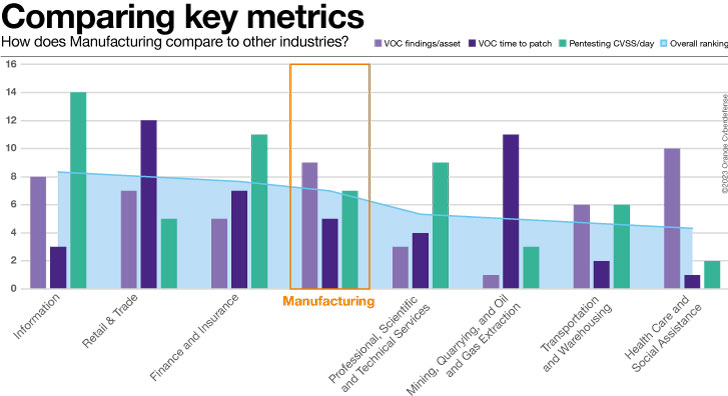
VOC unique findings/asset
On this metric there were seven other industries that performed
better than Manufacturing.
While we have a comparatively high number of assets from
Manufacturing clients in our scanning dataset, we report far fewer
Findings per Asset than the average across all industries. Almost
10 times fewer, in fact.
Time to patch
On this metric 6 other industries ranked better than
Manufacturing. The average age of all findings for this industry is
419 days, which is a concerning number and worse than recorded for
eight other industries in this dataset.
Pentesting findings
We observe that the average CVSS Per Day was 4.81, compared to
3.61 on average for clients in all other sectors in the dataset –
33% higher.
Is the Manufacturing sector being targeted more by
extortionists?
We use the North American Industry Classification System – NAICS
– classification system when categorizing our clients.
A consideration of double-extortion victim counts per industry
reveals a very interesting pattern: Of the 10 industries with the
most recorded victims in the dataset, 7 are also counted amongst
the biggest industries by entity count.
Manufacturing however, is a clear trend-breaker.
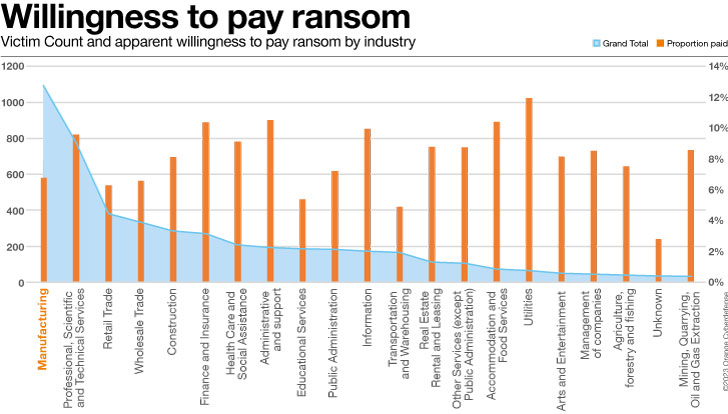
Another factor raises questions: if businesses in the
Manufacturing sector were more willing to pay ransom that would
make them more attractive as victims. But then we would expect to
see such businesses featuring on the ‘name and shame’ leak site
less often, not more.
Do our Manufacturing clients experience more
incidents?
The Manufacturing industry once again generated the highest
number of Incidents as a percentage of the total in our CyberSOC
dataset. 31% of all Incidents are generated for the 28% of our
clients that are from this sector.
The Incident data lacks context, however. To establish a
baseline for comparison, we assign customers a ‘Coverage Score’
between 0 and 5 in 8 different ‘domains’ of Threat Detection,
accounting for a maximum total detection score of 40.
We use the coverage score to normalize the incident count. Put
simply, the lower a client’s assessed coverage score is, the more
this adjustment will ‘boost’ the number of Incidents in this
comparison. The logic is that a low amount of coverage will just
not show us a lot of incidents, though they very likely occurr.
If we adjust the True Positive and False Positive Incidents as
described above, we still see more than seven times as many
Incidents per clients from Manufacturing than the average for all
industries.
In a similar comparison, limited only to Perimeter Security, and
only Medium Sized business, Manufacturing ranks 1st with the most
Incidents per Customer out of 7 comparable Industries.
Conclusion
We ruled out a massive impact of OT security vulnerabilities,
and therefore focus on regular IT systems. Our scanning teams
assessed a large number of targets but reported relatively few
vulnerabilities per asset. Overall, we rank the Manufacturing
sector as 5th or 6th weakest of all industries from a vulnerability
point of view.
The question of why we consistently record such a high
proportion of victims from the Manufacturing industry is not
readily answered with the data we have. We believe that in the end
it still comes down to the level of vulnerability, best reflected
in our Penetration Testing, and Findings Age data.
All of our data points to the fact that attackers are mostly
opportunistic. Rather than deliberately singling industries out,
they simply compromise businesses that are vulnerable.
The customers represented in our datasets have engaged with us
for Vulnerability Assessment or Managed Detection, and therefore
represent relatively ‘mature’ examples of that industry. We can
deduce that average businesses in this sector would benchmark worse
in terms of vulnerabilities. Whether the high number of victims we
observe on attacker leak-sites is a direct reflection of the high
number of overall victims in this sector, or the skewed reflection
of an industry that refuses to concede to initial ransom demands,
is not entirely clear.
What does appear likely, however, is that vulnerability is the
primary factor that determines which businesses get compromised and
extorted – in this sector as much as any other.
This is just an excerpt of the analysis. More details on how
different Industries performed in comparison to others, as well as
more CyberSOC, Pentesting and VOC data (along with plenty of other
interesting research topics) can be found in the Security Navigator[3]. It’s free of charge, so
have a look. It’s worth it!
Note: This article has been written and contributed by
Charl van der Walt, Head of Security Research at Orange
Cyberdefense.
Found this article interesting? Follow us on Twitter [4]
and LinkedIn[5]
to read more exclusive content we post.
References
- ^
Security
Navigator (www.orangecyberdefense.com) - ^
Security
Navigator 2023 (www.orangecyberdefense.com) - ^
Security
Navigator (www.orangecyberdefense.com) - ^
Twitter
(twitter.com) - ^
LinkedIn
(www.linkedin.com)
Read more https://thehackernews.com/2023/03/whats-wrong-with-manufacturing.html