Mar 13, 2023The Hacker News
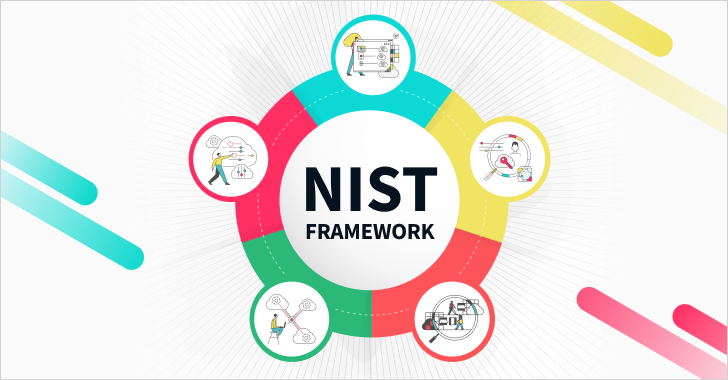
The National Institute of Standards and Technology (NIST) is one
of the standard-bearers in global cybersecurity. The U.S.-based
institute’s cybersecurity framework helps organizations of all
sizes understand, manage, and reduce their cyber-risk levels and
better protect their data. Its importance in the fight against
cyberattacks can’t be overstated.
While NIST hasn’t directly developed standards related to
securing the SaaS ecosystem, they are instrumental in the way we
approach SaaS security.
NIST recently released its Guide to a Secure Enterprise Network
Landscape[1]. In it, they discuss the
transformation from on-premise networks to multiple cloud servers.
Access to these servers, and the accompanying SaaS apps, is through
both secure and unsecured devices and locations across disparate
geography.
The move to the cloud has effectively obliterated the network
perimeter. As a result, companies have increased their attack
surface and are experiencing an escalation of attacks that span
across network boundaries.
Rather than focus on network-centric security, security must
take a three-pronged approach. The user, endpoint, and application
are keys to protecting data. This new paradigm emphasizes the
importance of identity, location, and contextual data associated
with the user, device, and service.
Learn how Adaptive Shield can help enforce
NIST compliance.[2]
The Tools to Meet Today’s Challenges
Today’s security tools need to scale to meet the volume,
velocity, and variety of today’s applications. They need to
integrate seamlessly with SaaS applications and provide coverage
for the entire SaaS stack.
To be effective, these tools need to minimize human intervention
for monitoring and remediation. Automation is critical for an
ecosystem that demands secure configurations for each user account
that has access to the application. Large organizations may have
millions of configurations to secure across their entire SaaS
stack; closing them manually is an impossible task.
SaaS Monitoring
SaaS security tools must be able to integrate with all the apps
on the stack and identify each application through the SaaS app’s
APIs. Once connected, it must monitor the security configurations,
staying alert to any changes. This configuration drift can have
severe consequences, as it exposes SaaS applications by removing
the safeguards put in place to prevent unauthorized access. It
needs to continuously monitor applications, and issue alerts as
risk increases.
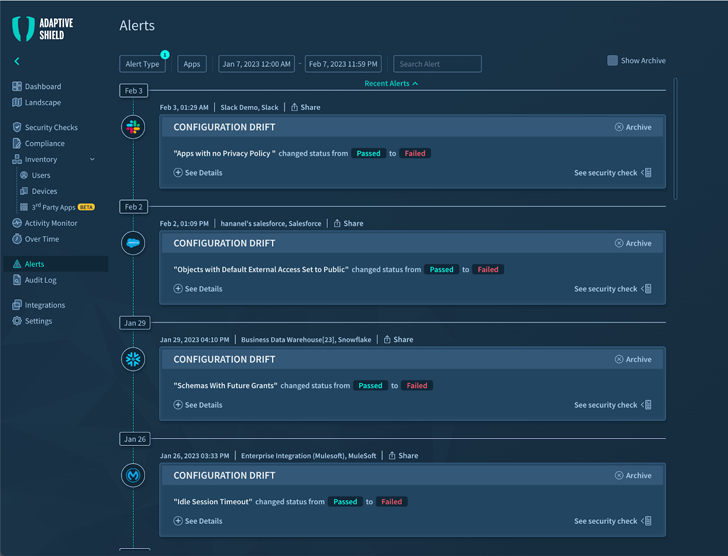 |
| Figure 1. SaaS Monitoring in Adaptive Shield Platform |
Contextual Data
Effective SaaS security tools use contextual data to detect
threats to the application and its data. These threats can come
from humans and machines and may have access to the system using
verified credentials.
Contextual data from across the SaaS stack can help identify
paradoxical travel, spikes in failed authentication attempts from
the same IP address for multiple accounts, or attempts where
automated tools test weak and common passwords against known user
names. It can also recognize malicious third-party applications
that are significantly overprivileged for their functionality.
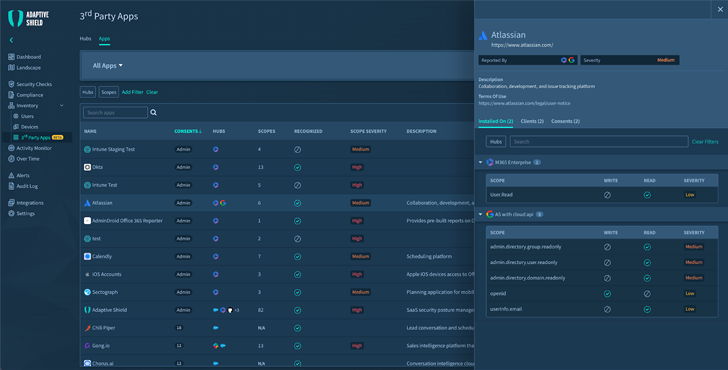 |
| Figure 2. Contextual Data as Seen in Adaptive Shield |
Get a demo of how Adaptive Shield can help
secure your SaaS stack[3]
Device Management
In the world of SaaS, the devices represent the network
perimeter. Accessing SaaS applications with devices that have poor
hygiene can put all the data at risk. Compromised devices can hand
over login credentials to threat actors, who can leverage that into
breaching and stealing data.
Effective SaaS security tools partner with endpoint security
providers to ensure that the devices that access SaaS apps have an
up-to-date operating system, all software has been updated, and any
patches have been applied.
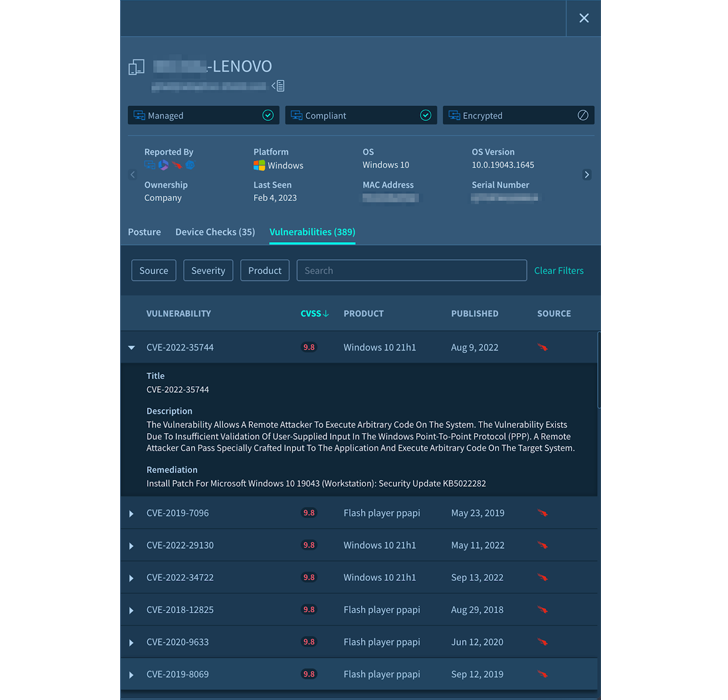 |
| Figure 3. Device Management in Adaptive Shield Platform |
User Authentication
While devices may be the perimeter, user ID is the barrier
preventing unfettered access to company data. Access should be
given using a zero-trust approach. All access should be granted
through an SSO connected to an enterprise-managed IdP.
Organizations should reinforce this entryway with a
phishing-resistant MFA authenticator.
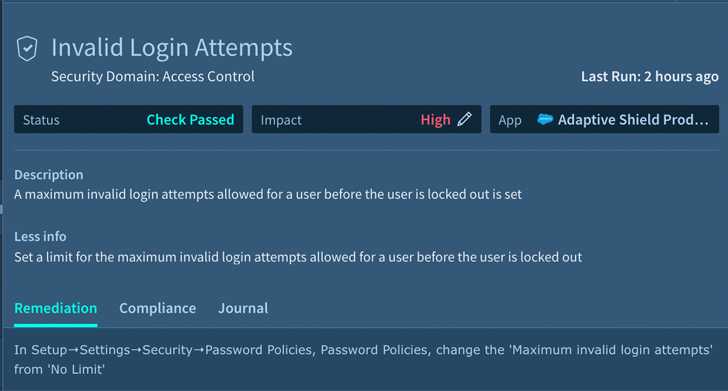 |
| Figure 4. Invalid Login Attempts Alert |
Meeting NIST Standards
Effective SSPM platforms are built on robust security checks
that review each SaaS configuration to ensure they are optimized
for protection. Typically, security setting recommendations are
influenced heavily by NIST’s cybersecurity approach, and their
guidance enables SSPM vendors to monitor and track usage, users,
and behaviors, as well as identify threats.
See how Adaptive Shield’s SSPM could protect
your SaaS stack[4]
Found this article interesting? Follow us on Twitter [5]
and LinkedIn[6]
to read more exclusive content we post.
References
- ^
Guide to
a Secure Enterprise Network Landscape
(nvlpubs.nist.gov) - ^
Learn
how Adaptive Shield can help enforce NIST compliance.
(www.adaptive-shield.com) - ^
Get a
demo of how Adaptive Shield can help secure your SaaS stack
(www.adaptive-shield.com) - ^
See how
Adaptive Shield’s SSPM could protect your SaaS stack
(www.adaptive-shield.com) - ^
Twitter
(twitter.com) - ^
LinkedIn
(www.linkedin.com)
Read more https://thehackernews.com/2023/03/how-to-apply-nist-principles-to-saas-in.html