Feb 23, 2023Ravie Lakshmanan

A new backdoor associated with a malware downloader named
Wslink has been discovered, with the tool likely
used by the notorious North Korea-aligned Lazarus Group, new
findings reveal.
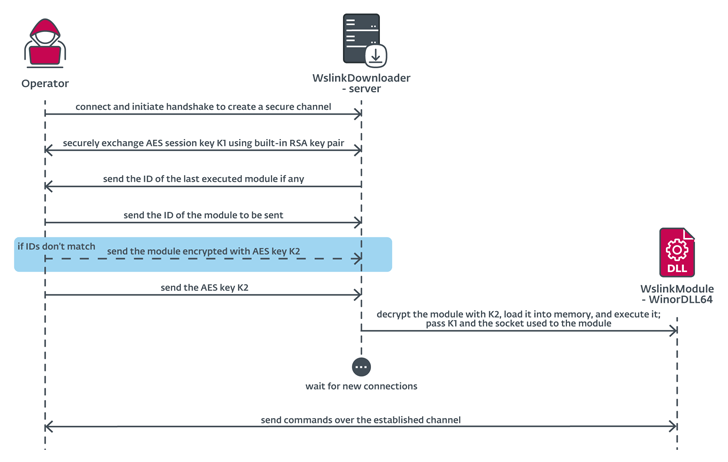
The payload, dubbed WinorDLL64 by ESET, is a
fully-featured implant that can exfiltrate, overwrite, and delete
files; execute PowerShell commands; and obtain comprehensive
information about the underlying machine.
Its other features comprise listing active sessions, creating
and terminating processes, enumerating drives, and compressing
directories.
Wslink was first documented[1]
by the Slovak cybersecurity firm in October 2021, describing it as
a “simple yet remarkable” malware loader that’s capable of
executing received modules in memory.
“The Wslink payload can be leveraged later for lateral movement,
due to its specific interest in network sessions,” ESET researcher
Vladislav Hrčka said[2]. “The Wslink loader
listens on a port specified in the configuration and can serve
additional connecting clients, and even load various payloads.”
Intrusions leveraging the malware are said to be highly targeted
owing to the fact that only a handful of detections have been
observed to date in Central Europe, North America, and the Middle
East.
In March 2022, ESET elaborated[3]
on the malware’s use of an “advanced multi-layered virtual machine”
obfuscator[4]
to evade detection and resist reverse engineering.
The links to Lazarus Group stem from overlaps in behavior and
code to that of previous campaigns – Operation GhostSecret[5]
and Bankshot[6]
– which have been attributed to the advanced persistent threat.
This includes similarities with the GhostSecret samples detailed
by McAfee in 2018, which come with a “data-gathering and
implant-installation component” that runs as a service, mirroring
the same behavior of Wslink.
ESET said the payload[7]
was uploaded to the VirusTotal malware database from South Korea,
where some of the victims are located, adding credence to the
Lazarus involvement.
The findings are once again demonstrative of the vast[8]
arsenal[9]
of hacking tools[10] employed by the Lazarus
Group to infiltrate its targets.
“Wslink’s payload is dedicated to providing means for file
manipulation, execution of further code, and obtaining extensive
information about the underlying system that possibly can be
leveraged later for lateral movement,” ESET said.
Found this article interesting? Follow us on Twitter [11] and LinkedIn[12] to read more exclusive
content we post.
References
- ^
first
documented (thehackernews.com) - ^
said
(www.welivesecurity.com) - ^
elaborated
(thehackernews.com) - ^
obfuscator
(github.com) - ^
Operation GhostSecret
(www.mcafee.com) - ^
Bankshot
(www.mcafee.com) - ^
payload
(www.virustotal.com) - ^
vast
(thehackernews.com) - ^
arsenal
(thehackernews.com) - ^
hacking tools
(thehackernews.com) - ^
Twitter
(twitter.com) - ^
LinkedIn
(www.linkedin.com)
Read more https://thehackernews.com/2023/02/lazarus-group-using-new-winordll64.html