Feb 11, 2023Ravie Lakshmanan

After the U.S. Cybersecurity and Infrastructure Security Agency
(CISA) released a decryptor for affected victims to recover from
ESXiArgs ransomware attacks[1], the threat actors have
bounced back with an updated version that encrypts more data.
The emergence of the new variant was reported[2]
by a system administrator on an online forum, where another
participant stated that files larger than 128MB will have 50% of
their data encrypted, making the recovery process more
challenging.
Another notable change is the removal of the Bitcoin address
from the ransom note, with the attackers now urging victims to
contact them on Tox to obtain the wallet information.
The threat actors “realized that researchers were tracking their
payments, and they may have even known before they released the
ransomware that the encryption process in the original variant was
relatively easy to circumvent,” Censys said[3]
in a write-up.
“In other words: they are watching.”
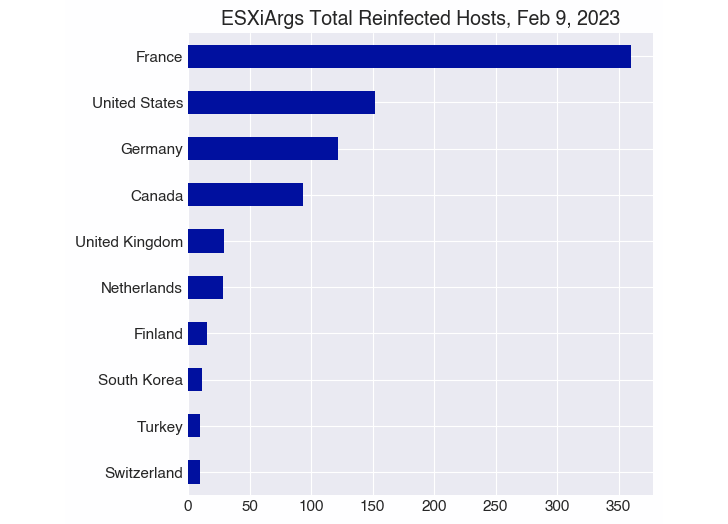
Statistics shared by the crowdsourced platform Ransomwhere
reveal[4]
that as many as 1,252 servers have been infected by the new version
of ESXiArgs as of February 9, 2023, of which 1,168 are
reinfections.
Since the start of the ransomware outbreak in early February,
over 3,800 unique hosts have been compromised. A majority[5]
of the infections are located in France, the U.S., Germany, Canada,
the U.K., the Netherlands, Finland, Turkey, Poland, and Taiwan.
ESXiArgs, like Cheerscrypt[6]
and PrideLocker[7], is based on the Babuk
locker, which had its source code leaked[8]
in September 2021[9]. But a crucial aspect
that differentiates it from other ransomware families is the
absence of a data leak site, indicating that it’s not running on a
ransomware-as-a-service[10] (RaaS[11]) model.
“Ransoms are set at just over two bitcoins (US $47,000), and
victims are given three days to pay,” cybersecurity company
Intel471 said[12].
While it was initially suspected that the intrusions involved
the abuse of a two-year-old, now-patched OpenSLP bug in VMware ESXi
(CVE-2021-21974), compromises have been reported in devices that
have the network discovery protocol disabled.
VMware has since said[13] that it has found no
evidence to suggest that a zero-day vulnerability in its software
is being used to propagate the ransomware.
This indicates that the threat actors behind the activity may be
leveraging several known vulnerabilities[14] in ESXi to their
advantage, making it imperative that users move quickly to update
to the latest version. The attacks have yet to be attributed to a
known threat actor or group.

“Based on the ransom note, the campaign is linked to a sole
threat actor or group,” Arctic Wolf pointed out[15]. “More established
ransomware groups typically conduct OSINT on potential victims
before conducting an intrusion and set the ransom payment based on
perceived value.”
Cybersecurity company Rapid7 said[16] it found 18,581
internet-facing ESXi servers that are vulnerable to CVE-2021-21974,
adding it further observed RansomExx2[17] actors
opportunistically targeting susceptible ESXi servers.
“While the dollar impact of this particular breach may seem low,
cyber attackers continue to plague organizations via death by a
thousand cuts,” Tony Lauro, director of security technology and
strategy at Akamai, said.
“The ESXiArgs ransomware is a prime example of why system
administrators need to implement patches quickly after they are
released, as well as the lengths that attackers will go to in order
to make their attacks successful. However, patching is just one
line of defense to rely on.”
Found this article interesting? Follow us on Twitter [18] and LinkedIn[19] to read more exclusive
content we post.
References
- ^
ESXiArgs
ransomware attacks (thehackernews.com) - ^
reported
(www.bleepingcomputer.com) - ^
said
(censys.io) - ^
reveal
(twitter.com) - ^
majority
(www.reuters.com) - ^
Cheerscrypt
(thehackernews.com) - ^
PrideLocker
(www.synacktiv.com) - ^
source
code leaked (heimdalsecurity.com) - ^
September 2021
(blog.morphisec.com) - ^
ransomware-as-a-service
(www.trendmicro.com) - ^
RaaS
(www.cloudflare.com) - ^
said
(intel471.com) - ^
said
(thehackernews.com) - ^
several known vulnerabilities
(www.greynoise.io) - ^
pointed out
(arcticwolf.com) - ^
said
(www.rapid7.com) - ^
RansomExx2
(thehackernews.com) - ^
Twitter
(twitter.com) - ^
LinkedIn
(www.linkedin.com)
Read more https://thehackernews.com/2023/02/new-esxiargs-ransomware-variant-emerges.html