Feb 07, 2023Ravie Lakshmanan
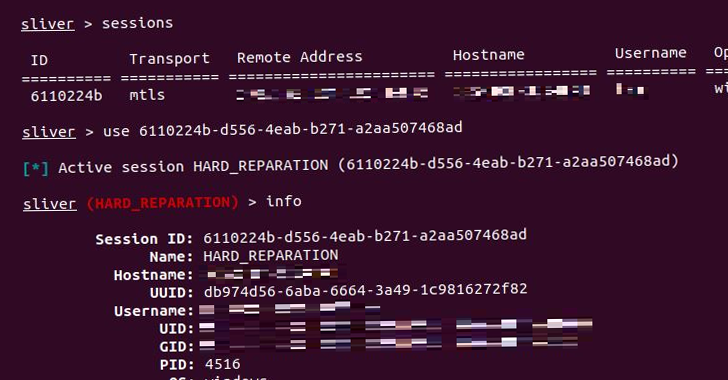
Threat actors are leveraging known flaws in Sunlogin software to
deploy the Sliver command-and-control (C2) framework for carrying
out post-exploitation activities.
The findings come from AhnLab Security Emergency response Center
(ASEC), which found that security vulnerabilities in Sunlogin, a
remote desktop program developed in China, are being abused to
deploy a wide range of payloads.
“Not only did threat actors use the Sliver backdoor, but they
also used the BYOVD[1]
(Bring Your Own Vulnerable Driver) malware to incapacitate security
products and install reverse shells,” the researchers said[2].
Attack chains commence with the exploitation of two remote code
execution bugs in Sunlogin versions prior to v11.0.0.33
(CNVD-2022-03672 and CNVD-2022-10270), followed by delivering
Sliver or other malware such as Gh0st RAT[3]
and XMRig crypto coin miner.
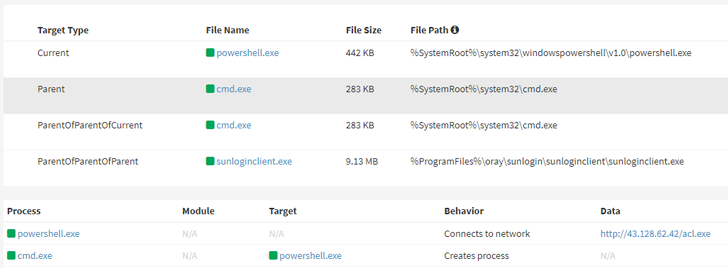
In one instance, the threat actor is said to have weaponized the
Sunlogin flaws to install a PowerShell script that, in turn,
employs the BYOVD technique to incapacitate security software
installed in the system and drop a reverse shell using
Powercat.
The BYOVD method abuses a legitimate but vulnerable Windows
driver, mhyprot2.sys, that’s signed with a valid certificate to
gain elevated permissions and terminate antivirus processes.
It’s worth noting here that the anti-cheat driver for the
Genshin Impact video game was previously utilized as a precursor to
ransomware deployment, as disclosed[4]
by Trend Micro.
“It is unconfirmed whether it was done by the same threat actor,
but after a few hours, a log shows that a Sliver backdoor was
installed on the same system through a Sunlogin RCE vulnerability
exploitation,” the researchers said.
The findings come as threat actors are adopting Sliver[5], a Go-based legitimate
penetration testing tool, as an alternative to Cobalt Strike and
Metasploit.
“Sliver offers the required step-by-step features like account
information theft, internal network movement, and overtaking the
internal network of companies, just like Cobalt Strike,” the
researchers concluded.
Found this article interesting? Follow us on Twitter [6]
and LinkedIn[7]
to read more exclusive content we post.
References
Read more https://thehackernews.com/2023/02/hackers-exploit-vulnerabilities-in.html