Feb 07, 2023Ravie Lakshmanan

The first-ever Linux variant of the Clop ransomware has been
detected in the wild, but with a faulty encryption algorithm that
has made it possible to reverse engineer the process.
“The ELF executable contains a flawed encryption algorithm
making it possible to decrypt locked files without paying the
ransom,” SentinelOne researcher Antonis Terefos said[1] in a report shared with
The Hacker News.
The cybersecurity firm, which has made available a decryptor[2], said it observed the
ELF version on December 26, 2022, while also noting its
similarities to the Windows flavor when it comes using the same
encryption method.
The detected sample is said to be part of a larger attack
targeting educational institutions in Colombia, including La Salle
University, around the same time. The university was added to the
criminal group’s leak site in early January 2023, per FalconFeedsio[3].
Known to have been active since 2019, the Clop (stylized as
Cl0p) ransomware operation suffered a major blow[4]
in June 2021 when six individuals affiliated with the gang were
arrested following an international law enforcement operation
codenamed Operation Cyclone.
But the cybercrime group staged an “explosive and unexpected[5]” comeback in early 2022,
claiming dozens of victims spanning industrial and tech
verticals.
SentinelOne characterized the Linux version as an early-stage
version owing to the fact that some functions that are present in
its Windows counterpart are missing.
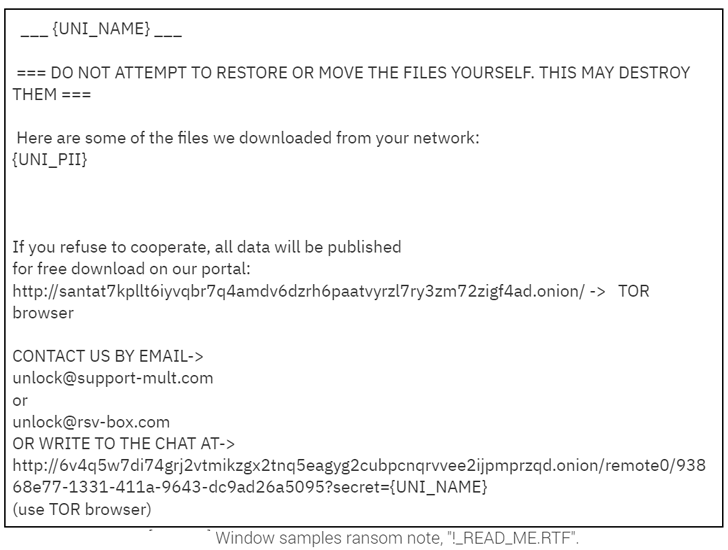
This lack of feature parity is also explained by the fact that
the malware authors have opted to build a custom Linux payload
rather than simply porting over the Windows version, suggesting
that future variants of Clop could close those gaps.
“A reason for this could be that the threat actor has not needed
to dedicate time and resources to improve obfuscation or
evasiveness due to the fact that it is currently undetected by all
64 security engines on VirusTotal,” Terefos explained.
The Linux version is designed to single out specific folders and
file types for encryption, with the ransomware containing a
hard-coded master key that can be utilized to recover the original
files without making a payment to the threat actors.
If anything, the development points to a growing trend of threat
actors increasingly venturing beyond Windows to target other
platforms.
“While the Linux-flavored variation of Cl0p is, at this time, in
its infancy, its development and the almost ubiquitous use of Linux
in servers and cloud workloads suggests that defenders should
expect to see more Linux-targeted ransomware campaigns going
forward,” Terefos said.
Found this article interesting? Follow us on Twitter [6]
and LinkedIn[7]
to read more exclusive content we post.
References
- ^
said (s1.ai) - ^
made
available a decryptor (github.com) - ^
FalconFeedsio
(twitter.com) - ^
suffered
a major blow (thehackernews.com) - ^
explosive and unexpected
(newsroom.nccgroup.com) - ^
Twitter
(twitter.com) - ^
LinkedIn
(www.linkedin.com)
Read more https://thehackernews.com/2023/02/linux-variant-of-clop-ransomware.html