Jan 26, 2023Ravie Lakshmanan
New research has linked the operations of a politically
motivated hacktivist group known as Moses Staff to another nascent
threat actor named Abraham’s Ax that emerged in
November 2022.
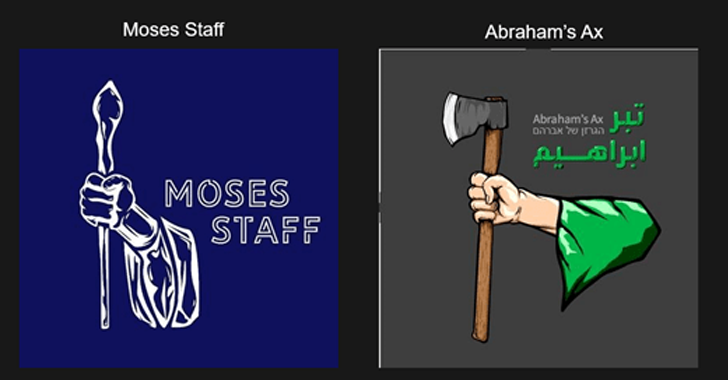
This is based on “several commonalities across the iconography,
videography, and leak sites used by the groups, suggesting they are
likely operated by the same entity,” Secureworks Counter Threat
Unit (CTU) said[1]
in a report shared with The Hacker News.
Moses Staff, tracked by the cybersecurity firm under the moniker
Cobalt Sapling[2], made its first appearance[3]
on the threat landscape in September 2021 with the goal of
primarily targeting Israeli organizations.
The geopolitical group is believed to be sponsored[4]
by the Iranian government and has since been linked to a string of
espionage and sabotage attacks that make use of tools like StrifeWater RAT[5]
and open source utilities such as DiskCryptor[6] to harvest sensitive
information and lock victim data on infected hosts.
The crew is also known to maintain a leak site that’s used to
distribute data stolen from their victims and disseminate their
messaging, which includes “exposing the crimes of the Zionists in
occupied Palestine.”
Now according to Secureworks’ analysis, “the Abraham’s Ax
persona is being used in tandem to attack government ministries in
Saudi Arabia” and that “this is likely in response to Saudi
Arabia’s leadership role in improving relations[7]
between Israel and Arab nations.”
For its part, Abraham’s Ax claims to be operating on behalf of
the Hezbollah Ummah despite no evidence to back it up. Hezbollah[8], which means “Party of
Allah” in Arabic, is a Lebanese Shia Islamist political party and
militant group that’s backed by Iran.
The striking overlaps in the modus operandi further raise the
possibility that the operators behind Abraham’s Ax are likely
leveraging the same custom malware which acts as a cryptographic
wiper to encrypt data without offering a means to recover the
data.
What’s more, both actors are united in their motivations in that
they operate without a financial incentive, with the intrusions
taking a more disruptive tone. The connections between the two
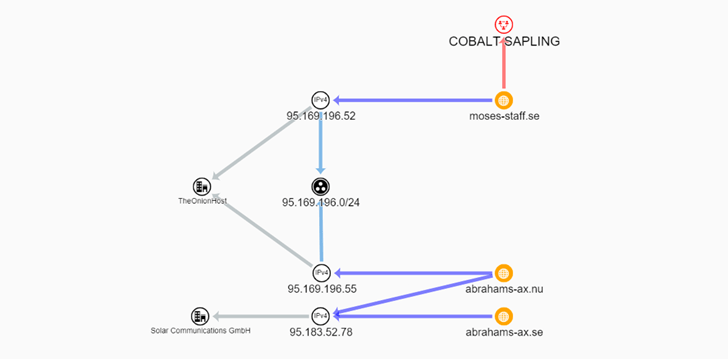
groups is also evidenced by the fact the WordPress-based leak sites
were hosted in the same subnet[9] in the early stages.
“Iran has a history of using proxy groups and manufactured
personas to target regional and international adversaries,” Rafe
Pilling, Secureworks principal researcher, said in a statement.
“Over the last couple of years an increasing number of criminal
and hacktivist group personas have emerged to target perceived
enemies of Iran while providing plausible deniability to the
Government of Iran regarding association or responsibility for
these attacks. This trend is likely to continue.”
Found this article interesting? Follow us on Twitter [10] and LinkedIn[11] to read more exclusive
content we post.
References
- ^
said
(secureworks.com) - ^
Cobalt
Sapling (www.secureworks.com) - ^
first
appearance (thehackernews.com) - ^
sponsored
(thehackernews.com) - ^
StrifeWater RAT
(thehackernews.com) - ^
DiskCryptor
(diskcryptor.org) - ^
improving relations
(www.theguardian.com) - ^
Hezbollah
(www.cfr.org) - ^
subnet
(en.wikipedia.org) - ^
Twitter
(twitter.com) - ^
LinkedIn
(www.linkedin.com)
Read more https://thehackernews.com/2023/01/researchers-uncover-connection-bw-moses.html