Jan 26, 2023Ravie Lakshmanan
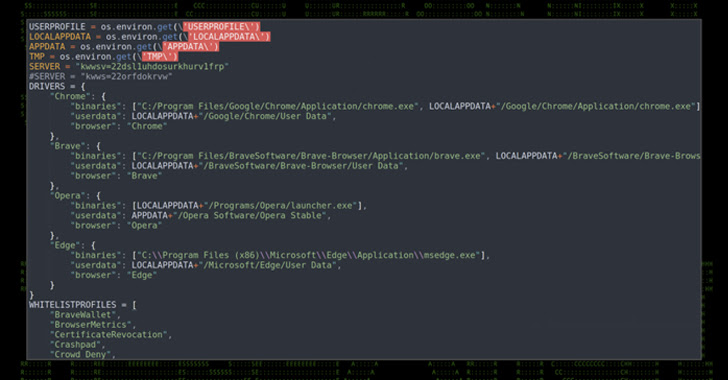
Cybersecurity researchers have unearthed a new Python-based
attack campaign that leverages a Python-based remote access trojan
(RAT) to gain control over compromised systems since at least
August 2022.
“This malware is unique in its utilization of WebSockets[1]
to avoid detection and for both command-and-control (C2)
communication and exfiltration,” Securonix said[2]
in a report shared with The Hacker News.
The malware, dubbed PY#RATION by the cybersecurity firm, comes
with a host of capabilities that allows the threat actor to harvest
sensitive information. Later versions of the backdoor also sport
anti-evasion techniques, suggesting that it’s being actively
developed and maintained.
The attack commences with a phishing email containing a ZIP
archive, which, in turn, harbors two shortcut (.LNK) files that
masquerade as front and back side images of a seemingly legitimate
U.K. driver’s license.
Opening each of the .LNK files retrieves two text files from a
remote server that are subsequently renamed to .BAT files and
executed stealthily in background, while the decoy image is
displayed to the victim.
Also downloaded from a C2 server is another batch script that’s
engineered to retrieve additional payloads from the server,
including the Python binary (“CortanaAssistance.exe”). The choice
of using Cortana, Microsoft’s virtual assistant, indicates an
attempt to pass off the malware as a system file.
Two versions of the trojan have been detected (version 1.0 and
1.6), with nearly 1,000 lines of code added to the newer variant to
support network scanning features to conduct a reconnaissance of
the compromised network and concealing the Python code behind an
encryption layer using the fernet
module[3].
Other noteworthy functionalities comprise the ability to
transfer files from host to C2 or vice versa, record keystrokes,
execute system commands, extract passwords and cookies from web
browsers, capture clipboard data, and check for the presence of
antivirus software.
What’s more, PY#RATION functions as a pathway for deploying more
malware, which consists of another Python-based info-stealer
designed to siphon data from web browsers and cryptocurrency
wallets.
The origins of the threat actor remain unknown, but the nature
of the phishing lures posits that the intended targets could likely
be the U.K. or North America.
“The PY#RATION malware is not only relatively difficult to
detect, the fact that it is a Python compiled binary makes this
extremely flexible as it will run on almost any target including
Windows, OSX, and Linux variants,” researchers Den Iuzvyk, Tim
Peck, and Oleg Kolesnikov said.
“The fact that the threat actors leveraged a layer of fernet
encryption to hide the original source compounds the difficulty of
detecting known malicious strings.”
Found this article interesting? Follow us on Twitter [4]
and LinkedIn[5]
to read more exclusive content we post.
References
- ^
WebSockets
(en.wikipedia.org) - ^
said
(www.securonix.com) - ^
fernet
module (cryptography.io) - ^
Twitter
(twitter.com) - ^
LinkedIn
(www.linkedin.com)
Read more https://thehackernews.com/2023/01/pyration-new-python-based-rat-utilizes.html