Jan 23, 2023Ravie Lakshmanan
The legitimate command-and-control (C2) framework known as
Sliver is gaining[1]
more traction[2]
from threat actors as it emerges as an open source alternative to
Cobalt Strike[3]
and Metasploit.
The findings come from Cybereason, which detailed[4]
its inner workings in an exhaustive analysis last week.
Sliver, developed by cybersecurity company BishopFox, is a
Golang-based cross-platform post-exploitation framework that’s
designed to be used by security professionals in their red team
operations.
Its myriad features for adversary simulation – including dynamic
code generation, in-memory payload execution, and process injection
– have also made it an appealing tool for threat actors looking to
gain elevated access to the target system upon gaining an initial
foothold.

In other words, the software is used as a second-stage to
conduct next steps of the attack chain after already compromising a
machine using one of the initial intrusion vectors such as
spear-phishing or exploitation of unpatched flaws.
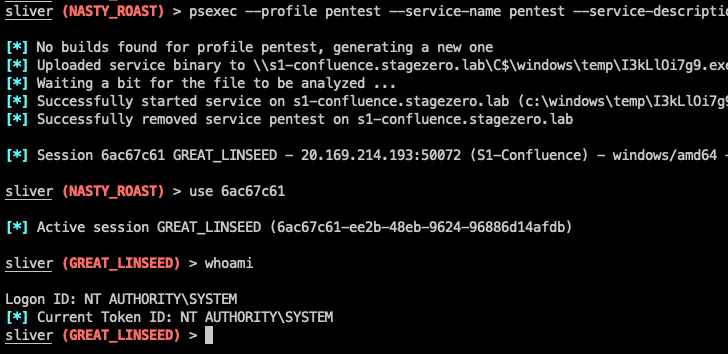
“Silver C2 implant is executed on the workstation as stage two
payload, and from [the] Sliver C2 server we get a shell session,”
Cybereason researchers Loïc Castel and Meroujan Antonyan said.
“This session provides multiple methods to execute commands and
other scripts or binaries.”
A hypothetical attack sequence detailed by the Israeli
cybersecurity company shows that Sliver could be leveraged for
privilege escalation, following it up by credential theft and
lateral movement to ultimately take over the domain controller for
the exfiltration of sensitive data.
Sliver has been weaponized in recent years by the Russia-linked
APT29[5]
group (aka Cozy Bear) as well as cybercrime operators like Shathak[6]
(aka TA551) and Exotic Lily[7]
(aka Projector Libra), the latter of which is attributed to the
Bumblebee malware loader.
That said, Sliver is far from the only open source framework to
be exploited for malicious ends. Last month, Qualys disclosed[8]
how several hacking groups, including Turla[9], Vice Society[10], and Wizard Spider[11], have utilized Empire
for post-exploitation and to expand their foothold in victim
environments.
“Empire is an impressive post exploitation framework with
expansive capabilities,” Qualys security researcher Akshat Pradhan
said. “This has led to it becoming a frequent favorite toolkit of
several adversaries.”
Found this article interesting? Follow us on Twitter [12] and LinkedIn[13] to read more exclusive
content we post.
References
- ^
gaining
(thehackernews.com) - ^
more
traction (thehackernews.com) - ^
Cobalt
Strike (thehackernews.com) - ^
detailed
(www.cybereason.com) - ^
APT29
(thehackernews.com) - ^
Shathak
(www.proofpoint.com) - ^
Exotic
Lily (thehackernews.com) - ^
disclosed
(blog.qualys.com) - ^
Turla
(thehackernews.com) - ^
Vice
Society (thehackernews.com) - ^
Wizard
Spider (thehackernews.com) - ^
Twitter
(twitter.com) - ^
LinkedIn
(www.linkedin.com)
Read more https://thehackernews.com/2023/01/threat-actors-turn-to-sliver-as-open.html