Jan 10, 2023Ravie Lakshmanan

The advanced persistent threat (APT) group known as
StrongPity has targeted Android users with a
trojanized version of the Telegram app through a fake website that
impersonates a video chat service called Shagle.
“A copycat website, mimicking the Shagle service, is used to
distribute StrongPity’s mobile backdoor app,” ESET malware
researcher Lukáš Štefanko said[1]
in a technical report. “The app is a modified version of the open
source Telegram app, repackaged with StrongPity backdoor code.”
StrongPity[2], also known by the names
APT-C-41 and Promethium, is a cyberespionage group active since at
least 2012, with a majority of its operations focused on Syria and
Turkey. The existence of the group was first publicly reported by
Kaspersky in October 2016.
The threat actor’s campaigns[3]
have since expanded to encompass more targets across Africa, Asia,
Europe, and North America, with the intrusions leveraging watering
hole attacks and phishing messages to activate the killchain.
One of the main hallmarks of StrongPity is its use of
counterfeit websites that purport to offer a wide variety of
software tools, only to trick victims into downloading tainted
versions of legitimate apps.
In December 2021, Minerva Labs disclosed[4]
a three-stage attack sequence stemming from the execution of a
seemingly benign Notepad++ setup file to ultimately deliver a
backdoor onto infected hosts.
That same year, StrongPity was observed[5]
deploying a piece of Android malware for the first time by possibly
breaking into the Syrian e-government portal and replacing the
official Android APK file with a rogue counterpart.
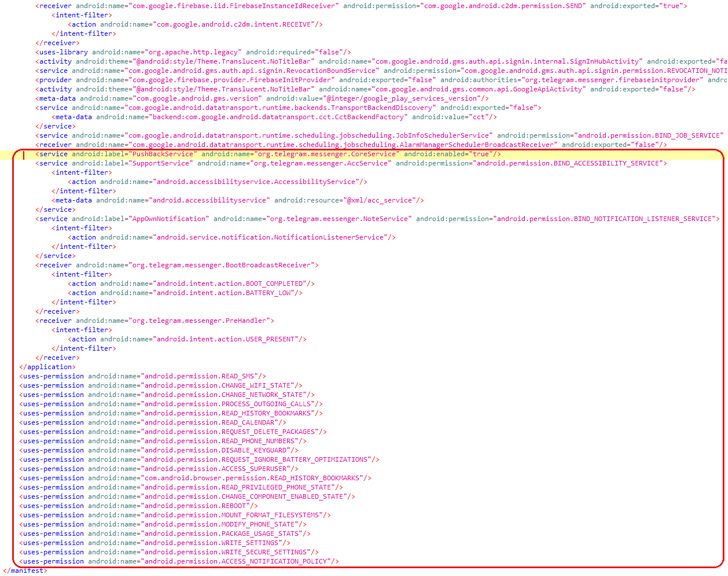
The latest findings from ESET highlight a similar modus operandi
that’s engineered to distribute an updated version of the Android
backdoor payload, which is equipped to record phone calls, track
device locations, and collect SMS messages, call logs, contacts
lists, and files.
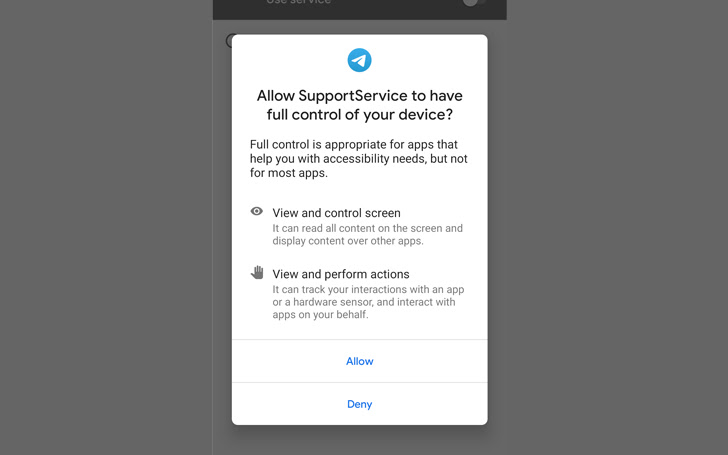
In addition, granting the malware accessibility services
permissions enables it to siphon incoming notifications and
messages from various apps like Gmail, Instagram, Kik, LINE,
Messenger, Skype, Snapchat, Telegram, Tinder, Twitter, Viber, and
WeChat.
The Slovak cybersecurity company described the implant as
modular and capable of downloading additional components from a
remote command-and-control (C2) server so as to accommodate the
evolving objectives of StrongPity’s campaigns.
The backdoor functionality is concealed within a legitimate
version of Telegram’s Android app that was available for download
around February 25, 2022. That said, the bogus Shagle website is no
longer active, although indications are that the activity is “very
narrowly targeted” due to the lack of telemetry data.
There is also no evidence the app was published on the official
Google Play Store. It’s currently not known how the potential
victims are lured to the fake website, and if it entails techniques
like social engineering, search engine poisoning, or fraudulent
ads.
There is also no evidence the app (“video.apk[6]“) was published on the
official Google Play Store. It’s currently not known how the
potential victims are lured to the fake website, and if it entails
techniques like social engineering, search engine poisoning, or
fraudulent ads.
“The malicious domain was registered on the same day, so the
copycat site and the fake Shagle app may have been available for
download since that date,” Štefanko pointed out.
Another notable aspect of the attack is that the tampered
version of Telegram uses the same package name as the genuine
Telegram app, meaning the backdoored variant cannot be installed on
a device that already has Telegram installed.
“This might mean one of two things – either the threat actor
first communicates with potential victims and pushes them to
uninstall Telegram from their devices if it is installed, or the
campaign focuses on countries where Telegram usage is rare for
communication,” Štefanko said.
Found this article interesting? Follow us on Twitter [7]
and LinkedIn[8]
to read more exclusive content we post.
References
Read more https://thehackernews.com/2023/01/strongpity-hackers-distribute.html