Dec 28, 2022Ravie Lakshmanan
Microsoft’s decision to block[1]
Visual Basic for Applications (VBA) macros by default for Office
files downloaded from the internet has led many threat actors to
improvise their attack chains in recent months.
Now according to Cisco
Talos[2], advanced persistent
threat (APT) actors and commodity malware families alike are
increasingly using Excel add-in (.XLL) files as an initial
intrusion vector.
Weaponized Office documents delivered via spear-phishing emails
and other social engineering attacks have remained one of the
widely used entry points for criminal groups looking to execute
malicious code.
These documents traditionally prompt the victims to enable
macros to view seemingly innocuous content, only to activate the
execution of malware stealthily in the background.
To counter this misuse, the Windows maker enacted
a crucial change[3]
starting in July 2022 that blocks
macros[4] in Office files attached
to email messages, effectively severing a crucial attack
vector.
While this blockade only applies to new versions of Access,
Excel, PowerPoint, Visio, and Word, bad actors have been experimenting[5]
with alternative infection routes[6] to deploy malware.
One such method turns out to be XLL
files[7], which is described by
Microsoft as a “type of dynamic link library (DLL) file that can
only be opened by Excel.”
“XLL files can be sent by email, and even with the usual
anti-malware scanning measures, users may be able to open them not
knowing that they may contain malicious code,” Cisco Talos
researcher Vanja Svajcer said in an analysis published last
week.
The cybersecurity firm said threat actors are employing a mix of
native add-ins written in C++ as well as those developed using a
free tool called Excel-DNA, a phenomenon that has witnessed a
significant spike since mid-2021 and continued to this year.
That said, the first publicly documented malicious use of XLL is
said to have occurred in 2017 when the China-linked APT10[8]
(aka Stone Panda) actor utilized the technique to inject its
backdoor payload into memory via process hollowing[9].
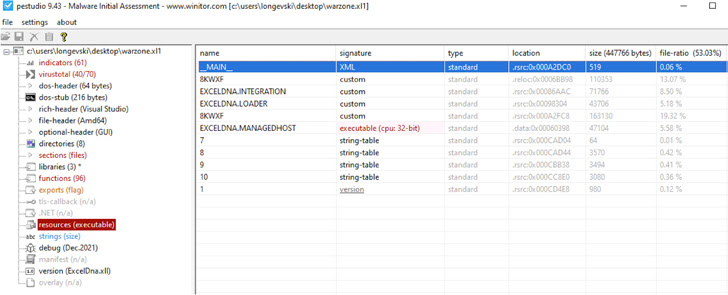
Other known adversarial collectives include TA410[10] (an actor with links to
APT10), DoNot
Team[11], FIN7[12], as well as commodity
malware families such as Agent
Tesla[13], Arkei[14], Buer[15], Dridex[16], Ducktail[17], Ekipa
RAT[18], FormBook[19], IcedID[20], Vidar
Stealer[21], and Warzone RAT[22].
The abuse of the XLL file format to distribute Agent
Tesla[23] and Dridex[24] was previously
highlighted by Palo Alto Networks Unit 42, noting that it “may
indicate a new trend in the threat landscape.”
“As more and more users adopt new versions of Microsoft Office,
it is likely that threat actors will turn away from VBA-based
malicious documents to other formats such as XLLs or rely on
exploiting newly discovered vulnerabilities to launch malicious
code in the process space of Office applications,” Svajcer
said.
Malicious Microsoft Publisher macros push Ekipa RAT
Ekipa
RAT[25], besides incorporating
XLL Excel add-ins, has also received an update in November 2022
that allows it to take advantage of Microsoft Publisher macros to
drop the remote access trojan and steal sensitive information.
“Just as with other Microsoft office products, like Excel or
Word, Publisher files can contain macros that will execute upon the
opening or closing [of] the file, which makes them interesting
initial attack vectors from the threat actor’s point of view,”
Trustwave noted[26].
It’s worth noting that Microsoft’s restrictions to impede macros
from executing in files downloaded from the internet does not
extend to Publisher files, making them a potential avenue for
attacks.
“The Ekipa RAT is a great example of how threat actors are
continuously changing their techniques to stay ahead of the
defenders,” Trustwave researcher Wojciech Cieslak said. “The
creators of this malware are tracking changes in the security
industry, like blocking macros from the internet by Microsoft, and
shifting their tactics accordingly.”
Found this article interesting? Follow us on Twitter [27] and LinkedIn[28] to read more exclusive
content we post.
References
- ^
block
(thehackernews.com) - ^
Cisco Talos
(blog.talosintelligence.com) - ^
enacted a crucial change
(thehackernews.com) - ^
blocks macros
(learn.microsoft.com) - ^
experimenting
(thehackernews.com) - ^
alternative infection routes
(thehackernews.com) - ^
XLL files
(learn.microsoft.com) - ^
APT10
(thehackernews.com) - ^
process hollowing
(attack.mitre.org) - ^
TA410
(thehackernews.com) - ^
DoNot Team
(thehackernews.com) - ^
FIN7
(thehackernews.com) - ^
Agent Tesla
(thehackernews.com) - ^
Arkei
(thehackernews.com) - ^
Buer
(thehackernews.com) - ^
Dridex
(thehackernews.com) - ^
Ducktail
(thehackernews.com) - ^
Ekipa RAT
(www.trustwave.com) - ^
FormBook
(thehackernews.com) - ^
IcedID
(thehackernews.com) - ^
Vidar Stealer
(thehackernews.com) - ^
Warzone RAT
(thehackernews.com) - ^
Agent Tesla
(unit42.paloaltonetworks.com) - ^
Dridex
(unit42.paloaltonetworks.com) - ^
Ekipa RAT
(cloudsek.com) - ^
noted
(www.trustwave.com) - ^
Twitter
(twitter.com) - ^
LinkedIn
(www.linkedin.com)
Read more https://thehackernews.com/2022/12/apt-hackers-turn-to-malicious-excel-add.html