Government entities in Ukraine have been breached as part of a
new campaign that leveraged trojanized versions of Windows 10
installer files to conduct post-exploitation activities.
Mandiant, which discovered the supply chain attack around
mid-July 2022, said the malicious ISO files were distributed via
Ukrainian- and Russian-language Torrent websites. It’s tracking the
threat cluster as UNC4166.
“Upon installation of the compromised software, the malware
gathers information on the compromised system and exfiltrates it,”
the cybersecurity company said[1]
in a technical deep dive published Thursday.
Although the adversarial collective’s provenance is unknown, the
intrusions are said to have targeted organizations that were
previously victims of disruptive wiper attacks attributed to
APT28[2], a Russian state-sponsored actor[3].
The ISO file, per the Google-owned threat intelligence firm, was
designed to disable the transmission of telemetry data from the
infected computer to Microsoft, install PowerShell backdoors, as
well as block automatic updates and license verification.
The primary goal of the operation appears to have been
information gathering, with additional implants deployed to the
machines, but only after conducting an initial reconnaissance of
the compromised environment to determine if it contains the
intelligence of value.
These included Stowaway[4], an open source proxy
tool, Cobalt Strike Beacon[5], and SPAREPART, a
lightweight backdoor programmed in C, enabling the threat actor to
execute commands, harvest data, capture keystrokes and screenshots,
and export the information to a remote server.
In some instances, the adversary attempted to download the TOR
anonymity browser onto the victim’s device. While the exact reason
for this action is not clear, it’s suspected that it may have
served as an alternative exfiltration route.

SPAREPART, as the name implies, is assessed to be a redundant
malware deployed to maintain remote access to the system should the
other methods fail. It’s also functionally identical to the
PowerShell backdoors dropped early on in the attack chain.
“The use of trojanized ISOs is novel in espionage operations and
included anti-detection capabilities indicates that the actors
behind this activity are security conscious and patient, as the
operation would have required a significant time and resources to
develop and wait for the ISO to be installed on a network of
interest,” Mandiant said.
Cloud Atlas Strikes Russia and Belarus
The findings come as Check Point[6]
and Positive Technologies[7]
disclosed attacks staged by an espionage group dubbed Cloud
Atlas against the government sector in Russia, Belarus,
Azerbaijan, Turkey, and Slovenia as part of a persistent
campaign.
The hacking crew, active since 2014, has a track record of
attacking entities in Eastern Europe and Central Asia. But since
the outbreak of the Russo-Ukrainian war, it has been observed
primarily targeting entities in Russia, Belarus, and
Transnistria.
“The actors are also maintaining their focus on the
Russian-annexed Crimean Peninsula, Lugansk, and Donetsk regions,”
Check Point said in an analysis last week.
Cloud Atlas[8], also called Clean Ursa,
Inception, and Oxygen, remains unattributed[9]
to date, joining the likes of other APTs like TajMahal[10], DarkUniverse, and
Metador[11]. The group gets its
name for its reliance on cloud services like OpenDrive to host
malware and for command-and-control (C2).
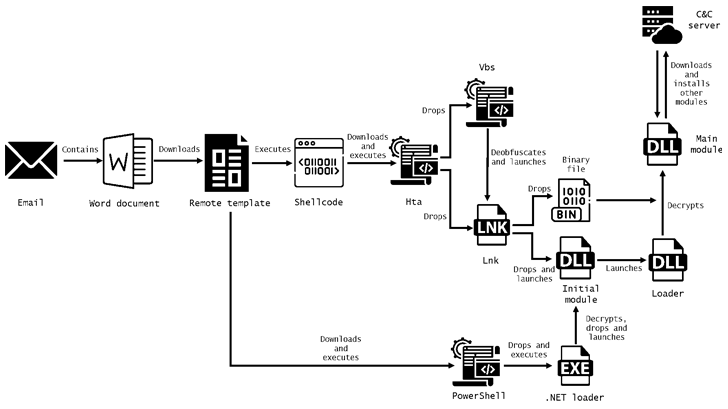
Attack chains orchestrated by the adversary typically make use
of phishing emails containing lure attachments as the initial
intrusion vector, which ultimately lead to the delivery of a
malicious payload via an intricate multi-stage sequence.
The malware then proceeds to initiate contact with an
actor-controlled C2 server to retrieve additional backdoors capable
of stealing files with specific extensions from the breached
endpoints.
Attacks observed by Check Point, on the other hand, culminate in
a PowerShell-based backdoor called PowerShower, which was first documented[12] by Palo Alto Networks
Unit 42 in November 2018.
Some of these intrusions in June 2022 also turned out to be
successful, permitting the threat actor to gain full access to the
network and use tools like Chocolatey[13], AnyDesk, and PuTTY to
deepen their foothold.
“With the escalation of the conflict between Russia and Ukraine,
their focus for the past year has been on Russia and Belarus and
their diplomatic, government, energy and technology sectors, and on
the annexed regions of Ukraine,” Check Point added.
Found this article interesting? Follow us on Twitter [14] and LinkedIn[15] to read more exclusive
content we post.
References
- ^
said
(www.mandiant.com) - ^
APT28
(thehackernews.com) - ^
Russian
state-sponsored actor (thehackernews.com) - ^
Stowaway
(github.com) - ^
Cobalt
Strike Beacon (thehackernews.com) - ^
Check
Point (research.checkpoint.com) - ^
Positive
Technologies (www.ptsecurity.com) - ^
Cloud
Atlas (securelist.com) - ^
remains
unattributed (securelist.com) - ^
TajMahal
(thehackernews.com) - ^
Metador
(thehackernews.com) - ^
first
documented (unit42.paloaltonetworks.com) - ^
Chocolatey
(thehackernews.com) - ^
Twitter
(twitter.com) - ^
LinkedIn
(www.linkedin.com)
Read more https://thehackernews.com/2022/12/trojanized-windows-10-installer-used-in.html