Dec 15, 2022Ravie Lakshmanan
Phishing campaigns involving the Qakbot malware[1]
are using Scalable Vector Graphics (SVG[2]) images embedded in HTML
email attachments.
The new distribution method was spotted by Cisco Talos, which
said[3]
it identified fraudulent email messages featuring HTML attachments
with encoded SVG images that incorporate HTML script tags[4].
HTML smuggling is a technique[5]
that relies on using legitimate features of HTML and JavaScript to
run encoded malicious code contained within the lure attachment and
assemble the payload on a victim’s machine as opposed to making an
HTTP request to fetch the malware from a remote server.
In other words, the idea is to evade email gateways by storing a
binary in the form of a JavaScript code that’s decoded and
downloaded when opened via a web browser.
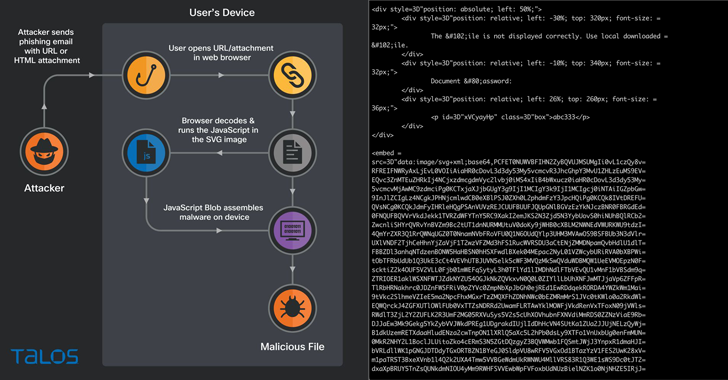
The attack chain spotted by the cybersecurity company concerns a
JavaScript that’s smuggled inside of the SVG image and executed
when the unsuspecting email recipient launches the HTML
attachment.
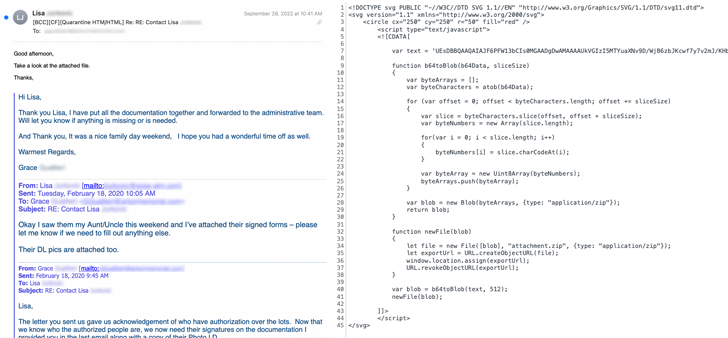
“When the victim opens the HTML attachment from the email, the
smuggled JavaScript code inside the SVG image springs into action,
creating a malicious ZIP archive and then presenting the user with
a dialog box to save the file,” researchers Adam Katz and Jaeson
Schultz said.
The ZIP archive is also password-protected, requiring users to
enter a password that’s displayed in the HTML attachment, following
which an ISO image is extracted to run the Qakbot trojan.
The finding comes as recent research[6]
from Trustwave SpiderLabs shows that HTML smuggling attacks are a
common occurrence, with .HTML (11.39%) and .HTM (2.7%) files
accounting for the second most spammed file attachment type after
.JPG images (25.29%) in September 2022.
“Having robust endpoint protection can prevent execution of
potentially obfuscated scripts, and prevent scripts from launching
downloaded executable content,” the researchers said.
“HTML smuggling’s ability to bypass content scanning filters
means that this technique will probably be adopted by more threat
actors and used with increasing frequency.”
Found this article interesting? Follow us on Twitter [7]
and LinkedIn[8]
to read more exclusive content we post.
References
Read more https://thehackernews.com/2022/12/hacking-using-svg-files-to-smuggle-qbot.html