
The notorious Emotet malware has returned with renewed vigor as
part of a high-volume malspam campaign designed to drop payloads
like IcedID[1]
and Bumblebee[2].
“Hundreds of thousands of emails per day” have been sent since
early November 2022, enterprise security company Proofpoint
said[3]
last week, adding, “the new activity suggests Emotet is returning
to its full functionality acting as a delivery network for major
malware families.”
Among the primary countries targeted are the U.S., the U.K.,
Japan, Germany, Italy, France, Spain, Mexico, and Brazil.
The Emotet-related activity was last observed in July 2022,
although sporadic[4]
infections[5]
have been reported[6]
since then. In mid-October, ESET revealed[7]
that Emotet may be readying for a new wave of attacks, pointing out
updates to its “systeminfo” module.
The malware, which is attributed to a threat actor known as
Mummy Spider (aka Gold Crestwood or TA542), staged a revival of
sorts late last year after its infrastructure was dismantled during
a coordinated law enforcement operation in January 2021.
Europol called Emotet the “world’s most dangerous malware” for
its ability to act as a “primary door opener for computer systems”
to deploy next-stage binaries that facilitate data theft and
ransomware. It started off in 2014 as a banking trojan before
evolving into a botnet.
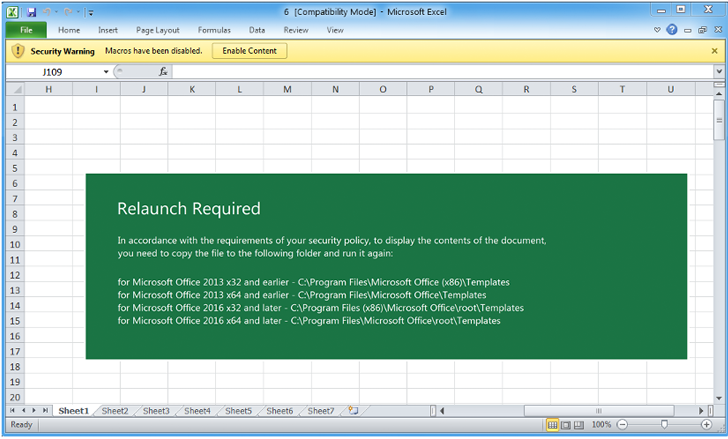
Infection chains involving the malware are known to employ
generic lures as well as the technique of email thread hijacking[8]
to lure recipients into opening macro-enabled Excel
attachments.
“Following Microsoft’s recent announcement[9]
that it would begin disabling macros by default in Office documents
downloaded from the internet, many malware families have begun
migrating away from Office macros to other delivery mechanisms like
ISO and LNK files,” Cisco Talos said[10] earlier this month.
“Therefore, it is interesting to note that this new campaign of
Emotet is using its old method of distributing malicious Microsoft
Office documents (maldocs) via email-based phishing.
An alternative method urges potential victims to copy the file
to a Microsoft Office Template location – a trusted location – and
launch the lure document from there instead of having to explicitly
enable macros to activate the kill-chain.
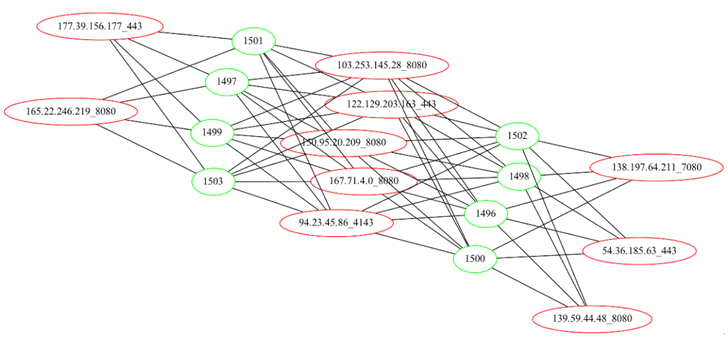
The renewed activity[11] has also been
accompanied by changes to the Emotet loader component, and addition
of new commands, and updates to the packer to resist reverse
engineering.
One of the follow-on payloads distributed through Emotet is a
brand new variant of the IcedID loader, which receives commands to
read and send file contents to a remote server, in addition to
executing other backdoor instructions that allow it to extract web
browser data.
The use of IcedID is concerning as it’s likely a precursor for
ransomware, the researchers pointed out. Another malware dropped
via Emotet is Bumblebee[12], according to Palo Alto
Networks Unit 42.
“Overall, these modifications made to the client indicate the
developers are trying to deter researchers and reduce the number of
fake or captive bots that exist within the botnet,” researchers Pim
Trouerbach and Axel F said.
“Emotet has not demonstrated full functionality and consistent
follow-on payload delivery (that’s not Cobalt Strike) since 2021,
when it was observed distributing The Trick and Qbot.”
References
- ^
IcedID
(thehackernews.com) - ^
Bumblebee
(thehackernews.com) - ^
said
(www.proofpoint.com) - ^
sporadic
(thehackernews.com) - ^
infections
(thehackernews.com) - ^
reported
(thehackernews.com) - ^
revealed
(thehackernews.com) - ^
email
thread hijacking (thehackernews.com) - ^
announcement
(thehackernews.com) - ^
said
(blog.talosintelligence.com) - ^
renewed activity
(asec.ahnlab.com) - ^
Bumblebee
(twitter.com)
Read more https://thehackernews.com/2022/11/notorious-emotet-malware-returns-with.html