
The threat actors behind the Hive ransomware-as-a-service (RaaS)
scheme have launched attacks against over 1,300 companies across
the world, netting the gang $100 million in illicit payments as of
November 2022.
“Hive ransomware has targeted a wide range of businesses and
critical infrastructure sectors, including government facilities,
communications, critical manufacturing, information technology, and
— especially — Healthcare and Public Health (HPH),” U.S.
cybersecurity and intelligence authorities said[1]
in an alert.
Active since June 2021, Hive’s RaaS operation involves a mix of
developers, who create and manage the malware, and affiliates, who
are responsible for conducting the attacks on target networks by
often purchasing initial access from initial access brokers
(IABs).
In most cases, gaining a foothold involves the exploitation of
ProxyShell flaws[2]
in Microsoft Exchange Server, followed by taking steps to terminate
processes associated with antivirus engines and data backups as
well as delete Windows event logs.
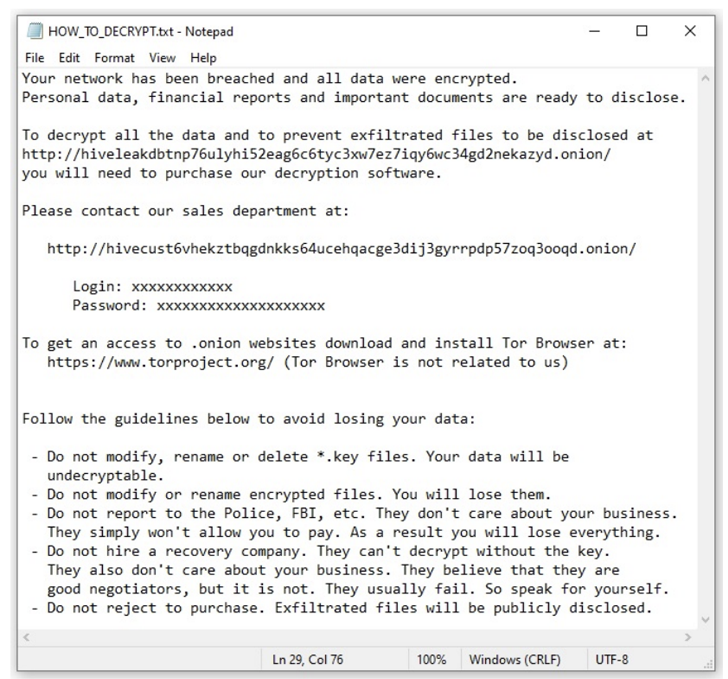
The threat actor, which recently upgraded its malware[3]
to Rust as a detection evasion measure, is also known to remove
virus definitions prior to encryption.
“Hive actors have been known to reinfect—with either Hive
ransomware or another ransomware variant—the networks of victim
organizations who have restored their network without making a
ransom payment,” the U.S. Cybersecurity and Infrastructure Security
Agency (CISA) said.
According to data[4]
shared by cybersecurity company Malwarebytes, Hive compromised
about seven victims in August 2022, 14 in September, and two other
entities in October, marking a drop in activity from July, when the
group targeted 26 victims.
References
- ^
said
(www.cisa.gov) - ^
ProxyShell flaws
(thehackernews.com) - ^
upgraded
its malware (thehackernews.com) - ^
data
(thehackernews.com)
Read more https://thehackernews.com/2022/11/hive-ransomware-attackers-extorted-100.html