
Microsoft on Thursday attributed the recent spate of ransomware
incidents targeting transportation and logistics sectors in Ukraine
and Poland to a threat cluster that shares overlaps with the
Russian state-sponsored Sandworm group[1].
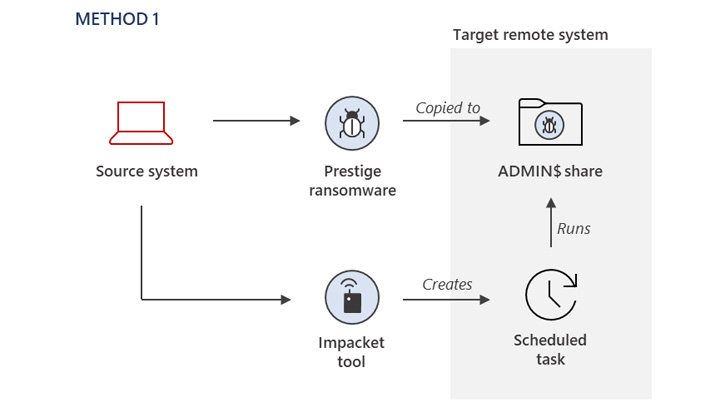
The attacks, which were disclosed by the tech giant last month,
involved a strain of previously undocumented malware called
Prestige[2]
and is said to have taken place within an hour of each other across
all victims.
The Microsoft Threat Intelligence Center (MSTIC) is now tracking
the threat actor under its element-themed moniker Iridium (née
DEV-0960), citing overlaps with Sandworm (aka Iron Viking,
TeleBots, and Voodoo Bear).
“This attribution assessment is based on forensic artifacts, as
well as overlaps in victimology, tradecraft, capabilities, and
infrastructure, with known Iridium activity,” MSTIC said[3]
in an update.
The company also further assessed the group to have orchestrated
compromise activity targeting many of the Prestige victims as far
back as March 2022, before culminating in the deployment of the
ransomware on October 11.
The method of initial compromise still remains unknown, although
it’s suspected that it involved gaining access to highly privileged
credentials necessary to activate the killchain.
“The Prestige campaign may highlight a measured shift in
Iridium’s destructive attack calculus, signaling increased risk to
organizations directly supplying or transporting humanitarian or
military assistance to Ukraine,” the company said.
The findings come over a month after Recorded Future linked
another activity group (UAC-0113) with ties to the Sandworm actor
as having singled out Ukrainian users[4] by masquerading as
telecom providers in the country to deliver backdoors onto
compromised machines.
Microsoft, in its Digital Defense Report published[5]
last week, further called out Iridium for its pattern of targeting
critical infrastructure and operational technology entities.
“Iridium deployed the Industroyer2 malware[6]
in a failed effort to leave millions of people in Ukraine without
power,” Redmond said, adding the threat actor used “phishing
campaigns to gain initial access to desired accounts and networks
in organizations within and outside Ukraine.”
The development also arrives amid sustained ransomware attacks
aimed at industrial organizations worldwide during the third
quarter of 2022, with Dragos reporting 128 such incidents during
the time period compared to 125 in the previous quarter.
“The LockBit ransomware family[7] account for 33% and 35%
respectively of the total ransomware incidents that target
industrial organizations and infrastructures in the last two
quarters, as the groups added new capabilities in their new LockBit
3.0 strain,” the industrial security firm said[8].
Other prominent strains observed in Q3 2022 include Cl0p[9], MedusaLocker[10], Sparta[11], BianLian[12], Donuts[13], Onyx[14], REvil[15], and Yanluowang[16].
References
- ^
Sandworm
group (thehackernews.com) - ^
Prestige
(thehackernews.com) - ^
said
(www.microsoft.com) - ^
singled
out Ukrainian users (thehackernews.com) - ^
published
(thehackernews.com) - ^
Industroyer2 malware
(thehackernews.com) - ^
LockBit
ransomware family (thehackernews.com) - ^
said
(www.dragos.com) - ^
Cl0p
(www.trendmicro.com) - ^
MedusaLocker
(thehackernews.com) - ^
Sparta
(www.mynewsdesk.com) - ^
BianLian
(thehackernews.com) - ^
Donuts
(www.bleepingcomputer.com) - ^
Onyx
(thehackernews.com) - ^
REvil
(thehackernews.com) - ^
Yanluowang
(darktrace.com)
Read more https://thehackernews.com/2022/11/microsoft-blames-russian-hackers-for.html